
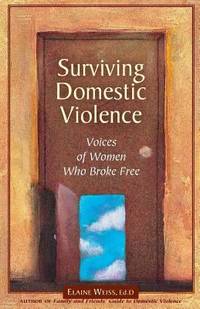
Subtitle: Voices of Women Who Broke Free
Recommended to me by: Finding it in a Little Free Library
A compassionate and thorough look at how women get ensnared into abusive relationships with men, and how they get themselves out. Elaine Weiss includes her own story. She clarifies repeatedly that the abuse is not the victim/survivor’s fault, and there is no “type” of woman that is more vulnerable. Any woman can get into a relationship with an abusive person, and that’s what creates an abusive relationship.
The book was published in 2000, which only partially excuses its heterosexual and gendered lens. Yes, many abusive relationships are men abusing women. And some are not. This book could have also addressed queer relationships and women abusers in at least one of its examples.
The stories are also strongly biased toward the women finding loving marriages after leaving the abusive relationships. This supports the point that it’s not the women’s fault, but also pushes the narrative that a positive relationship is the ultimate goal and measure of success in healing.
It took me a long time to start reading the book after picking it up. And I did skim a couple of the stories where I didn’t want to read about the verbal abuse the woman was enduring. The bewildered teen looking around to see if anyone will tell her the abuse is wrong and not her fault breaks my heart. But I’m glad I did finally read the book. It is a great resource for people who carry stereotypes about who gets abused and why, both as bystanders and as people who have been abused themselves.
Erica Reed says
In my opinion, this is one of the best books on domestic violence ever written. It is a smorgasbord of stories or a variety of common cases. It conveys the seriousness of DV without being overly graphic. Weiss clears up common misconceptions and uses terrific analogies. It’s a short book too. In fact, I believe that this book (along with Lundy Bancroft’s books and quality resources in conjunction with the O.J. Simpson case) should be required reading for a DV 101 class and relevant majors. This is the kind of book that would be particularly helpful for a future professional or someone trying to understand DV from the outside. (For self-help, I prefer Bancroft’s books and When Love Hurts by Jill Cory). Unfortunately, these courses don’t exist because the APA, ACA, etc. opposes them (ex. senate hearings in Iowa in 2024 and Hawaii in 2026). Nonetheless, this is a classic book and one of the very best! It is so good that I would like to see the publisher reissue the book with a new cover, perhaps in conjunction with Denise Brown’s upcoming book in the fall of 2026.