• Skip to primary navigation
  • Skip to main content
  • Skip to primary sidebar
Curious, Healing

Curious, Healing

Books about healing, business, and fun

  • About Sonia Connolly

nonfiction

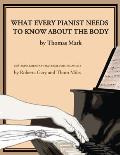
“What Every Pianist Needs to Know about the Body” by Thomas Mark

November 16, 2024 by Sonia Connolly Leave a Comment

book cover
Recommended to me by: Reading What Every Singer Needs to Know about the Body

I bought this book around the time I studied piano for a year in 2015, but never got around to reading it. I got rid of it along with two bike trailer loads of books at Powells before leaving Portland. Now in 2024 I’m learning piano again with renewed interest, so I got the book from inter-library loan and gave it a try.

What Every Singer Needs to Know about the Body is very dense and technical. I read it a few pages at a time. I expected the piano book to be similarly dense. Instead, it is more accessibly written and covers some of the same material as What Every Musician Needs to Know about the Body, so I could read it a chapter or two at time.

It was useful to see the general material about balance and alignment in the body again. I’m starting to sense my AO joint that supports the base of my skull, and understand what it might mean to free my neck instead of pulling my head down. I’m still trying to sense the weight-supporting part of my lumbar spine curving up through the center of my body.

This book talks a lot about freeing the arms and integrating their movement with the whole body, since the arms (not just the fingers) play the piano. Most of what we think of as back and chest muscles are really arm muscles, originating on the torso and attaching to the shoulder blade and humerus.

I appreciated the exercise to find balance for the collarbone and shoulder blade position. Pull them up, then slowly allow them to release down until there’s no muscular effort. Pull them down and then slowly release up. Pull them forward and slowly release back. Pull them back and slowly release forward. I want to do that at the beginning of practice sessions. (Described at about 1:15:00 in the video linked below.)

You can think of the forearm and hand having a shallow arch, with the keystone at the wrist. Lead with the head and reach with your whole spine when leaning toward the top or bottom notes of the keyboard.

It also had revelatory material about the piano itself. To play louder, press the keys faster to “throw” the little hammer at the string more strongly. To play softer, press the keys more slowly. I was having trouble figuring out loud and soft, and this explains it. Also, once a key’s descent triggers that hammer throw, continuing to push hard on it will have no effect on the sound. Releasing the key does release the damper to end the sound.

Of all the books I got rid of, this is one I will buy again, because it’s useful to me now, and I’m going to want to come back to the material.

It has material for organists too, which was interesting even though less directly useful to me. I had no idea playing the organ was such an athletic whole-body activity.

Highly recommended for pianists and organists!

I also got rid of the companion video, and I found it again on the Internet Archive! What Every Pianist Needs to Know about the Body (2 hour video) by Thomas Mark. Also highly recommended. It’s illuminating to see his demonstrations of moving in balance, and some of the ways to be out of balance.
Available at bookshop.org.

Filed Under: nonfiction Tagged With: bodywork, illustrated, music

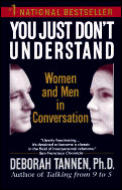
“You Just Don’t Understand” by Deborah Tannen, Ph.D.

August 31, 2024 by Sonia Connolly Leave a Comment

book cover
Subtitle: Women and Men in Conversation

Recommended to me by: a friend

My friend was telling me about a gathering where one person had a knee injury. All the women who stopped to chat with the injured person asked how she was doing and how she had gotten injured. All the men talked about their own knee injuries or other injuries they had experienced. My friend said the men were trying to save the injured person’s pride and equalize status by saying they had gotten injured too. I sputtered that that was a very generous interpretation, but I didn’t necessarily agree. She recommended this book.

The book was published in 1990, and it shows. There is an updated edition from 2007, but I got the older edition from the library.

Tannen’s thesis is that women talk to support intimacy, and men talk to compete for status. The first half of the book has many examples, without ever mentioning sexism or cultural influences, not to mention non-binary people. Men protect their independence at the same time as women are trying to build connection, causing discord in heterosexual relationships.

Just about when I was going to stop reading in frustration, Tannen says that Italian preschoolers of any gender debate heatedly with each other, because that is what Italian culture teaches and expects. She also talks about New York Jewish culture, where both women and men are more direct and outspoken, and less direct people interpret that as being rude and pushy.

Then she talks about sexism, where men who are direct and authoritative are interpreted as being powerful and appropriately masculine, whereas women are seen as overstepping their bounds and being arrogant or aggressive. She talks about how the press talked about Geraldine Ferraro in disparagingly gendered terms “but they didn’t mean to.” I wonder if she wanted to retract that generous interpretation after seeing how the press treated Hillary Clinton.

At the very end, she says that she is not advocating for anyone to change their style, but to keep in mind these differences and be open to believing in people’s good intentions. Like any less-dominant group, I think women already understand the status-oriented style quite well, and men need to pick up the slack by learning to work better with a collaborative style.

The book does have a few nods toward Not All Men, and Not All Women. It mentions gay and lesbian relationships once that I noticed. It has a terribly racist description of communication styles in a Mayan community in Mexico that I can only hope is improved in the 2007 edition.

My friend did a great job of summarizing the primary takeaway of the book (women talk for connection, men talk for status). It’s a useful thing to listen for.

Available at bookshop.org.

Filed Under: nonfiction Tagged With: communication, psychology, relationship

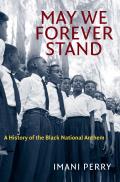
“May We Forever Stand” by Imani Perry

July 15, 2024 by Sonia Connolly Leave a Comment

book cover
Subtitle: A History of the Black National Anthem

Recommended to me by: Jesse the K

The author Dr. Imani Perry was at the time of publication in 2018 the Hughes-Rogers Professor of African American Studies at Princeton University. Wikipedia says that in addition to a Ph.D., she has a J.D. from Harvard Law School. As of 2023, she is now a professor at Harvard.Her book is a carefully researched and engagingly written in-depth historical study of the song “Lift Every Voice and Sing” as it has been intertwined with Black Americans’ creation of a rich community life and struggles for civil rights.

The song was written by brothers James Weldon Johnson (lyrics) and John Rosamond Johnson (music) in 1900 in Jacksonville, Florida. The song spread among the many Black formal and informal community associations and was soon named the Black National Anthem.

It was sung at all-Black schools as part of nurturing the pride and sense of self of the students. It was woven into plays created to educate children and adults alike about the struggles and achievements of Black Americans. It created solidarity and hope.

The book contains enough content for a semester course on Black American History from the end of the Civil War through to the 1980s, with “Lift Every Voice and Sing” tying it all together.

Highly recommended.

Available at bookshop.org.

Filed Under: nonfiction Tagged With: activism, anti-racism, politics, spirituality, survival story

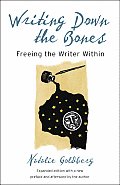
“Writing Down the Bones” by Natalie Goldberg

March 2, 2024 by Sonia Connolly Leave a Comment

book cover
Subtitle: Freeing the Writer Within

Recommended to me by: finding it in a little free library

Natalie Goldberg combines writing practice and Zen practice in short chapters where she shares about her own writing adventures, and repeatedly admonishes the reader (or herself) to just sit down and write. I appreciated her ongoing willingness to sink into the depths of herself and write whatever showed up. The book veers between writing exercises, Zen wisdom, and her anxiety about eating too many brownies.

“A writer’s job is to make the ordinary come alive, to awaken to the specialness of simply being.”

“If you give yourself over to honesty in your practice, it will permeate your life.”

“We are good, and when our work is good, it is good. We should acknowledge it and stand behind it.”

I wonder if this book would have landed differently for me if I had read it when I was still writing and sending out an article each month. Since writing is not something I’m trying to make a living at, I don’t have the urgency or intensity around it that this book speaks to.

Recommended for people wrestling with being a writer as an identity, a practice, and/or a career.

Available at bookshop.org.

Filed Under: nonfiction Tagged With: memoir, spirituality, writing

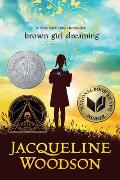
“brown girl dreaming” by Jacqueline Woodson

January 31, 2024 by Sonia Connolly Leave a Comment

book cover
Recommended to me by: Reading Jaqueline Woodson’s children’s book The Day You Begin

In spare, elegant poetry with each word exactly as it needs to be, Jacqueline Woodson takes us back before her birth in her family history, and then slowly forward in time. She shares her sensory experiences as a young child in Ohio and then in the South, and later after her family moved to Brooklyn, NY. The writing is lyrical, gripping, joyous, painful.

Life is dangerous for a Black family in the 60s and 70s, and she grieves for relatives as they die, at the same time as she struggles with reading in school and bonds with a neighbor girl as Forever Friends. She is aware of the struggle for civil rights, and participates as much as she can.

Highly recommended! Every word is worth reading, through the acknowledgements and end notes all the way to the photographs of family members as children at the very end.

Available at bookshop.org.

Filed Under: nonfiction, poetry Tagged With: anti-racism, memoir, neurodiversity

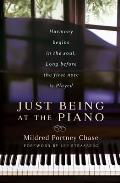
“Just Being at the Piano” by Mildred Portney Chase

January 13, 2024 by Sonia Connolly Leave a Comment

book cover
Subtitle: Harmony Begins in the Soul, Long Before the First Note Is Played

Recommended to me by: the Little Free Library down the street

A meditative little book on how to learn and teach piano in a kind, body-centered way. Mildred Portney Chase was a musical prodigy, playing piano by ear at age 3 or 4, and went on to be a concert pianist. She writes in detail about how she finds relaxed, sensitive movement in her fingers, hands, and arms to play her best. She fiercely defends the right of young students to improvise and learn at their own pace.

I have only studied a little piano. Some of the book is applicable to singing, and some of it is specific to the piano, which as she says is an instrument that cannot be brought close in to the musician’s body. I passed the book along to a piano player and teacher, and I’ll be curious to hear what she thinks of it.

Recommended if you’re interested in music and musicians, or if you play piano and want to create beautiful tones.

Available at bookshop.org.

Filed Under: nonfiction Tagged With: memoir, music, spirituality

  • « Go to Previous Page
  • Page 1
  • Page 2
  • Page 3
  • Page 4
  • Page 5
  • Interim pages omitted …
  • Page 48
  • Go to Next Page »

Primary Sidebar

Recent Books

  • “Atlas of the Heart” by Brene Brown
  • “Life After Cars” by Sarah Goodyear, Doug Gordon, Aaron Naparstek
  • “Tidy First?” by Kent Beck
  • “When You Had Power” and “You Knew the Price” by Susan Kaye Quinn
  • “Taproot” by Keezy Young
  • “The Tower at Stony Wood” by Patricia A McKillip
  • “Hospicing Modernity” by Vanessa Machado de Oliveira
  • “How We Show Up” by Mia Birdsong
  • “The Enchanted Greenhouse” by Sarah Beth Durst
  • “What It Takes to Heal” by Prentis Hemphill

Tags

activism aging anti-racism bodywork business childhood abuse childrens CivicTech communication disability domestic violence fantasy feminism finance Focusing food fun healing health at any size illustrated Judaism leadership lgbt marketing memoir music natural world neurodiversity politics psychology relationship romance science science fiction software spirituality survival story trauma writing young adult

Categories

Archives

Please note: bookshop.org and Amazon links are affiliate links. Copyright © 2026 · Genesis Sample on · WordPress