• Skip to primary navigation
  • Skip to main content
  • Skip to primary sidebar
Curious, Healing

Curious, Healing

Books about healing, business, and fun

  • About Sonia Connolly

nonfiction

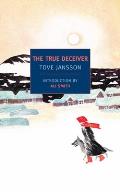
“The True Deceiver” by Tove Jansson

February 20, 2010 by Sonia Connolly Leave a Comment

Recommended to me by: Ursula Le Guin

In contrast to Tove Jansson’s kind, easygoing, whimsical Moomintrolls, the humans in The True Deceiver are hard-edged, uneasy, complicated.

Yellow-eyed young Katri Kling and her “simple” younger brother Mats are orphans in a blue-eyed Finnish village. Katri fights for survival through observation and analysis, noting her fellow villagers’ hostility towards her and each other. She is also meticulously honest, seeking detached, pure clarity.

Her neighbors both resent her and come to her for advice, receiving fair solutions that nevertheless encourage negative views of each other.

Even with her awkward contempt of social politeness, Katri manages to befriend local heiress and author Anna Aemelin. She successfully arranges to move herself and her brother into Anna’s house, and becomes Anna’s business manager as well.

Anna is vaguely friendly to everyone. Katri challenges her world by showing her how she is taken advantage of at every turn.

In the end, both Katri’s and Anna’s approaches to life are thrown into question. Elderly Madame Nygard, whose warm kitchen still holds an old-fashioned wood-burning stove, seems to offer a kinder but still observant middle ground.

This is not a feel-good book. It accurately portrays the cruelty that can result from desperation and isolation in a claustrophic environment. The ending holds ambiguous hints of change, but doesn’t resolve the tension.

I want the focus to be wider, to show reasons in the past or healing in the future. In this single winter moving into spring, Katri seems trapped without access to her own heart.
Available at bookshop.org.

Filed Under: nonfiction

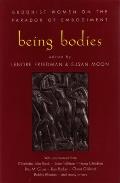
“Being Bodies” edited by Lenore Friedman & Susan Moon

February 15, 2010 by Sonia Connolly 3 Comments

Recommended to me by: Catherine Holmes Clark, who also has a detailed site about her journey with environmental illness.

The sweet relief of reading about Buddhism from the perspective of women connected with their bodies took me by surprise. Until I read this book, I didn’t realize how much I’d been reading around a feeling of exclusion in The Wise Heart by Jack Kornfield and other books about Buddhism centered on male experience.

Thirty-three essays by different Buddhist women are divided into five sections:

  • Body as Suffering – bringing awareness to the experience of chronic illness.
  • Body as Nature – the feeling of failure because giving birth brought pain, even with awareness.
  • Body as Gender – helping a daughter remain aware as she navigates adolescent self-judgment of her body.
  • Body as Vehicle – dealing with difficulties through “no more struggle,” “using poison as medicine,” and “seeing whatever arises as enlightened wisdom.”
  • Body as Self – navigating addiction to alcohol, compulsive eating, and the loneliness of being embodied.

Images from the essays have woven themselves into my awareness.

At my cutting board chopping carrots or parsnips, I think of Darlene Cohen’s essay, “The Only Way I Know of to Alleviate Suffering.” She writes about helping people with arthritis discover that they can cut carrots by bringing their awareness to the details of their bodies’ experience with the board, the knife, and the carrots.

I recommend this book to anyone who wants to revel in the Buddhist perspective of women connected to their bodies.

Available at bookshop.org.

Filed Under: nonfiction Tagged With: disability, healing, psychology, spirituality

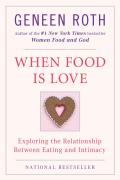
“When Food is Love” by Geneen Roth

February 11, 2010 by Sonia Connolly 1 Comment

Recommended to me by: a client.

Geneen Roth has written several books about overcoming compulsive eating by removing external rules around food and listening to one’s own body instead. She also talks about the source of compulsive eating – not an internal lack of control, but a survival strategy to overcome the lack of external control in childhood.

In this book, she talks about her own history with intimacy, and the connections between how we treat food, and how we treat emotional connections in our lives. She reveals the neglect and emotional and physical abuse of her childhood, and shares stories from her “Breaking Free” workshops as well.

If you deeply explore one area of life, you will find the answers to every area. What you learn as you break free from your obsession with food is what you need to learn about intimacy:

Commit yourself.
Tell the truth.
Trust yourself.
Pain ends and so does everything else.
Laugh easily.
Cry easily.
Have patience.
Be willing to be vulnerable.
When you notice that you are clinging to anything and it’s causing trouble, drop it.
Be willing to fail.
Don’t let fear stop you from leaping into the unknown, or from sitting in dark silence.
Remember that everything gets lost, stolen, ruined, worn out, or broken; bodies sag and wrinkle; everyone suffers; and everyone dies.
No act of love is ever wasted.

The book is full of vivid metaphors and urgent truths. It is a call to turn inside, face one’s demons with gentleness and compassion, and find freedom.

Available at bookshop.org.

Filed Under: nonfiction Tagged With: childhood abuse, healing, health at any size, memoir, psychology, survival story

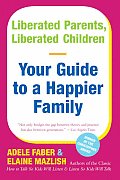
“Liberated Parents, Liberated Children” by Adele Faber & Elaine Mazlish

February 4, 2010 by Sonia Connolly Leave a Comment

I liked How To Talk So Kids Will Listen & Listen So Kids Will Talk so much that I read the authors’ prior book.

“Liberated Parents, Liberated Children” was published first, by many years. It tells the story of how the authors and a group of other parents (fictionalized to protect privacy) learned respectful, compassionate communication and boundary skills from Dr. Haim Ginott.

Over 5 years, they and their families were transformed.

The skills (summarized below) are the same in both books. This book highlights each parent’s journey as they struggle to learn how to honor their children’s feelings, and their own feelings as well.  They share both immediate successes and frustrating stumbles.  Their dedication to finding a better way shines through the pages.

I am grateful to them for persevering, and for publicizing what they learned. I am grateful to Dr. Haim Ginott for creating these skills, and teaching them. I am grateful to all the parents out there dedicated to learning a better way. I wish my parents had had this kind of dedication and support.

From the book’s inside cover:

Find out how the mood in your home can change when you respond:

To crying with: “A scratch can hurt.”
(Instead of “Stop crying. It’s only a scratch.”)

To accidents with: “The milk spilled. We need a sponge.”
(Instead of “Now look what you did!”)

To misbehavior with “Walls are not for writing on. Paper is for writing on.”
(Instead of “Bad boy! No more crayons for you!”)

To messiness with: “It would be really helpful if you would put the juice back in the fridge.”
(Instead of “Why can’t you ever clean up after yourself?”)

To rudeness with “You really hate it when Aunt Harriet pinches your cheek.”
(Instead of “You’re making a big fuss over nothing. Aunt Harriet loves you.”)

To whining with: “It’s really hot for you in here, isn’t it?”
(Instead of “How can you feel hot? It’s cool in here.”)

To carelessness with: “Kids, the door’s open!”
(Instead of “Shut the door! What’s wrong with you?”)

To sibling fighting with “You two are really angry with each other. Why don’t you each write down what happened.”
(Instead of “I don’t care who started it! I just want it ended!”)

Highly recommended to anyone who wants to interact more peacefully and successfully with outer or inner children.

Available at bookshop.org.

Filed Under: nonfiction Tagged With: communication, psychology

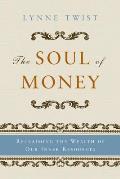
“The Soul of Money” by Lynne Twist

January 12, 2010 by Sonia Connolly Leave a Comment

Recommended to me by: Spirituality bookgroup, and several others.

Lynne Twist recounts her fundraising for The Hunger Project non-profit, including anecdotes about her encounters with both desperately poor and despairingly wealthy people.

She also shares her own journey from oblivious, superficial spending to heart-centered use of funds.

She explores the effects of our toxic myths of scarcity (there’s not enough, more is better, that’s just the way it is), and replaces them with sufficiency.

Sufficiency is defined as a declaration that there is enough, and we are enough. “We engage in life from a sense of our own wholeness rather than a desperate longing to be complete.”

In sufficiency, money flows through our lives, rather than being accumulated for its own sake. We use money with integrity to express value, rather than allowing it to determine value. Turning our attention to inner resources allows us to meet challenges of external scarcity. “In the nourishment of our attention, our [internal] assets expand and grow.”

I had never thought of fundraising as offering someone the opportunity to align their actions with their values. This new model changes the power dynamic from giver/receiver to an equal exchange.

It was encouraging to notice that I already follow one of the book’s major recommendations: aligning my spending with my values. I still have the goal of becoming more comfortable with the flow of money in my life.

Available at bookshop.org.

Filed Under: nonfiction Tagged With: business, finance

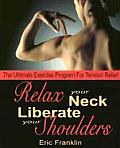
“Relax your Neck, Liberate your Shoulders” by Eric Franklin

January 1, 2010 by Sonia Connolly Leave a Comment

Recommended to me by: a friend who spends a lot of time at the computer.

The book begins, “[M]y head was balancing on a completely loose neck. It actually felt as if it was free of gravity and it was a pleasure to turn my head since my neck felt so supple, my shoulders were light as flufffed feathers, and my breathing was free and deep.”

I would love to feel that way!

The book offers playful exercises and imagery, as well as detailed anatomical drawings to help reach that desired state. The core approach of the Franklin Method is to regain awareness, balance, and relaxation from the inside, rather than impose it externally or forcefully.

One of the exercises: Imagine a tiny balloon at the back of your neck, supporting your skull, and at the same time let your jaw hang down. To me, the feeling of support is palpable, and my shoulders drop away from my ears.

The anatomical information is helpful as well. For example, when a muscle contracts, the long chains of proteins do not curl or bunch up – they slide past each other like the teeth of two intertwined combs. It is much easier for me to envision muscle fibers sliding apart than it is to “relax” or “let go.”

I will continue to use the exercises in my quest for a completely loose neck, and I’ll incorporate the new knowledge into my bodywork practice as well.

Available at bookshop.org.

Filed Under: nonfiction Tagged With: bodywork, illustrated

  • « Go to Previous Page
  • Page 1
  • Interim pages omitted …
  • Page 43
  • Page 44
  • Page 45
  • Page 46
  • Page 47
  • Page 48
  • Go to Next Page »

Primary Sidebar

Recent Books

  • “Atlas of the Heart” by Brene Brown
  • “Life After Cars” by Sarah Goodyear, Doug Gordon, Aaron Naparstek
  • “Tidy First?” by Kent Beck
  • “When You Had Power” and “You Knew the Price” by Susan Kaye Quinn
  • “Taproot” by Keezy Young
  • “The Tower at Stony Wood” by Patricia A McKillip
  • “Hospicing Modernity” by Vanessa Machado de Oliveira
  • “How We Show Up” by Mia Birdsong
  • “The Enchanted Greenhouse” by Sarah Beth Durst
  • “What It Takes to Heal” by Prentis Hemphill

Tags

activism aging anti-racism bodywork business childhood abuse childrens CivicTech communication disability domestic violence fantasy feminism finance Focusing food fun healing health at any size illustrated Judaism leadership lgbt marketing memoir music natural world neurodiversity politics psychology relationship romance science science fiction software spirituality survival story trauma writing young adult

Categories

Archives

Please note: bookshop.org and Amazon links are affiliate links. Copyright © 2026 · Genesis Sample on · WordPress