• Skip to primary navigation
  • Skip to main content
  • Skip to primary sidebar
Curious, Healing

Curious, Healing

Books about healing, business, and fun

  • About Sonia Connolly

“Uprooted” by Naomi Novik

June 21, 2016 by Sonia Connolly Leave a Comment

book cover

Recommended to me by: Eric Roberts

A fantasy novel based on Eastern European folk tales, but going in a direction all its own. The main character is a young woman, and there are other women with agency in the book. Unfortunately it is still a feudal social structure with a king and a male line of succession. Most of the people in power are men. There is a kickass black woman wizard, however!

There are two kinds of magic, and one of them is a follow-your-nose, do-what-feels-right, stay-in-connection kind of magic that feels as realistic to me as any magic can. I’ve never thought much of cookbook magic.

People care about each other and for each other. There is some attention to the need for rest and healing after wounds, although they do tend to be elided quickly as the action continues.

I found it entirely unbelievable that a 17 year old village girl would be completely sexually ignorant. Farm animals! Older friends! One room cottages! Listening to her own body!

The ongoing helpless suffering at the beginning of the book kicked me out, and I spent the rest of the book muttering about what the author was doing. But I did read the whole thing. There is a *lot* of violence. The narrator comments on it, is sickened by it, but the violence still continues.

I’ve been thinking a lot about evil, and where the responsibility for it lies, and where it originates. Whether there is an independent evil entity sowing evil in people. When and how we have to take responsibility for our own evil actions, and expect others to take responsibility for theirs. The book wrestles with those questions. The conclusion did not feel satisfactory to me.

I was having trouble finding words for this review, and it helped me to read this one. It’s comforting when others respond to the same issues I sensed, and can put words around them.

Recommended if story structure and plot, with some modern improvements on the social justice front, are more important to you than a lot of violence and suffering.

Available at bookshop.org.

Filed Under: fiction Tagged With: fun, young adult

“The Polyvagal Theory” by Stephen W. Porges

June 21, 2016 by Sonia Connolly 1 Comment

book cover

Subtitle: Neurophysiological Foundations of Emotions, Attachment, Communication, and Self-Regulation

Recommended to me by: Joshua Sylvae

This book is a chronological collection of Stephen Porges’ scientific research papers about vagal nerves and their functions, written in technical, medical language. Later papers summarize earlier research and even define some terms, so the book gets easier to read as it goes along.

The vagal nerve, also known as the tenth cranial nerve, originates in the brainstem and branches to the lungs, heart, digestive system, and face, independent of the spinal cord. It makes up most of the parasympathetic nervous system. It has both efferent (motor, from the brain to the periphery) neurons and afferent (sensory, from the periphery to the brain) neurons, creating a system that tends to stay in a given operating range (homeostasis) via negative feedback.

It is bilateral, one on each side of the body, and the two sides have slightly different functions, since we are not internally symmetrical, with the heart tilted to the left and the stomach on the left, etc.

As well as being bilateral, there are also two separate systems, thus “poly vagal theory”, many vagal nerves: an ancient system that all vertebrates have, and an additional newer system that mammals have. When the newer system is active, it suppresses the older system.

The ancient system is dorsal (originating toward the back of the brainstem) and unmyelinated (not sheathed).

Reptiles have this ancient vagal system, and a sympathetic system. They have a low resting metabolic rate. Under stress, their sympathetic system speeds up heart rate and breathing. If that doesn’t fix the problem, the dorsal vagal system puts them into freeze, dropping heart rate (bradycardia) and breathing rate (apnea). This works well to convince predators they are dead, or extend the time they can stay underwater.

The newer vagal system is ventral (originating toward the front of the brainstem) and myelinated (sheathed). It controls facial expressions, vocalizations (speech, singing, and other sounds), and coordinates breathing with vocalizing and swallowing. It tightens the muscles of the middle ear to filter out low frequency sounds that might drown out speech frequencies.

Mammals have a high resting metabolic rate, and a high requirement for a consistent oxygen supply. The newer vagal system is a “brake” on the sympathetic nervous system, gently reducing heart rate and breathing rate and allowing a focus on social signals. Under stress, the brake is removed, giving control to the sympathetic nervous system and instantaneously raising heart and breathing rate. If that does not take care of the problem, control goes to the ancient vagal system, sharply dropping heart rate (bradycardia) and breathing rate (apnea), which can be fatal for mammals.

The vagal brake can be engaged and disengaged at the speed of thought, unlike the sympathetic nervous system which works via adrenal hormones and other circulating chemicals that take a while to clear out of the body.

When the vagal system is busy telling the diaphragm to breathe in, the heart gets less of a “brake” signal and speeds up slightly. The brake is restored on the out-breath, slowing the heart slightly. This is RSA – Respiratory Sinus Arrhythmia. It can be used as a non-invasive indicator of vagal tone. The greater the difference in heart rate while breathing in versus breathing out, the more vagal tone there is.

The ancient vagal system has been partially recruited for pro-social immobility – accepting an embrace, for example.

The ancient vagal system also explains the immobility many people experience during rape. Understanding the neurological basis helps to reduce shame about not fighting back.

Available at bookshop.org.

Filed Under: nonfiction Tagged With: trauma

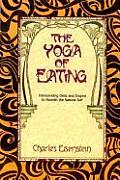
“The Yoga of Eating” by Charles Eisenstein

June 21, 2016 by Sonia Connolly Leave a Comment

book cover

Subtitle: Transcending Diets and Dogma to Nourish the Natural Self

Recommended to me by: a client

A compassionate, wise look at our food choices. What are we saying yes to? How can we bring more kind attention to the nurturance and nutrition our bodies need? How do our food needs relate to the rest of our lives? An invitation to allow rather than coerce.

Highly recommended.

Available at bookshop.org.

Filed Under: nonfiction Tagged With: food

“Understanding and Treating Chronic Shame” by Patricia A. DeYoung

May 23, 2016 by Sonia Connolly 1 Comment

book cover

Subtitle: A Relational/Neurobiological Approach

Recommended to me by: Ani Rose Whaleswan

Patricia DeYoung says that although shame feels like a one-person problem, believing “There is something terribly wrong with me,” she defines it as a relational problem: Shame is an experience of our felt sense of self disintegrating in relation to a dysregulating other. Expecting attunement or regulation, we experience fragmentation instead, and immediately push that intolerable experience out of consciousness.

Shame is healed by right-brain connection, not left-brain reasoning and affirmations.

The book is filled with both lively client stories and technical psychological theory. It’s validating to know that researchers are beginning to understand relational trauma at a neurological level. It’s even better to know that relational therapists are holding this information about shame compassionately in mind while creating a healing space for their clients.

When our clients are able to feel their shame, letting the light and air get at it, we must stay honestly present with them. We have to encourage them to feel this most difficult emotion when what we want to say is: No, you are not ugly or worthless. No, I have never experienced you as selfish or stupid. Of course we would like to convince them that they are worthy, lovable persons. Instead, we must help them push through the language of ugly, stupid and worthless to the even more painful feelings of deep shame, feelings of not mattering at all to anyone, feelings of needing someone and finding no one, and feelings of disintegration and annihilation.

(Italics in original)

There is procedural advice for therapists: how to create a non-shaming environment, how to co-create narratives that include right-brain processing, how to discuss shame directly. Oddly, for a book about right-brain healing, touch is not mentioned anywhere.

Unlike many books that skip over the disorganized attachment style, this book addresses it and its “fearful chaos” directly.

The book also discusses mutual enactment, when client and therapist trigger each other’s deep shame, and yet keep working together with underlying good intentions. The mutually stuck pattern shifts not with dramatic insights, but incrementally, yielding little by little to moments of seeing each other more as whole people rather than just threats.

Highly recommended for therapists and others willing to wade through sections of psychological theory.

Available at bookshop.org.

Filed Under: nonfiction Tagged With: psychology, trauma

“The Other Wind” by Ursula K Le Guin

April 14, 2016 by Sonia Connolly Leave a Comment

book cover

I read this back when it originally came out in 2001. I remembered the overall story arc and the spectacular image of Tehanu at the end, but none of the details at all. It was great to have a visit with Ged and Tenar and Tehanu, but the characters felt oddly distant, not emotionally engaging. It felt like they were moving through their assigned parts in the repair of their world’s storyline, but they didn’t really have a choice. I did like the careful attention to the disposition of a cat.

Oddly, for a book by Le Guin in the 21st century, the main actors are men. Yes, women are involved and consulted and even central to the storyline, but I was left with the sense that they were pushing their way in from the sidelines, and the men were awkwardly surprised to see them.

Recommended if you want a visit with Earthsea.

Available at bookshop.org.

Filed Under: fiction Tagged With: fun

“Hold Me Tight” by Dr. Sue Johnson

April 8, 2016 by Sonia Connolly 1 Comment

book cover

Subtitle: Seven Conversations for a Lifetime of Love

Dr. Sue Johnson, creator of Emotionally Focused Couples Therapy, applies attachment theory to adult relationships, and everything suddenly makes sense. Attachment relationships provide an anchor and sense of safety in the world. They feel just as essential to our survival as attachment relationships do to children, so it makes sense we fight or flee when they feel threatened.

The seven conversations are:

  1. Recognize Demon Dialogues – look underneath for attachment fears, and see how both people contribute to patterns.
    • Find the Bad Guy – casting blame for distress
    • Protest Polka – one person withdraws, the other makes demands, in a cycle
    • Freeze and Flee – both people withdraw, and the relationship is on its deathbed
  2. Find the Raw Spots – identify triggers for attachment longings and fears.
  3. Revisit a Rocky Moment – talk through a past conversation that didn’t go well, taking into account patterns, raw spots, and deeper emotions.
  4. Hold Me Tight – emotional attunement, accessibility, responsiveness, and engagement. Each person tunes into their own emotions and shares what they are most afraid of, and then the attachment longing that is live in that moment. Hopefully the partner turns toward them and fulfills the longing, creating a new bonding experience. The person who usually withdraws goes first.
  5. Forgiving Attachment Injuries – relationship traumas, usually involving some kind of abandonment, need to be healed, not ignored.
    1. The hurt partner speaks their pain as openly and simply as possible.
    2. The injuring partner stays emotionally present and acknowledges the wounded partner’s pain and their part in it.
    3. Emotionally connect around this, start rebuilding trust.
    4. Injuring partner takes ownership and expresses regret and remorse.
    5. Hold Me Tight conversation centered around the attachment injury – what is needed now to bring comfort and closure. Hopefully the injuring partner fulfills this.
    6. Create a narrative that captures the injuring event and how it is being healed.
  6. Bonding Through Sex and Touch – bring emotional connection, communication, and trust to touch and sex.
  7. Keep Your Love Alive – name ways to reconnect when a Demon Dialogue crops up, celebrate the positive moments, discuss attachment needs and issues, make rituals for separation and reunion, create an ongoing story of the living relationship, create a vision for the relationship in the future.

There is more than one gay couple in this book! And one couple of Asian descent. Women and men are individuals, not stereotyped caricatures. The client stories are realistic, practical, and encouraging.

Despite the pop-psych title and Overuse of Capital Letters, this book is solidly researched and makes a lot of sense. Highly recommended.

Available at bookshop.org.

Also read Dr. Sue Johnson’s more recent Love Sense, which covers a lot of the same material, with more information about the neurochemistry of attachment. Oddly, she leaves out the disorganized attachment style entirely. There is an extended example of a couple repairing their relationship.

Filed Under: nonfiction Tagged With: communication, psychology

  • « Go to Previous Page
  • Page 1
  • Interim pages omitted …
  • Page 32
  • Page 33
  • Page 34
  • Page 35
  • Page 36
  • Interim pages omitted …
  • Page 70
  • Go to Next Page »

Primary Sidebar

Recent Books

  • “How We Show Up” by Mia Birdsong
  • “The Enchanted Greenhouse” by Sarah Beth Durst
  • “What It Takes to Heal” by Prentis Hemphill
  • Kitchens of Hope by Linda S. Svitak and Christin Jaye Eaton with Lee Svitak Dean
  • “Very Far Away From Anywhere Else” by Ursula K Le Guin
  • “Seaward” by Susan Cooper
  • “Surviving Domestic Violence” by Elaine Weiss
  • “The Book of Love” by Kelly Link
  • “Alexandra’s Riddle” by Elisa Keyston
  • “Weaving Hope” by Celia Lake

Tags

activism aging anti-racism bodywork business childhood abuse childrens CivicTech communication disability domestic violence fantasy feminism finance Focusing food fun healing health at any size illustrated Judaism leadership lgbt marketing memoir music natural world neurodiversity politics psychology relationship romance science science fiction software spirituality survival story trauma writing young adult

Categories

Archives

Please note: bookshop.org and Amazon links are affiliate links. Copyright © 2025 · Genesis Sample on · WordPress