• Skip to primary navigation
  • Skip to main content
  • Skip to primary sidebar
Curious, Healing

Curious, Healing

Books about healing, business, and fun

  • About Sonia Connolly

healing

“It Didn’t Start With You” by Mark Wolynn

March 11, 2018 by Sonia Connolly 1 Comment

book cover

Subtitle: How inherited family trauma shapes who we are and how to end the cycle

Recommended to me by: a client

The book starts with Mark Wolynn’s story. He had sudden trouble with an eye and, fearing blindness, traveled in southeast Asia seeking gurus and healers who could help him. Finally, two separate gurus said, “Go home and call your mother and your father.” He went home, healed his relationship with his parents, felt much better, and incidentally his vision returned.

The next section reviews scientific research on epigenetics, how people’s cortisol levels and behaviors are affected by trauma experienced by their parents. When our grandmother is pregnant with our mother, the precursor cell of the egg that will become us is already formed. It makes sense that bodies would be prepared for a dangerous environment if the parents experience danger.

The next section has case histories of how an early break in the maternal relationship can cause ongoing problems. Parents are described as an ongoing source of the flow of life, so being estranged from them interrupts that flow. Since the author solved his problem by reconnecting with his parents, everyone should reconnect with their parents. Bizarrely, for a book about inherited trauma, actively abusive parents are never mentioned.

A person can unconsciously act out a parent’s or other relative’s story, even if they don’t know about the past events. Anything that is hidden can surface inside a relative.

The remedy, in addition to reconciling with your parents “even if you’d rather eat thumbtacks,” is to identify your core sentence and listen for echoes of past stories. Write down your worst fear, and look for phrases that are more intense or resonate with the past. When a family is affected by war or atrocities like the Holocaust, trauma can reverberate through the generations.

We can imagine making contact with past relatives, and respectfully return their feelings to them, and imagine them wishing us well. We can similarly imagine returning parents’ feelings to them if it is not safe to contact them directly.

Accepting our parents is important. As Martha Beck said in (I think) “Leaving the Saints,” it’s possible to accept a rattlesnake exactly as it is and stay respectfully out of range of its fangs.

Recommended as food for thought, as long as you remember that the author’s solution will not be the solution for everyone. Since my family tree has several branches chopped short by the Holocaust, it’s good to see an acknowledgment of the repercussions for later generations.
Available at bookshop.org.

Filed Under: nonfiction Tagged With: healing, memoir, psychology, trauma

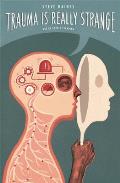
“Trauma Is Really Strange” by Steve Haines, art by Sophie Standing

December 24, 2017 by Sonia Connolly 2 Comments

book cover

Recommended to me by: boxofdelights

This is a graphic “novel” (although it’s non-fiction) or comic, or graphic medicine book. Each page is divided into panels with drawings and word bubbles, sometimes with additional explanations in tiny red print at the bottom of the page.

This is a solid introduction to the nervous system and how it responds to stress, including the sympathetic and parasympathetic nervous systems and Porges’ polyvagal theory, all in a friendly reassuring format. Trauma is defined as events that exceed our ability to cope with them. Healing is focused on being present and tolerating intense internal sensations, rather than reworking the past or experiencing big emotional catharsis. The goal is to tone down the reflexes of fight-or-flight and dissociation.

“Healing trauma is about meeting the body. In trauma, old parts of the brain change how the body works. By paying attention to feelings in the body and learning to self-regulate we can reboot the brain.”

The material is familiar to me, with a different emphasis than I’m used to, perhaps because the book is British.

The people in the drawings almost all come across as male. A few have more detail and come across as female. The people do have a wide range of skin colors, which is great. There is a drawing of a baby being born out of a disembodied blob – apparently it was too hard to draw a whole person giving birth. There was a surprisingly ableist use of “blindly” that brought me up short.

The book covers a lot of ground in a clear way. Of course it can’t cover everything. At the same time, I would have liked to see a disclaimer that everyone’s experience with trauma is different, and everyone’s healing path is different. Near the end, there is an entire page dedicated to Trauma Release Exercises (TRE), and the whole book feels skewed toward people for whom that’s the answer.

Yes, it’s less neat and reassuring to say, “This works for some people, not all,” but it is more honest, and more kind to those for whom it is all more complicated.  The last thing a traumatized person needs is to hear, “This works for everyone,” when that thing doesn’t work for them.

Available at bookshop.org.

Filed Under: nonfiction Tagged With: healing, illustrated, psychology, trauma

“Journey to the Dark Goddess” by Jane Meredith

August 28, 2017 by Sonia Connolly 1 Comment

book cover

Subtitle: How to Return to Your Soul

Recommended to me by: Mereth

Jane Meredith weaves together research and interpretation about three myths of descent into the underworld with her own experiences of unintentional and intentional descents. The book is divided into sections on Preparation, Descending, In the Underworld, and Coming Back Out.

The three myths are: Inanna as she descends to her sister’s realm, Persephone as she is taken to the underworld and marries there, and Psyche who is sent to the underworld by Aphrodite as part of a series of tasks to win the right to partner with Eros. These myths are maps of what we might encounter in our own descents – times when everything comes apart through illness, loss, or other transformations.

Jane Meredith strongly advocates for descending consciously with rituals, rather than being dragged into descents without preparation or warning. She makes the case that our lives ebb and flow the way the moon does, and contraction is just as valid as expansion. She also advocates for making maps of our journeys, recording our experiences for the benefit of ourselves and others.

I participated in a Descent of Inanna ritual twenty years ago, and still have the plaster mask I made then. I’ve encountered plenty of descents in my life as well. I wanted the book to tell me how to Ascend, how to find that turning point when things start to get better, rather than living in the underworld. She talks about ascending slowly and consciously, integrating new information. Mirroring the descent of Inanna where she gives up seven aspects of her power and self, in an Ascent we reclaim what we gave up, possibly in changed form.

My body sensed the return of the sun after the recent total solar eclipse as a turning point. The light does return! Things do get better! I’ll have to pay attention to what I’m reclaiming.

Overall, these suggestions and rituals are about confronting the raw truths of ourselves and our lives. Descent is about surrendering everything. Choosing to descend is about reclaiming our power to live fully, even in the hardest times.

Highly recommended as a guide for moving consciously through hard times.

Available at bookshop.org.

Filed Under: nonfiction Tagged With: healing, spirituality

“8” by Amy Fusselman

August 8, 2017 by Sonia Connolly Leave a Comment

book cover

Recommended to me by: a client

This is a book about healing, rather than a book about trauma.

Amy Fusselman layers incidents with “her pedophile” among meditations about the nature of time, parenting, relationships, healing, bodywork, therapy, New York City cab rides, and writing in a coffee shop when celebrities walk by. She loops among the topics gracefully, like the figure skater she was as a girl.

Recommended for one person’s perspective on the effects of childhood sexual abuse, putting it in its (admittedly important) place among the rest of the events in a life. Recommended for touching on the topic of abuse forthrightly, and then going on to something else, rather than sinking into it more and more deeply. This is how healing works.

Available at bookshop.org.

Filed Under: nonfiction Tagged With: childhood abuse, healing, memoir, survival story

“Vision For Life” by Meir Schneider

July 24, 2017 by Sonia Connolly 3 Comments

book cover

Subtitle: Ten Steps to Natural Eyesight Improvement

Recommended to me by: David Mitchell

Meir Schneider tells the story of his own vision improvement starting from near blindness using the Bates Method, and then shares detailed exercises and instructions for vision care and improvement. He founded the School for Self-Healing in San Francisco to share his discoveries.

His 10 steps to improve vision take time and energy. Some can be done along with daily life, like looking into the distance and looking at details. Some are specific exercises, like the long swing. Some require additional equipment and setup to block the stronger eye or use red/green glasses. He recommends integrating the work throughout the day as part of a commitment to better vision.

10 steps:

  1. Long swing: standing, swing the body back and forth with an index finger raised in front of the eyes about a foot away.
  2. Look into the distance
  3. Explore the periphery: wave hands out to the sides while looking in the distance, and block central vision with a small square of stiff paper or cardboard.
  4. Sunning and skying: move head side to side and up and down with closed eyes facing the sun (or sky)
  5. Night walking
  6. Palming: cover the eyes with relaxed hands and visualize darkness or blackness
  7. Shifting: look at details
  8. Block the strong eye
  9. Blink
  10. Vision and body

There are additional exercises for various conditions such as crossed eyes (tape a narrow piece of paper over the center of your face and toss a ball from hand to hand) and glaucoma (lots of exercises to improve blood flow and reduce neck tension).

The writing in the book is warm, encouraging, and carefully detailed. Recommended to learn about how to care for our own vision and our own bodies.

Available at bookshop.org.

Filed Under: nonfiction Tagged With: disability, healing

“Death Without Denial Grief Without Apology” by Barbara K. Roberts

March 18, 2017 by Sonia Connolly 1 Comment

book cover

Subtitle: A Guide for Facing Death and Loss

This is a loving clear-eyed unflinchingly personal look at terminal illness, death, and grief by Oregon’s former governor Barbara Roberts. Her husband Frank Roberts died of cancer during her governorship. From the introduction:

I hope for a culture of loving openness in every medical office, hospital room, health care clinic, and emergency room where news of life’s limitations and death’s impending arrival are discussed openly and compassionately. People who are dying and their families and loved ones must be prepared to create such a culture for themselves.

Frank was a state senator during his last year, and there are some mentions of both of their political work in their choice to keep his terminal illness private for some time. I can only imagine the strength it took to continue to govern through illness and grief.

She tells the story of his diagnosis, their decision process together, their choice of hospice rather than further treatment, his quiet death, and her grief afterward. Emotions are included, but the story is calmly told. She shares the practical steps of planning for death. She talks openly about her own and others’ private rituals of grief, such as bringing flowers to a recently dead wife on an anniversary, or talking to the urn containing Frank’s ashes.

Highly recommended!

Wikipedia page about Oregon Democratic governor Barbara Roberts. Her term was from 1991-1995. She was the first woman Oregon governor. The second was just elected in 2016, our current governor Kate Brown.

Available at bookshop.org.

Filed Under: nonfiction Tagged With: disability, healing, memoir, psychology, spirituality, survival story

  • « Go to Previous Page
  • Page 1
  • Interim pages omitted …
  • Page 5
  • Page 6
  • Page 7
  • Page 8
  • Page 9
  • Interim pages omitted …
  • Page 17
  • Go to Next Page »

Primary Sidebar

Recent Books

  • “How We Show Up” by Mia Birdsong
  • “The Enchanted Greenhouse” by Sarah Beth Durst
  • “What It Takes to Heal” by Prentis Hemphill
  • Kitchens of Hope by Linda S. Svitak and Christin Jaye Eaton with Lee Svitak Dean
  • “Very Far Away From Anywhere Else” by Ursula K Le Guin
  • “Seaward” by Susan Cooper
  • “Surviving Domestic Violence” by Elaine Weiss
  • “The Book of Love” by Kelly Link
  • “Alexandra’s Riddle” by Elisa Keyston
  • “Weaving Hope” by Celia Lake

Tags

activism aging anti-racism bodywork business childhood abuse childrens CivicTech communication disability domestic violence fantasy feminism finance Focusing food fun healing health at any size illustrated Judaism leadership lgbt marketing memoir music natural world neurodiversity politics psychology relationship romance science science fiction software spirituality survival story trauma writing young adult

Categories

Archives

Please note: bookshop.org and Amazon links are affiliate links. Copyright © 2026 · Genesis Sample on · WordPress