• Skip to primary navigation
  • Skip to main content
  • Skip to primary sidebar
Curious, Healing

Curious, Healing

Books about healing, business, and fun

  • About Sonia Connolly

illustrated

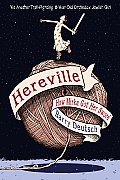
“Hereville: How Mirka Got Her Sword” by Barry Deutsch

October 31, 2010 by Sonia Connolly 2 Comments

Subtitle: Yet Another Troll-Fighting 11-Year-Old Orthodox Jewish Girl

Recommended to me by: Barry Deutsch’s Alas, A Blog

A graphic novel set in an Orthodox Jewish town called Hereville, in a blended family with many girls and one little brother. The facial expressions and other details in the drawings are captivating – I read the book twice and noticed a lot that I’d missed the first time. The characters are realistic even while engaged in unrealistic adventures.

The strict rules of Orthodox Judaism are included in the story, with only the occasional pictorial editorial comment, such as the bored expressions of the youth having “vibrant, passionate discussions” on Shabbat. Yiddish terms are translated in footnotes.

The fantastic elements of witch encounters and troll fights contrast oddly with the Orthodox background, sibling arguments about reputation, and a step-mother’s efforts to manage a large family. The ending is decidedly unexpected.

Mirka is portrayed as reaching for a knife, sword, or tree-branch to violently solve her problems. She is also portrayed as being so immersed in Jewish culture that she didn’t recognize a pig when she saw one.

I’m not sure what to think of the book. It draws me in, and at the same time leaves me wondering if the author’s message is subtly derogatory toward Judaism. While I wouldn’t want to live in an Orthodox community myself, I don’t want to see one exposed to ridicule, either.

Barry Deutsch is a cartoonist in Portland, Oregon.
Available at bookshop.org.

Filed Under: fiction Tagged With: fun, illustrated, spirituality, young adult

“Totally Tolerant” by Diane Webber and Laurie Mandel

October 31, 2010 by Sonia Connolly Leave a Comment

Subtitle: Spotting and stopping prejudice

A brief, photo-filled book with concrete advice for teens on embracing diversity and overcoming prejudice.  Adults can benefit from this book as well.

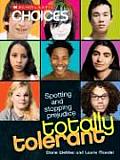
As you can see on the cover, the photos strongly support the book’s message, showing people of a variety of skin colors, genders, and ethnicities.

Diversity is defined as difference.  Tolerance is defined as “respect for everyone’s religion, gender, race, ethnicity, sexual orientation, and social class.”  Stories about students from different backgrounds illustrate positive and negative experiences with tolerance and the effects they had.

From the back cover: “Everyone should at least make an attempt to stop bigotry.  Otherwise, other people suffer because you don’t have the guts to stand up for what you believe in.”  — Kevin, 14.

I’m encouraged to see the clear, positive approach this book takes toward spotting and stopping prejudice.  It addresses bullying as well.  I wish every teen (and every adult) would read and absorb its wisdom.

Available at biblio.com.

Filed Under: nonfiction Tagged With: anti-racism, communication, disability, illustrated, lgbt, psychology

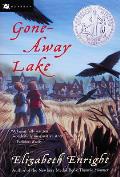
“Gone-Away Lake” by Elizabeth Enright

June 21, 2010 by Sonia Connolly Leave a Comment

Recommended to me by: Marissa Lingen

The title sounded familiar and I thought I read it as a child, but the story itself didn’t ring any bells. Published in 1957, the book features two half-grown kids interacting with two elderly people living in abandoned summer homes, surrounded by lots of nature and lots of kindness.

Portia visits her cousin Julian for the summer, way out in the country. At 11 and 12 years old, they blithely leave the house every morning to visit their new friends at Gone-Away Lake and don’t return until dinner, without accounting for their time to Julian’s parents.

Portia and Julian are close friends without a trace of romance or self-consciousness. They only quarrel once, late in the book. Although the quarrel seems resolved, they each spend more time with friends of their own gender after that.

There is some emphasis on the stereotypes of girls being afraid more often and talking more, and boys liking construction and dirt more. At the same time, the stereotypes are gently questioned by the boys admitting to being afraid too, and the girls exploring right along with them.

Minnehaha and Pindar live peacefully in abandoned houses beside the marsh which used to be Lake Tarrigo, without most modern conveniences. Their day to day activities gently question our assumptions about what is necessary for happiness.

It’s a relief to read a book about emotionally healthy people enjoying their world and each other.

Available at bookshop.org.

Filed Under: fiction Tagged With: childrens, fun, illustrated

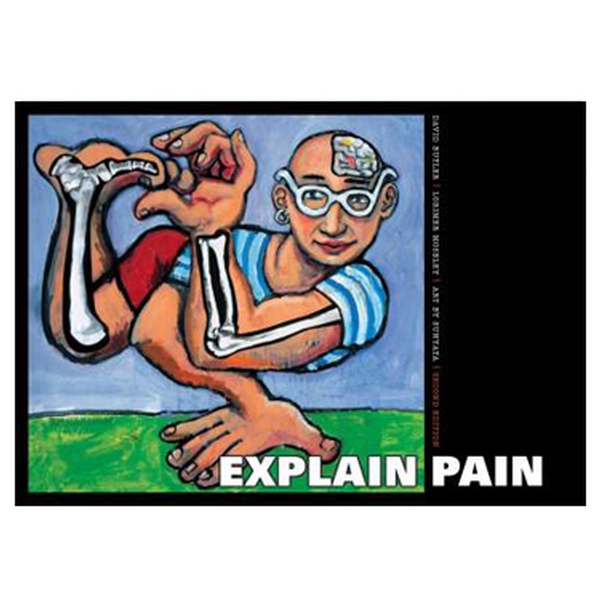
“Explain Pain” by David Butler and Lorimer Moseley

June 8, 2010 by Sonia Connolly 2 Comments

Recommended to me by: Kim Hillis, PT

If this book didn’t cost $70, I would be telling every client and practitioner to buy one right now. Both scientific and playful, it offers the latest research about understanding and healing chronic pain.

The sensation of pain is the brain’s response to perceived threat. Until it is interpreted by the brain, pain is (just) an electrical and chemical signal.

Pain is initially associated with tissue damage and inflammation (acute pain). Sometimes the pain response continues after the tissue has gone through the healing process (chronic pain).

Pain does not always correlate with tissue damage, especially with chronic pain. As pain continues, the nervous system adapts by making the pain signal easier to trigger. Emotional stress and beliefs about pain can contribute to triggering pain in a frustrating negative cycle.

The body’s representation in the brain (the homonculus) becomes “smudged” in areas of chronic pain. This can be corrected with gentle movement, retraining the brain to represent the body more accurately.

“Hurt does not always equal harm.” A sensitized nervous system can be retrained and calmed through gradual increases in activity. Having fun and varying the context of a painful movement can help retrain the nervous system.

Explain Pain blog: explainpain.blogspot.com

Available from NOIGroup in Australia or OPTP in the US

Filed Under: nonfiction Tagged With: bodywork, healing, illustrated

“Finding Life Beyond Trauma” by Victoria Follette, Ph.D. and Jacqueline Pistorello, Ph.D.

April 24, 2010 by Sonia Connolly 3 Comments

Subtitle: Using Acceptance and Commitment Therapy to Heal from Post-Traumatic Stress and Trauma-Related Problems

Acceptance and Commitment Therapy (abbreviated ACT, and pronounced as a whole word) invites clients to observe their own behaviors and let go of strategies which might be keeping them from living their most valued life. It includes a strong emphasis on mindfulness and compassion.

ACT assumes that trying to suppress or escape pain can generate more suffering. Paradoxically, facing pain and accepting it can be the best strategy to ease the pain.

This substantial workbook offers theory, illustrations, stories, metaphors, and exercises to help the reader observe existing strategies around pain, establish values, and choose strategies that move toward those values.

The book assumes that the reader is highly avoidant. Since we all use avoidance in overt or covert ways, it can be helpful for many of us.

My favorite metaphor from the book: You’re blindfolded, and one day you fall in a deep hole. All you have is a shovel, so you start digging. You dig to the right, to the left, and even under your feet, but you’re still in the (enlarged) hole. Eventually, even if someone brought you a ladder, you would think it was a different sort of shovel. Suggestion: put down the shovel and just stop digging.

Putting down the shovel looks different for each person. We all have our favorite strategies that work up to a point, but then we keep depending on them long after they’re just making things worse. The shovel contains all our current working assumptions. Putting down the shovel is a leap of faith into new assumptions.

One of my shovels is wondering what I’m doing wrong in any given situation. Before I put it down, it feels like a radical, risky act. After I put it down, it’s a huge relief.

Another useful metaphor: willingness is like jumping. We can say we’re jumping, we can think about jumping, we can try to jump, but either we’re jumping or we’re not. We can’t half-jump.

Willingness to change is similar. It is important to check whether we’re actually willing to make a change, and choose changes that are small enough that we are willing to risk them.

The book describes unwillingness in willingness’s clothing. One of many examples: “After experiencing a loss, I tried to accept it so that I could stop feeling so sad.”

There are many more useful metaphors and exercises in this book. I highly recommend it for anyone healing from trauma, or helping others heal.

Available at bookshop.org.

Filed Under: nonfiction Tagged With: healing, illustrated, psychology, trauma

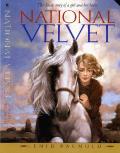
“National Velvet” by Enid Bagnold

April 19, 2010 by Sonia Connolly Leave a Comment

I received this book, originally published in 1935, with a childhood gift of six classic Young Adult novels. I’ve carried the set from home to home ever since, but hadn’t reread any of the books in many years.

Before I send the set off to my niece and nephew, I decided to reread “National Velvet,” since the image of Velvet struggling with her unruly stomach had been coming to mind.

I remembered the essence of the book – horse-mad young Velvet rides and wins a steeplechase race – but had forgotten most of the details, including that the story takes place in England.

The writing is gorgeously evocative. Here is the opening paragraph:

Unearthly humps of land curved into the darkening sky like the backs of browsing pigs, like the rumps of elephants. At night when the stars rose over them they looked like a starlit herd of divine pigs. The villagers called them Hullocks.

I paused there in my reading to imagine the Hullocks, reminded of a village I visited in southern England, ensconced in a narrow valley dropping to the sea.

It turns out that Velvet grows up in just such a village with her three older sisters, much younger brother, solid parents, and butcher’s assistant Mi Taylor. Their cramped living quarters are attached to her father’s slaughterhouse. Mi lives in an outbuilding, and their old horse has a rickety barn.

The girls seem young for their ages by modern standards. At fourteen, Velvet prances about pretending to ride paper horses. Her seventeen year old sister has her first beau. The girls can ride alone for miles among the Hullocks, but their mother tells them what to wear to the village fair. The family shares few words but much love.

I recommend reading this book for the layered details of village life and relationships. I was less interested in the wish-come-true plot, although to be fair I’m considerably older than the target audience of the book. There are sub-themes about news and fame and innocence which provide food for thought.

Available at bookshop.org.

Filed Under: fiction Tagged With: illustrated, young adult

  • « Go to Previous Page
  • Page 1
  • Interim pages omitted …
  • Page 11
  • Page 12
  • Page 13
  • Page 14
  • Page 15
  • Go to Next Page »

Primary Sidebar

Recent Books

  • “How We Show Up” by Mia Birdsong
  • “The Enchanted Greenhouse” by Sarah Beth Durst
  • “What It Takes to Heal” by Prentis Hemphill
  • Kitchens of Hope by Linda S. Svitak and Christin Jaye Eaton with Lee Svitak Dean
  • “Very Far Away From Anywhere Else” by Ursula K Le Guin
  • “Seaward” by Susan Cooper
  • “Surviving Domestic Violence” by Elaine Weiss
  • “The Book of Love” by Kelly Link
  • “Alexandra’s Riddle” by Elisa Keyston
  • “Weaving Hope” by Celia Lake

Tags

activism aging anti-racism bodywork business childhood abuse childrens CivicTech communication disability domestic violence fantasy feminism finance Focusing food fun healing health at any size illustrated Judaism leadership lgbt marketing memoir music natural world neurodiversity politics psychology relationship romance science science fiction software spirituality survival story trauma writing young adult

Categories

Archives

Please note: bookshop.org and Amazon links are affiliate links. Copyright © 2026 · Genesis Sample on · WordPress