• Skip to primary navigation
  • Skip to main content
  • Skip to primary sidebar
Curious, Healing

Curious, Healing

Books about healing, business, and fun

  • About Sonia Connolly

nonfiction

“Visceral Manipulation” by Jean-Pierre Barral & Pierre Mercier

June 23, 2019 by Sonia Connolly 2 Comments

book cover

Recommended to me by: Required for the Visceral Manipulation class

A highly technical textbook for the Visceral Manipulation class. Some anatomical terms are defined, and some aren’t. Some are illustrated, and some aren’t. The book seems directed at medical doctors (“order radiographs when indicated”) and at the same time seems slightly defensive when describes experiments demonstrating results from these techniques.

For each internal organ, anatomy and relationships to other organs are precisely described, along with possible variations and disorders. The mobility (motion with breathing) and motility (intrinsic motion) of each organ is also described, along with manual techniques to improve these motions. I’m assuming the class will make all this clearer – these are not techniques to learn from a book, even with the included photographs.

Available at IAHE.

Filed Under: nonfiction Tagged With: bodywork, illustrated

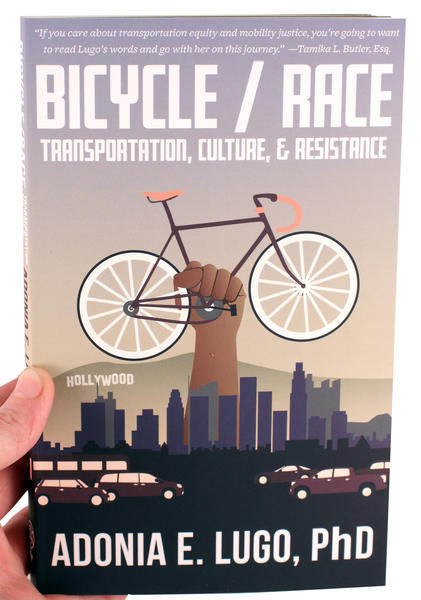
“Bicycle/Race” by Adonia E. Lugo, Phd

May 27, 2019 by Sonia Connolly Leave a Comment

book cover

Subtitle: Transportation, Culture, & Resistance

Recommended to me by: Elly Blue

Adonia Lugo gives us both a warm memoir and a carefully researched overview of her anthropological study of racism in bicycling activism. She shares her background as a half-Mexican, half-white girl growing up in San Juan Capistrano in Southern California, her joyful involvement with bicycling as transportation while studying in Portland, and her direct experiences of racism and resistance as she pursued her PhD research. As part of it, she helped create the first cicLAvia in LA, where streets are closed to cars and opened to bicyclists and pedestrians.

Race and mobility are intertwined because we designed segregation into our built environments and how we police them, and racial equity in the distribution of public money isn’t a metaphor or a goal you opt into; it’s a legal obligation, thanks to the civil rights movement. I wasn’t pointing to the culture of white supremacy embedded in bike advocacy, policy, and planning because I wanted to cause trouble; it was about fulfilling the promise of our shared democracy.

She writes about the successive waves of colonization and conquest that shaped Southern California, the role of racism in people’s preference for private cars, selective police enforcement against people of color, and the reinforcement of white supremacy in the networks of people who set public policy. She writes about how her family’s loving support gave her the confidence to try to create change, and how she realized that entrenched systems were resisting her efforts.

Highly recommended! I read it a chapter or two at a time, with pauses to digest the information about the racist underpinnings of US culture and transportation.

Available at Microcosm Publishing.

Filed Under: nonfiction Tagged With: activism, anti-racism, feminism, illustrated, memoir, politics

“Running on Empty” by Jonice Webb, PhD

April 16, 2019 by Sonia Connolly 1 Comment

book cover

Subtitle: Overcome Your Childhood Emotional Neglect

Emotional neglect is the whitespace between parental actions, what didn’t happen rather than what did happen. Lack of emotional connection, not paying attention, and not responding competently to the child’s emotional needs. The parent sees the child as an extension of themselves, a possession, or a burden, rather than a separate person.

The book describes twelve kinds of emotionally neglectful parents, with brief vignettes. The twelfth kind is the most common, “Well Meaning But Emotionally Neglected Themselves” parents.

Some effects of emotional neglect:

Some effects of emotional neglect are

  1. Feelings of Emptiness
  2. Counter-dependence (not depending on anyone)
  3. Unrealistic Self-Appraisal (not being mirrored by parents, lack of self-understanding)
  4. No Compassion for Self, Plenty for Others
  5. Guilt and Shame; What is Wrong with Me?
  6. Self-Directed Anger, Self-Blame
  7. The Fatal Flaw (If People Really Know Me They Won’t Like Me)
  8. Difficulty Nurturing Self and Others
  9. Poor Self-Discipline
  10. Alexithymia: Poor Awareness and Understanding of Emotions

There is also a brief, respectful chapter on suicidal feelings.

The second part of the book is “Filling the Tank.” It starts by talking about how change happens, gradually, with some setbacks, requiring ongoing persistence to move through avoidance and discomfort.

The sections on how to fill in missing parenting by acquiring new habits are trying to be helpful, but they feel glib and superficial. “Keep practicing these skills you never learned, you’ll get there eventually!” Topics include boundaries, emotional fluency, self-care, diet and exercise, and kind self-talk.

In the brief section on relationships, there is a useful tip on horizontal and vertical questioning. Horizontal questions ask for information and can be answered quickly. Vertical questions ask the person to turn inward to find and share understanding.

The chapter on parenting encourages stepping away from guilt and filling up yourself to be able to fill up your child.

The final chapter, for therapists, felt more helpful. Here is how to really help someone who was emotionally neglected, by providing what they missed out on, rather than the previous chapters that seem to say, “Figure this out for yourself.”

It is important to name and recognize Emotional Neglect in ourselves and others. The ideas in this book are groundbreaking and crucial. The self-help format does not quite work, but it is still worth reading. It reminds me of The Emotionally Absent Mother by Jasmin Lee Cori, which covers related ground with more focus on understanding what was missing and less focus on self-help.

Available at bookshop.org.

Filed Under: nonfiction Tagged With: healing, psychology, trauma

“shadow daughter” by harriet brown

March 23, 2019 by Sonia Connolly Leave a Comment

book cover

Subtitle: A Memoir of Estrangement

Recommended to me by: Body Impolitic

A powerful, lyrical book about Harriet Brown’s complicated relationship with her difficult mother, including estrangement, and about family estrangement in general. She describes her ambivalence and self-blame in the face of anecdotes demonstrating dramatic emotional abuse, as well as the long process of naming her own truth.

The book also covers estrangement in general, both the pressures against it and the reasons for it. She interviews and quotes from other people who have gone through estrangement, and researchers into the topic.

She brings in estranged parent forums with both clarity about their self-deception and defensiveness, and empathy as well. There is a sense of bending over backwards to be fair.

The lower case title and author name on the cover make me sad on Harriet Brown’s behalf. I wonder if they were her choice, or a marketer’s design.

I am fascinated by the way Harriet Brown continues to put a lot of effort into family relationships, despite the ruptures and judgements stemming from her estrangement with her mother. She skillfully navigates those tricky waters.

I read the book cover to cover in an evening. Highly recommended if you have had to walk away or strongly limit an important family relationship, or if you want to understand that process better.

More stories by Harriet Brown on her website.

Available at bookshop.org.

Filed Under: nonfiction Tagged With: childhood abuse, healing, memoir, survival story, trauma

“Stop Caretaking the Borderline or Narcissist” by Margalis Fjelstad, Phd

March 23, 2019 by Sonia Connolly Leave a Comment

book cover

Subtitle: How to End the Drama and Get on with Life

Recommended to me by: a client

A clear analysis and set of tools for bringing your energy back to yourself when you have been wrapped up in caretaking someone who is volatile and focused on themselves. In the book, persistently difficult people are labeled as narcissists or borderlines, or BP/NP for short. I have hesitations about casually throwing around psychological diagnoses and prefer to focus on problematic behaviors, such as the inability to see others’ point of view.

Accept that the difficult person will not suddenly become empathic and considerate. Move out of the drama triangle (persecutor, rescuer, victim) into the caring triangle (assertiveness and doing, caring and choice, acceptance and self-responsibility). I like having a clear alternative to the drama triangle. Practice saying no, disengaging from arguments, and saying what you want. Take concrete actions to make your life better, possibly including ending or severely curtailing the relationship.

Recommended for anyone fed up with the caretaker role in relationships with persistently difficult people.

Available at bookshop.org.

Filed Under: nonfiction Tagged With: psychology, relationship

“It’s Ok that You’re Not Ok” by Megan Devine

February 19, 2019 by Sonia Connolly 3 Comments

book cover

Subtitle: Meeting Grief and Loss in a Culture That Doesn’t Understand

Recommended to me by: Robyn Posin

The way our culture deals with grief is vastly broken. We treat it as a problem to be solved rather than as an experience to be carried. We shame grieving people for not doing the process “right” (what does that even mean) rather than listening to and accompanying them. We spout platitudes like, “It’s all for the best,” to separate ourselves from the reality of loss.

Megan Devine shares about her own catastrophic grief at the accidental death of her husband at age 40, and offers support for others going through grief.

Pain is a healthy, normal response when someone you love is torn from your life. It hurts, but that doesn’t make pain wrong.

Suffering comes when we feel dismissed or unsupported in our pain, and when we thrash around inside our pain, questioning our choices, our “normalcy,” our actions and reactions.

She advises experimenting to see what helps even a tiny bit in the depths of grief. What lets you feel companioned in your pain. What lessens the suffering. What supports wellness and avoids “worseness.” What are your internal signals of overwhelm, and what to do about it.

She addresses how (and why) to stay alive, physical and mental effects of grief, how to manage anxiety, and why to make some kind of art to express your grief. Advice to supporters is: listen. Don’t try to fix, minimize, or put the focus on yourself. Listen.

The last section of the book addresses how to handle would-be supporters’ missteps, and how to help them be more helpful.

The word trauma is only mentioned once in the book, even though it focuses on traumatic sudden losses. I wonder how much the combination of trauma and grief can be eased with trauma healing techniques.

Highly recommended to anyone who has been knocked down by grief, or had a friend knocked down by grief. (That’s just about everyone.)

Megan Devine blogs and runs online Writing Your Grief support groups at her website, Refuge in Grief.

Available at bookshop.org.

Filed Under: nonfiction Tagged With: healing, memoir, psychology

  • « Go to Previous Page
  • Page 1
  • Interim pages omitted …
  • Page 11
  • Page 12
  • Page 13
  • Page 14
  • Page 15
  • Interim pages omitted …
  • Page 48
  • Go to Next Page »

Primary Sidebar

Recent Books

  • “How We Show Up” by Mia Birdsong
  • “The Enchanted Greenhouse” by Sarah Beth Durst
  • “What It Takes to Heal” by Prentis Hemphill
  • Kitchens of Hope by Linda S. Svitak and Christin Jaye Eaton with Lee Svitak Dean
  • “Very Far Away From Anywhere Else” by Ursula K Le Guin
  • “Seaward” by Susan Cooper
  • “Surviving Domestic Violence” by Elaine Weiss
  • “The Book of Love” by Kelly Link
  • “Alexandra’s Riddle” by Elisa Keyston
  • “Weaving Hope” by Celia Lake

Tags

activism aging anti-racism bodywork business childhood abuse childrens CivicTech communication disability domestic violence fantasy feminism finance Focusing food fun healing health at any size illustrated Judaism leadership lgbt marketing memoir music natural world neurodiversity politics psychology relationship romance science science fiction software spirituality survival story trauma writing young adult

Categories

Archives

Please note: bookshop.org and Amazon links are affiliate links. Copyright © 2025 · Genesis Sample on · WordPress