• Skip to primary navigation
  • Skip to main content
  • Skip to primary sidebar
Curious, Healing

Curious, Healing

Books about healing, business, and fun

  • About Sonia Connolly

“Your Body Knows the Answer” by David I. Rome

March 13, 2016 by Sonia Connolly 1 Comment

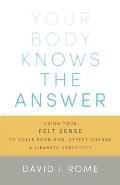
book cover

Subtitle: Using Your Felt Sense to Solve Problems, Effect Change & Liberate Creativity

This is a gentle, step by step introduction to Focusing, with exercises for each section and personal annotated examples of Focusing sessions. David Rome calls his approach Mindful Focusing. He explains how to be with ourselves in a Focusing way without a Companion to hold space for us.

It starts with GAP, Grounded Aware Presence. Settle into the support of your chair, or the ground if you’re standing. Notice the sights and sounds of your environment. Sense into your heart and breathing, right in this moment. I like the quick simplicity of that.

The second exercise is friendly attending, being with whatever comes the way we would be with a shy frightened creature, available, observant, warm, allowing it to approach when it’s ready.

The book continues with gateways to the felt sense (mind, body, emotions), and working with felt senses in the context of specific situations. The second half talks about finding actions steps, deep listening with others, and working with conflicts.

There are a lot of words about how to find a felt sense and how to interact with it. I’m still not sure when I’m in contact with one and when I’m in contact with something different (but what would that be). It seems to be part of Focusing for me to be uncertain if I’m doing it right.

Recommended for people interested in exploring Focusing, especially those already familiar with mindfulness practice.

Available at bookshop.org (half-price on remainder as of 12-Mar-2016).
Filed Under: nonfiction Tagged With: Focusing, healing, psychology

“The Body Keeps the Score” by Bessel van der Kolk

March 7, 2016 by Sonia Connolly Leave a Comment

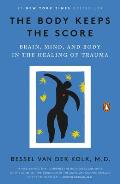
book cover

Subtitle: Brain, Mind, and Body in the Healing of Trauma

This book is intense to read. I dipped in and out, wanting to read it, but not wanting to get overwhelmed with the dramatic abuse stories that are included. There is a lot of great research on trauma here, lucidly and understandably presented. I was happy to notice that I already knew about most of it, partly because I took a two day seminar with Bessel van der Kolk a few years ago.

The one treatment that was new to me was Albert Pesso’s and Diane Boyden-Pesso’s psychomotor therapy with “structures”, where one person, the protagonist, places other people from the group in a 3-D representation of their internal landscape. It’s reparative, including ideal parents as well as parents as they actually were. The therapist makes witnessing statements and carefully tracks the physical and emotional reactions of the protagonist, helping them feel safe and seen. Pesso Boyden System Psychomotor Therapy

This book talks about the most extreme effects of trauma. Adults who can’t feel their bodies at all. Kids who act out and get treatment rather than quietly going to school. It also talks about intensive interventions by skilled practitioners. It feels both daunting and tantalizing.

At the same time, it’s reassuring in a sense. If I don’t have all those dramatic symptoms, maybe I’m doing something right all this time.

I had Opinions about some of van der Kolk’s statements. His organization focuses on treating traumatized children, because that gives them the most leverage. On the one hand, yes, that makes sense. On the other hand, way to tell a whole lot of traumatized adults that we don’t matter – again. My sense is that both are equally important, even from a leverage point of view. Those healing children need healing adults around them.

He also thinks research is more important than “deep, subjective resonance.” Yes, research is important, and I’m glad he’s doing it. At the same time, my body says deep subjective resonance is more important for healing.

Recommended as an overview of current scientific thinking on trauma mechanisms and healing.

Available at bookshop.org.

Filed Under: nonfiction Tagged With: psychology, trauma

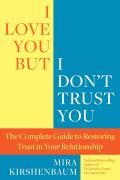
“I Love You But I Don’t Trust You” by Mira Kirshenbaum

March 5, 2016 by Sonia Connolly Leave a Comment

book cover

Subtitle: The Complete Guide to Restoring Trust in Your Relationship

This book really is what it says on the tin. Mira Kirshenbaum is a couple’s therapist who shares both her own and clients’ stories to illustrate the stages of responding to betrayal and rebuilding trust.

  • How to evaluate whether the relationship is worth investing in
  • How to manage the anger which is a natural response to betrayal
  • The need for evidence that the betrayer cares
  • The need for the betrayer to see the situation from the betrayed person’s point of view.
  • Reconnecting with the good aspects of the relationship
  • Discuss root causes without (hearing) blame
  • Discuss needs and how to meet them
  • The (eventual) decision to forgive

The book is compassionate to both sides. Yes, big mistakes happen. They are sometimes not forgivable. The betrayed person naturally feels a strong need to re-establish safety, and may not use the most skilled techniques to achieve that.

There are no “shoulds” about leaving or staying. While the book naturally focuses on relationships that are worth rebuilding, there are also clear call-outs for danger signs, such as people who are power-seeking for its own sake, or people who are suspicious for its own sake, or relationships that don’t have enough good in them to be worth the work.

Small ongoing betrayals such as unreliability are addressed, as well as big betrayals like affairs or squandering shared money. Ongoing power imbalances can also be a source of mistrust. There is an in-depth discussion of differences in being open or hidden causing mistrust.

I winced at the section title, “Sleeping in a Nazi’s bed.” As a grandchild of Holocaust survivors, I am emphatically not a fan of metaphorical Nazis. But the author meant real Nazis! Her mother was a German Jew who survived the Holocaust, and brought her safely out of Germany afterward. When she went back to Germany to visit as a young adult, a sudden illness caused her to accept the hospitality of kind strangers who were admittedly Nazis during the war. She talks about how trust can make sense, even though we have reason to be mistrustful.

Sadly, all the couples in this book are heterosexual, and there’s no indication they’re anything other than white. And it was published in 2012! On the positive side, the men and women are depicted as having a variety of frailties and strengths, and a variety of relationships together.

Recommended for a better understanding of trust, betrayal, and relationship dynamics.

Available at bookshop.org.

Filed Under: nonfiction Tagged With: communication, psychology

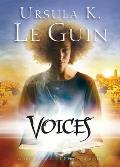
“Voices” by Ursula K. Le Guin

March 5, 2016 by Sonia Connolly Leave a Comment

book cover

Recommended to me by: adrian-turtle on dreamwidth.

This sequel to Gifts is much more comfortable to read. Rather than being about households polarized and divided by their powers, it is about a harshly occupied city where the people are known for “having peace in their bones.”

The city-dwellers are people of color, and the invaders are white. In the 17-year seige, many mixed-race children of rape have been born, including the protagonist, Memer. She seems to accept her mixed heritage matter-of-factly, while hating the invaders for their killing, destruction, and ongoing oppression.

It is reassuring to read about alternatives to retaliation and violence even with such apparently evil invaders. Sometimes annexation is a victory, or at least better than other available options.

A woman wants to take a risk and a man (caringly) tells her she shouldn’t. She takes the risk anyway – and nothing bad happens! I hadn’t realized how deeply I had internalized the moralistic unhappy ending that keeps women shut up in their houses, until I paused reading at the argument because I didn’t want to read about the woman being hurt for daring to be out in the world. I’m so glad that’s not how it went, this time.

Gender is relatively fluid in this book. Women and girls change their hairstyle and clothes, and easily pass as men or boys. Perhaps it is a skill learned out of necessity, or perhaps the invaders see so few women, in such limited circumstances, that they cannot recognize them in other environments.

And, it is lovely to see the main characters from Gifts again, grown into kind, powerful adults.

Available at bookshop.org.

Filed Under: fiction Tagged With: fun, young adult

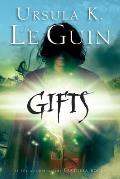
“Gifts” by Ursula K. Le Guin

February 20, 2016 by Sonia Connolly 1 Comment

book cover

Recommended to me by: Referenced in The Opposite of Rape Culture is Nurturance Culture blog post.

This is not a comfortable book to read. At first it feels irritatingly simplistic and aimed at young readers, but with not enough happening. Then it feels irritatingly complex with not enough answers to hard questions.

What if the best we can do with destructiveness inside us is do nothing, hold still, for a really long time. What if we lose what really matters to us. What if the people around us are doing the best they can with their destructiveness and lack of resources. What if, eventually, there is less destructiveness and we have more options than we thought.

In her essay, Nora Samaran uses “Gifts” as an example of needing to look at something backwards, violence vs. nurturance. “Gifts” doesn’t talk directly about nurturance, although the two young people at its center are shown to be attuned to each other, and there is some gruffly attuned parenting as well.

An uneasy, thought-provoking read, with layers.

Available at bookshop.org.

Filed Under: fiction Tagged With: fun, young adult

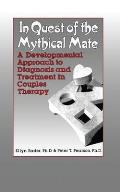
“In Quest of the Mythical Mate” by Ellyn Bader and Peter Pearson

February 18, 2016 by Sonia Connolly Leave a Comment

book cover

Subtitle: A Developmental Approach to Diagnosis and Treatment in Couples Therapy

Recommended to me by: Robyn Posin

This is a carefully crafted book about effective, compassionate couples therapy, including a clear theoretical framework and practical suggestions for diagnosis and treatment. I’m guessing the title was created by a marketing department, because it doesn’t fit the book at all (to my relief).

Their framework is that relationships go through stages just as children do. The stages are named symbiotic (we are so alike), differentiating (how do we work out differences), practicing (turning outward independently), and rapprochement (turning back toward the relationship). The members of a couple can be at different stages, for example symbiotic-differentiating, or symbiotic-practicing. All the stages are important and valuable. The symbiotic stage is expected and helps create a strong foundation for the relationship.

Diagnosis is made through talking with the couple, questionnaires about problems and goals, and through a “paper exercise” – giving a couple a blank piece of paper and telling them, “This represents something very important to each of you. You have 5 minutes to work out who will get to hold it.”

There are a lot of case histories, including one lesbian couple and one couple with a woman of Japanese ancestry. I would have liked to see more diversity, although I suppose this isn’t bad for a book from the 80’s.

The therapists are perceptive, compassionate, and direct. They name inappropriate behavior, and teach their clients healthier alternatives.

Recommended for people interested in couple dynamics and effective therapy.

Available at bookshop.org.

Filed Under: nonfiction Tagged With: communication, psychology

  • « Go to Previous Page
  • Page 1
  • Interim pages omitted …
  • Page 33
  • Page 34
  • Page 35
  • Page 36
  • Page 37
  • Interim pages omitted …
  • Page 70
  • Go to Next Page »

Primary Sidebar

Recent Books

  • “How We Show Up” by Mia Birdsong
  • “The Enchanted Greenhouse” by Sarah Beth Durst
  • “What It Takes to Heal” by Prentis Hemphill
  • Kitchens of Hope by Linda S. Svitak and Christin Jaye Eaton with Lee Svitak Dean
  • “Very Far Away From Anywhere Else” by Ursula K Le Guin
  • “Seaward” by Susan Cooper
  • “Surviving Domestic Violence” by Elaine Weiss
  • “The Book of Love” by Kelly Link
  • “Alexandra’s Riddle” by Elisa Keyston
  • “Weaving Hope” by Celia Lake

Tags

activism aging anti-racism bodywork business childhood abuse childrens CivicTech communication disability domestic violence fantasy feminism finance Focusing food fun healing health at any size illustrated Judaism leadership lgbt marketing memoir music natural world neurodiversity politics psychology relationship romance science science fiction software spirituality survival story trauma writing young adult

Categories

Archives

Please note: bookshop.org and Amazon links are affiliate links. Copyright © 2025 · Genesis Sample on · WordPress