• Skip to primary navigation
  • Skip to main content
  • Skip to primary sidebar
Curious, Healing

Curious, Healing

Books about healing, business, and fun

  • About Sonia Connolly

feminism

“Saber es Poder” by Maxine Harris, Fabiana Wallis, Hortensia Amaro

September 2, 2012 by Sonia Connolly 2 Comments

Subtitle: Modelo de Trauma y Recuperación para Mujeres Latinas

Translation: Knowledge is Power: Model of Trauma and Recovery for Latina Women

Recommended to me by: Fabiana Wallis’ bio at Conexiones

This book is a curriculum for a 25-session trauma recovery support group for Latina women. Since I hope to work with Conexiones Center for Trauma Recovery as a practitioner, my goal was to refresh my Spanish language skills and learn the vocabulary associated with trauma and recovery. It served that goal well.

The book also included specific information about Latino/a culture and issues for immigrants.

I read this book as both a practitioner helping people recover from trauma, and as a daughter of immigrants from Latin America who experienced trauma. I fit the target reader in some ways and not in others, especially since the book assumes a sharp separation between facilitators and group members.

The information was very basic, aimed at group participants who had never thought about trauma and its connection to present behaviors. There was recurring emphasis on the issues of drug use, prostitution, and unprotected sex. There was no discussion of the mechanisms of PTSD in the body.

In the various units, I saw identification of the damage wrought by trauma, but less help in building new skills than I expected. I imagine a woman reaching the end of the support group and thinking, “Now what?!” At the same time, I imagine that the opportunity to speak about past trauma and receive support would be healing in itself.

When used by knowledgeable and compassionate group facilitators, I think this book would form the basis for a useful, culturally aware support group for Latina survivors of abuse.
Filed Under: nonfiction Tagged With: anti-racism, domestic violence, feminism, psychology, trauma

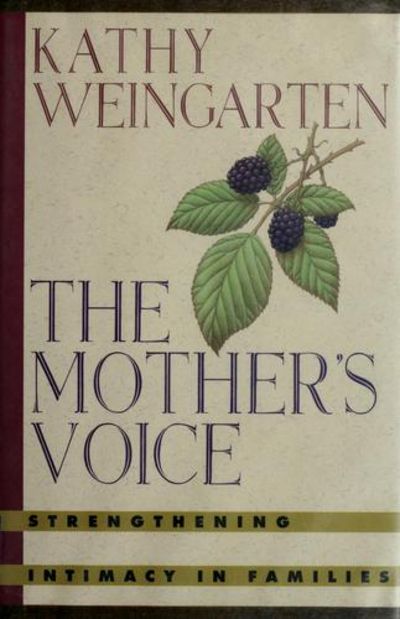
“The Mother’s Voice” by Kathy Weingarten

November 12, 2011 by Sonia Connolly Leave a Comment


Subtitle: Strengthening Intimacy in Families

I read this by coincidence, and it fits perfectly with themes I’ve been thinking about lately. Kathy Weingarten, a family therapist, addresses double binds that society creates for women around acceptable roles and definitions of success. She talks about dominating behaviors in men and how to address them. She weaves her personal story of motherhood, illness, and family together with societal trends. Throughout, she maintains awareness of intersectional issues of race, class, sexual orientation, and gender.

When she was diagnosed with breast cancer, she realized that her need to focus on her health conflicted directly with her need to be a “good mother” by focusing wholly on her pre-adolescent children. This contrast brought to light the invisible constraints society placed on her thoughts about mothering. She includes thoughts about the roles of wives and fathers as well.

At age 7, her son bullied her daughter, then 3 years old. She withdrew from his dominating behavior, and had to consciously reconnect with him. As she connects with him as “like her” rather than disconnecting as “alien, unlike her,” she has leverage to change the roles society prescribes for boys, sons, and men, as well as for mothers.

When she shares her true feelings and thoughts with her children in age-appropriate ways rather than maintaining a perfectly serene front, she builds real connections with them and allows them to see her as a separate person.

I appreciate how much consciousness and intention Weingarten brings to her mothering.

Some passages become repetitive, perhaps in an attempt to convince the reader, but that is a minor flaw. Overall, this is a beautifully written, carefully thought out, intimate gift of a book. Highly recommended.

Available at biblio.com

Filed Under: nonfiction Tagged With: communication, feminism, memoir, psychology

“The Female Man” by Joanna Russ

May 25, 2011 by Sonia Connolly Leave a Comment

Recommended to me by: wordweaverlynn

Joanna Russ died recently, and many people have been posting tributes to her visionary feminist writing. I had heard of her, but not read her books. Someone linked to her short story When It Changed (full version at the link) and I wanted to read more.

Reading “The Female Man” is a bumpy ride. One always starts a book disoriented, looking for cues about what governs the setting and characters. All the way through, I was still looking for cues, still waiting to get oriented.

I loved the descriptions of Whileaway, a planet with only women. I could quibble with some of the authorial choices (everyone has babies around age 30, all children are taken from their mothers at age 5), but the relief of a society without patriarchy overrides all that.

I winced at the descriptions of the world of typical (middle class, white) women in the 1960’s. Again, I could quibble with some of the details, but there is too much painful truth there, and too much of it is still true.

“But I don’t like it,” she said simply. You’re not supposed to do that. On Whileaway, perhaps, but not here. […]

He takes her hand and closes her fingers around the glass, shaking his forefinger at her playfully: “Come on now, I can’t believe that; you made me get it for you—”

The third setting, a dystopia divided into Manland and Womanland, left me cold. I nearly stopped reading because of the sudden violence and contempt for gender-variance.

The book starts with a quote from “The Politics of Experience” about the layers of invalidation involved in the dynamics between men and women. With courage and clarity, this book cuts through all that. “Here is my truth! Here is my experience!”   I can see how it would be a lifeline to women drowning in invalidation.

Available at bookshop.org.

Filed Under: fiction Tagged With: feminism

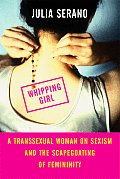
“Whipping Girl” by Julia Serano

May 13, 2011 by Sonia Connolly 1 Comment

Subtitle: A transsexual woman on sexism and the scapegoating of femininity

An illuminating book. Julia Serano describes her own experience as a transsexual woman, including the identities she explored before deciding to transition, and the internal and external changes she noticed during transition. She uses her experiences, carefully supported with research, to call out some of our societal assumptions and prejudices about gender.

She proposes that we all have a subconscious sex from birth. For people in whom it matches the body’s sex, it remains unnoticed, and leads to the assumption that it matches for everyone. For people in whom it does not match, it causes ongoing deep pain and sadness. Changing the body’s sex and gender presentation relieves the pain and leads to a sense of rightness instead.

She argues that rather than being marginal in feminism, the treatment of transsexual women is a central issue. Transsexual women are discriminated against because they have chosen to move from a societally more valued class – men – to a societally less valued class – women. She sees transsexual men receiving much less discrimination because they don’t violate the societal preference for maleness.

She notes in the introduction that her biggest challenge in writing the book is addressing several audiences: transsexual people, non-trans academics in women’s, queer, and gender studies, and those who want to learn more about transsexuality and feminism. I fall in the third camp, and found myself less engaged by detailed discussions of academic framing of transsexuality, or interpersonal politics in LGBT groups.

At the same time, I’m glad the material was there. Now I’m aware that many academics view gender as entirely socially constructed, and that transsexuals tend to be marginalized in LGBT groups because many of them express gender in a more stereotypically masculine or feminine way.

She argues that it is femininity itself which is devalued and under attack, being equated with weakness, passivity, and artifice. I see her point that she became more connected with her emotions when she started taking estrogen, and that emotions are devalued in our culture. I also see that women (and men) can enjoy dressing up to please themselves.

At the same time, I struggled with her assertion that femininity is natural. Many attributes I associate with femininity (rather than femaleness) are artificial and mandated by the patriarchy: dieting, makeup to appear youthful, hair sculpted with toxic chemicals, high heels, uncomfortable movement-impairing clothing, etc.

I agree that we need to accept each person’s gender expression as equally valuable, while also working to remove patriarchal manipulations of the expression of femininity (and masculinity as well).

Highly recommended to anyone interested in better understanding feminism, sexism, and transsexuality.

Available at bookshop.org.

Filed Under: nonfiction Tagged With: feminism, lgbt, memoir

  • « Go to Previous Page
  • Page 1
  • Interim pages omitted …
  • Page 5
  • Page 6
  • Page 7

Primary Sidebar

Recent Books

  • “We Belong to the Drum” by Sandra Lamouche and Azby Whitecalf
  • “Atlas of the Heart” by Brene Brown
  • “Life After Cars” by Sarah Goodyear, Doug Gordon, Aaron Naparstek
  • “Tidy First?” by Kent Beck
  • “When You Had Power” and “You Knew the Price” by Susan Kaye Quinn
  • “Taproot” by Keezy Young
  • “The Tower at Stony Wood” by Patricia A McKillip
  • “Hospicing Modernity” by Vanessa Machado de Oliveira
  • “How We Show Up” by Mia Birdsong
  • “The Enchanted Greenhouse” by Sarah Beth Durst

Tags

activism aging anti-racism bodywork business childhood abuse childrens CivicTech communication disability domestic violence fantasy feminism finance Focusing food fun healing health at any size illustrated Judaism leadership lgbt marketing memoir music natural world neurodiversity politics psychology relationship romance science science fiction software spirituality survival story trauma writing young adult

Categories

Archives

Please note: bookshop.org and Amazon links are affiliate links. Copyright © 2026 · Genesis Sample on · WordPress