• Skip to primary navigation
  • Skip to main content
  • Skip to primary sidebar
Curious, Healing

Curious, Healing

Books about healing, business, and fun

  • About Sonia Connolly

healing

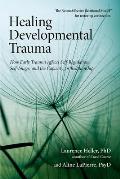
“Healing Developmental Trauma” by Laurence Heller, PhD and Aline LaPierre, PsyD

March 17, 2015 by Sonia Connolly Leave a Comment

book cover

Subtitle: How Early Trauma Affects Self-Regulation, Self-Image, and the Capacity for Relationship

The first section of this book is focused on analysis and categorization. It describes five adaptive survival styles in response to developmental ruptures in connection, attunement, trust, autonomy, and love and sexuality. I found this part dry and off-putting, and skimmed through it.

The second section narrows the focus to the connection adaptive style in response to very early trauma, abuse, and neglect. It describes physiological responses to trauma and shares several transcripts of therapy sessions. This section was much more engaging and useful. The therapeutic style is named NeuroAffective Relational Model, abbreviated NARM throughout.

Therapists are recommended to be non-judgmental, present, authentic, gentle, and attuned with the client. Careful tracking of the client’s responses allows alternation between expansion and contraction, with emphasis on positive expansion. Anger and aggression are recognized as natural, necessary responses to trauma. Unresolved defensive-orienting responses to trauma linger in tension around the eyes and narrowed field of vision, so working with eyes and gaze is useful. Therapeutic touch is a resource to repair early neglect.

Recommended as an introduction to the differences between shock trauma and developmental trauma, with some body-centered and client-centered techniques to help.
Available at bookshop.org.

Filed Under: nonfiction Tagged With: childhood abuse, healing, psychology, trauma

“Overcoming Trauma Through Yoga” by David Emerson and Elizabeth Hopper

February 12, 2015 by Sonia Connolly 1 Comment

Subtitle: Reclaiming Your Body

Recommended to me by: a client

This book is divided into three parts: a general introduction to the history of trauma treatment and PTSD, a suggested yoga practice for traumatized people, illustrated with photographs, and suggestions for offering trauma-sensitive yoga for clinicians and yoga teachers.

Throughout the book, it is clear that these people get it. They emphasize choice, empowerment, and reconnecting with the body. From Stephen Cope’s foreword: “Sometimes we encounter experiences that so violate our sense of safety, order, predictability, and right, that we feel utterly overwhelmed […]. Unable to bear reality. We have come to call these shattering experiences trauma.”

Trauma involves being helpless to avoid pain. In trauma-sensitive yoga, students are repeatedly encouraged to change postures if they are painful, and instructions emphasize choice and control over their own bodies. Students are encouraged to attend to their own experience, rather than trying to get postures “right”.

There were two instructions in the book that seemed less well-attuned to traumatized yoga students. One is to “lift the crown of the head,” without explaining how to find a balanced upright posture for the head. The other is to “hug in and around the lower belly” to activate core muscles. Many traumatized people chronically clench their bellies already.

Trauma-sensitive yoga classes move slowly to give students time to connect with their physical experience. “Physical assists” (touching students) is done rarely, with permission, and with careful attention to possible triggering effects. Thought is given to the props available – many trauma survivors find straps triggering because of having been restrained, so the book suggests not having straps in the room.

“In teaching trauma-sensitive yoga, the job of the yoga teacher is not to create artificial challenges—many of our students have already challenged themselves more than we may ever know just by showing up. The work of the teacher is to cultivate enough safety so that students can challenge themselves as they are ready, and in ways they feel safe.”

Highly recommended for its compassionate approach to anyone dealing with trauma or traumatized people.

Available at bookshop.org.

Filed Under: nonfiction Tagged With: bodywork, healing, illustrated, psychology, trauma

“The Art of Empathy” by Karla McLaren

November 3, 2014 by Sonia Connolly Leave a Comment

Subtitle: A Complete Guide to Life’s Most Essential Skill

Recommended to me by: Reading The Language of Emotions

The first part of this book analyzes the six components of empathy, including the ability to sense emotions internally, sense emotions of others, and manage emotions. It continues with a recap of the material in The Language of Emotions, including the recommended skills of burning contracts, conscious complaining, and rejuvenation.

It’s a dense book, and I did not have time to continue before returning it to the library. I’m noting it here because I do want to get back to it eventually, and I think it can be useful for people who are curious about empathy.

Available at bookshop.org.

Filed Under: nonfiction Tagged With: healing, psychology

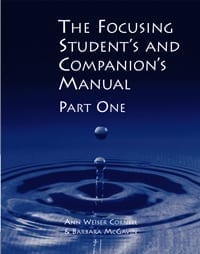
“The Focusing Student’s and Companion’s Manual” by Barbara McGavin and Ann Weiser Cornell

September 21, 2014 by Sonia Connolly Leave a Comment

Recommended to me by: Jael Emberley

I took Focusing classes I and II from Jael Emberley, and bought both parts of the manual, even though the second part is for classes III and IV. Both parts are written in clear, friendly language, and delightfully illustrated by Mary Ferris. Her expressive line drawings of anthropomorphized hares capture the subtleties and humor of Focusing.

Focusing is paying attention inside to an unfolding felt sense about an issue or situation. Somatic Experiencing includes a lot of Focusing. I read Part Two now to learn more about how to be present with merging and exiling of internal “something”s. Suggestions include

  • Use presence language. “I sense something in me that feels overwhelmed.”
  • Turn toward the Something that has Feelings about the Feeling, and might be saying things like, “I don’t want to be scared!” “It’s bad to be angry.”
  • Notice behaviors that come out of Feelings about Feelings, like rushing the process, forcing a choice, analyzing, diagnosing, deciding, fixing, doubting, arguing, and especially criticizing.
  • For critics, sense for what they’re not wanting.
  • Acknowledge parts that are trying to force other parts to Do It Right.
  • Exiling – something is judged as so bad and dangerous it is removed from awareness. As it comes back, the symbols for it might move from inanimate to animate.
  • Exiles need a lot of time and safety to gain trust and come back into inner relationship.

Recommended for learning about Focusing and being amused and touched by the line drawings.

Part One and Part Two are available from FocusingResources.com

Filed Under: nonfiction Tagged With: communication, Focusing, healing, illustrated, psychology

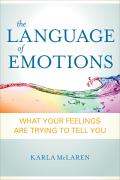
“The Language of Emotions” by Karla McLaren

July 22, 2014 by Sonia Connolly 2 Comments

Subtitle: What Your Feelings are Trying to Tell You

Recommended to me by: a client

I read a couple of books lately that had their good points, but I only got half way through them, and when I started to post about them I had more negative thoughts than positive ones, so I deleted the drafts.

This book was the opposite experience. When it came due at the library and I was only half way through, I went out and bought a copy. While there were aspects that didn’t work for me, overall I encountered a lot of solid, useful insights.

Karla McLaren shares her history as an abuse survivor and an empath, offers simple practices to work skillfully with emotions, and then analyzes how each emotion fits into her framework. All emotions are equally valid, from anger to joy to suicidal urges. Trauma recovery is woven through the book.

Emotions (corresponding with water) are seen as part of an inner village with the intellect (air), body (earth), and spirit/vision (fire). Health is a village in dynamic balance, responding with agility to ongoing events.

The practices she recommends are grounding, defining boundaries, burning contracts, conscious complaining, and rejuvenation.

I’ve found that visualization is a superficial activity for me, so visualizing a grounding cord descending into the earth does not substantially change my energy. Visualizing the destruction of my “contracts” with old behaviors and memories sounds wonderful, but I haven’t seen much effect from cutting cords and similar rituals.

She suggests sending anger into one’s boundary, which sounds like great advice, although I’m not quite sure how to do it. She also says, “People won’t know you’re angry,” which sounds like a bit of judgment about anger sneaking in.

Since these practices form the core of McLaren’s work with emotions, I wish I resonated better with them. I suspect I do some form of them in a more wordless way, sensing rather than visualizing.

The detailed analysis of each emotion includes associated questions to ask or statements to make when the emotion arises, along with gifts the emotion brings and advice on how to integrate the emotion honorably into one’s life.

Emotion Purpose Questions/Statements
Anger Protection and Restoration What must be protected? What must be restored?
Apathy and Boredom The Mask for Anger What is being avoided? What must be made conscious?
Guilt and Shame Restoring Integrity Who has been hurt? What must be made right?
Hatred The Profound Mirror What has fallen into my shadow? What must be reintegrated?
Fear Intuition and Action What action must be taken?
Confusion The Mask for Fear What is my intention? What action should be taken?
Jealousy and Envy Relational Radar What has been betrayed? What must be healed and restored?
Panic and Terror Frozen Fire What has been frozen in time? What healing action must be taken?
Sadness Release and Rejuvenation What must be released? What must be rejuvenated?
Grief The Deep River of the Soul What must be mourned? What must be released completely?
Depression Ingenious Stagnation Where has my energy gone? Why was it sent away?
Suicidal Urges The Darkness Before Dawn What idea or behavior must end now? What can no longer be tolerated in my soul?
Happiness Amusement and Anticipation Thank you for this lively celebration!
Contentment Appreciation and Recognition Thank you for renewing my faith in myself!
Joy Affinity and Communion Thank you for this radiant moment!

There is much more information in the book than I have covered here. Highly recommended!

Available at bookshop.org.

Filed Under: nonfiction Tagged With: childhood abuse, healing, memoir, psychology

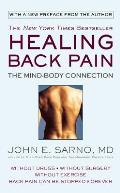
“Healing Back Pain” by John E. Sarno, MD

July 10, 2014 by Sonia Connolly Leave a Comment

Subtitle: The Mind-Body Connection

Recommended to me by: Amy Bennett

What Dr. Sarno tells his TMS patients:

  • Resume physical activity. It won’t hurt you.
  • Talk to your brain: tell it you won’t take it anymore.
  • Stop all physical treatments for your back—they may be blocking your recovery.

DON’T

  • Repress your anger or emotions—they can give you a pain in the back.
  • Think of yourself as being injured. Psychological conditioning contributes to ongoing back pain.
  • Be intimidated by back pain. You have the power to overcome it.

Dr. Sarno defines Tension Myositis Syndrome (TMS) as chronic pain in muscles and tendons of the back, neck, buttocks, and limbs. He asserts that most back pain is not caused by muscle strain or ruptured disks or past car accidents, but rather by the brain depriving an area of sufficient oxygen for the purpose of distraction from anger or other unpalatable emotions.

The book describes his theory and includes many case histories of people who fully recovered from debilitating pain once they understood that it was caused by repressing emotions. In Dr. Sarno’s experience, most people improve simply by achieving that understanding.

Unfortunately, the book doesn’t contain any suggestions for other ways to deal with emotions, although it does strongly imply that acknowledging them and setting clear boundaries can be helpful.

I think the mechanism is slightly different, tension and pain as a result of suppressing emotions rather than as a subconscious distraction. I still highly recommend this book for a refreshing perspective on chronic pain.

Available at bookshop.org.

Filed Under: nonfiction Tagged With: bodywork, disability, healing, psychology

  • « Go to Previous Page
  • Page 1
  • Interim pages omitted …
  • Page 8
  • Page 9
  • Page 10
  • Page 11
  • Page 12
  • Interim pages omitted …
  • Page 17
  • Go to Next Page »

Primary Sidebar

Recent Books

  • “How We Show Up” by Mia Birdsong
  • “The Enchanted Greenhouse” by Sarah Beth Durst
  • “What It Takes to Heal” by Prentis Hemphill
  • Kitchens of Hope by Linda S. Svitak and Christin Jaye Eaton with Lee Svitak Dean
  • “Very Far Away From Anywhere Else” by Ursula K Le Guin
  • “Seaward” by Susan Cooper
  • “Surviving Domestic Violence” by Elaine Weiss
  • “The Book of Love” by Kelly Link
  • “Alexandra’s Riddle” by Elisa Keyston
  • “Weaving Hope” by Celia Lake

Tags

activism aging anti-racism bodywork business childhood abuse childrens CivicTech communication disability domestic violence fantasy feminism finance Focusing food fun healing health at any size illustrated Judaism leadership lgbt marketing memoir music natural world neurodiversity politics psychology relationship romance science science fiction software spirituality survival story trauma writing young adult

Categories

Archives

Please note: bookshop.org and Amazon links are affiliate links. Copyright © 2026 · Genesis Sample on · WordPress