• Skip to primary navigation
  • Skip to main content
  • Skip to primary sidebar
Curious, Healing

Curious, Healing

Books about healing, business, and fun

  • About Sonia Connolly

healing

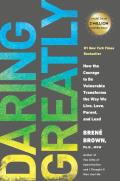
“Daring Greatly” by Brene Brown

December 29, 2012 by Sonia Connolly 3 Comments

Subtitle: How the Courage to Be Vulnerable Transforms the Way We Live, Love, Parent, and Lead

This book recapitulates Brene Brown’s previous books The Gifts of Imperfection and I Thought It Was Just Me (but it isn’t) and adds material on vulnerability and worthiness as it applies to community, work, and parenting. This book feels more complete and at the same time less academic than the prior books. Her research supports her points rather than distancing from them.

Those who feel lovable, who love, and who experience belonging simply believe they are worthy of love and belonging. They don’t have better or easier lives, they don’t have fewer struggles with addiction or depression, and they haven’t survived fewer traumas or bankruptcies or divorces. (emphasis in the original)

The opposite of scarcity is enough, and we are already enough. Wholehearted living includes showing up and being vulnerable. Vulnerability is not weakness. There is no “get out of vulnerability free” card. Vulnerability is not the same as letting it all hang out.

The Viking-or-Victim worldview divides the world into winners and losers, and has very little room for vulnerability. The worldview is useful in life-threatening or traumatic situations, but prevents connection when the emergency is over.

The book touches on cruelty, how not to be cruel, and how to respond to cruelty. Our culture of narcissism is fed by shaming each other and avoiding vulnerability. As more of us become willing to be vulnerable and authentic, the hope is that bullying will diminish. I wish there were a more concrete, powerful answer.

The book encourages us to dare greatly and be vulnerable despite the fear and shame that arises. Vulnerability is the gateway to joy.

Available at bookshop.org.

Filed Under: nonfiction Tagged With: healing, psychology

“Poppies on the Rubbish Heap” by Madge Bray

September 1, 2012 by Sonia Connolly Leave a Comment

Subtitle: Sexual Abuse, The Child’s Voice

Madge Bray shares her journey as a child advocate social worker, along with several abused children’s case histories. Woven through the book is the history of recognition and backlash around the sexual abuse of children. Madge Bray pioneered the use of toys and play therapy to elicit children’s stories and help them heal.

The toys include anatomically correct dolls, angry puppets, and a battery-operated rabbit that trembles silently. Madge Bray offers a neutral, welcoming space for the children to interact with the toys and find self-expression. She enters into their world rather than demanding that they communicate in adult ways.

The book is intense and riveting. It tells of catastrophic abuse from the wounded child’s perspective, as the child is heard and helped. It tells of victorious court battles as well as one story about a child whose parents withdrew him from therapy before he could tell his story.

Recommended as a look into social work with children in England, the realities of child sexual abuse, and the healing power of deep listening.

Available at bookshop.org.

Filed Under: nonfiction Tagged With: childhood abuse, domestic violence, healing, memoir, psychology, trauma

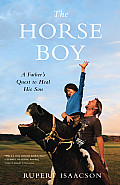
“The Horse Boy” by Rupert Isaacson

July 9, 2012 by Sonia Connolly Leave a Comment

Subtitle: A Father’s Quest to Heal His Son

Recommended to me by: Kristin Neff mentions her husband’s book about their journey to Mongolia in her book Self-Compassion.

Rupert Isaacson writes about how his intuition and determination (and privilege) bring him to Mongolia where horseback riding and shamans help his autistic son Rowan.

He describes both people and places by their degree of physical beauty. He does not acknowledge the privilege that makes his journey possible. His story about meeting his wife Kristin says a lot about how he relates to the world.

[T]he moment I saw her, stretched out in a beach chair by the pool of the Southern Star Hotel, all long-legged, tan, and languid, […] a voice in my head, accompanied by an almost physical pull of intuition under my diaphragm, said, clear as day, That’s your wife. [… She responded,] “I’m not available.”
Which of course for me was like a red rag to a bull.

I learned a lot about autism, horses, shamanism, and Mongolia. I’m glad their adventure went well and brought improvement for Rowan. I’m amazed and a little jealous of how Rupert’s intuition panned out and he got everything he wanted, including financial success.

Of course, it’s unlikely that a book about how someone followed their intuition and was led completely astray would see print.

Available at bookshop.org.

Filed Under: nonfiction Tagged With: disability, fun, healing, memoir

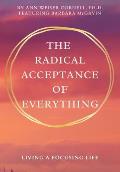
“The Radical Acceptance of Everything” by Ann Weiser Cornell

June 30, 2012 by Sonia Connolly 1 Comment

Subtitle: Living a Focusing Life

Recommended to me by: Ann Weiser Cornell’s website

I bought this book because of my excitement about The Power of Focusing. I was not disappointed.

These essays by Ann Weiser Cornell and her working partner Barbara McGavin describe both the theory and practice of Inner Relationship Focusing, as well as some of the history behind its development. They show specific, concrete ways to radically accept everything, including Inner Critics, exiled parts, internal conflicts, and non-response.

I started reading the book on the train, but stopped because I was embarrassed to cry next to my seatmate. The tears came from recognition and longing. This is how I want to be heard, and how I want to hear others. This is how I want exiled parts of me to be welcomed home.

Highly recommended.

Available at bookshop.org.

Filed Under: nonfiction Tagged With: communication, Focusing, healing, psychology

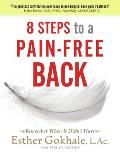
“8 Steps to a Pain-Free Back” by Esther Gokhale, L.Ac. with Susan Adams

April 23, 2012 by Sonia Connolly 1 Comment

Subtitle: Remember When It Didn’t Hurt

Recommended to me by: Rosalind Bell

This book is a beautifully photographed and illustrated step-by-step guide to moving well as a human. It is also a carefully crafted sales brochure for the author’s clinic and method, with testimonials sprinkled liberally through the text.

Esther Gokhale (“Go-clay”) grew up in India, studied biochemistry and acupuncture in the US, and, inspired by her own back pain, conducted research on body mechanics in Burkina Faso, India, Portugal, and elsewhere.

She suggests that we integrate stretchsitting, stretchlying, tallstanding, and glidewalking into our lives to regain our birthright of healthy pain-free movement. The foundation of these movements is to allow the pelvis to tip forward so the top is lower in front and the sacrum protrudes slightly in back. The rest of the back remains relatively straight, with the shoulders settled down and back.

In contrast, many of us learned to tuck the pelvis so that if we had a tail, we’d be sitting on it.

The photographs of babies and adults from around the world are gorgeous and convincing. The book is carefully respectful of traditional cultures and full-figured people. I would have liked to see photos of people of color from the USA, and white people from traditional cultures, rather than the strict divide with only white people from the USA and people of color from traditional cultures.

While there is a lot of discussion about cultural influences on posture, there is no reference to the long-term effects of physical and emotional trauma. For some people there is more to healing than learning to move with a stretched back.

I highly recommend this book for the photos, for new ways of observing movement and posture, and for useful exercises to improve the use of your body.

More information about the Gokhale Method.

Available at bookshop.org.

Filed Under: nonfiction Tagged With: bodywork, healing, illustrated

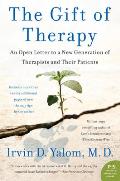
“The Gift of Therapy” by Irvin Yalom, MD

April 14, 2012 by Sonia Connolly Leave a Comment

Subtitle: An Open Letter to a New Generation of Therapists and Their Patients

Recommended to me by: Rachel Manija

This is a collection of short tips about psychotherapy from a longtime practitioner. I loved his tips about creating a warm, safe, positive relationship with the client and processing the here-and-now of the relationship for clues about how to help the client with external relationships. I loved that he starts with the assumption that he is helping to remove obstacles, because everyone naturally grows and develops given the chance. I loved that he sees himself as a fellow traveler with his clients.

This quote early in the book of German philosopher Arthur Schopenhauer expresses our common expectations that life should go well, and that we’ve done something wrong if it doesn’t, and yet it so often doesn’t.

In early youth, as we contemplate our coming life, we are like children in a theater before the curtain is raised, sitting there in high spirits and eagerly waiting for the play to begin. It is a blessing that we do not know what is really going to happen. Could we foresee it, there are times when children might seem like condemned prisoners, condemned, not to death, but to life, and as yet all uncounscious of what their sentence means.

I found the stated assumption that clients are causing their own problems frustrating and condescending. He overtly says he makes that assumption because that is how he can be effective in helping the client. Reminds me of someone looking for lost keys under the streetlight because they can see better there.

Of course it’s true in many cases, and looking at one’s role in a recurring problem can be a fruitful exploration. He seems to say that it is universally true, and does not acknowledge the work a client may already have done in that arena. Some clients need help to stop blaming themselves. I hear an underlying assumption that clients are broken, despite his starting assertion that growth simply requires the removal of blocks.

I think as a white male doctor he has a lot more experience of agency in his life than a lot of his clients, and he would also naturally discuss in his book the clients who benefited most from his approach. It makes me angry that the book made me question myself again on the topic, and I imagine he had that effect on some clients as well.

He repeatedly brings up the damaging effect on psychotherapy of insurance, “managed care,” lower compensation, less training, and “evidence-based” treatments. This book is a defense of long-term therapy toward profound change.

The book is a quick read. I recommend it as a tool to learn about psychotherapy, although I would not personally benefit from a therapist who followed all these practices.

Available at bookshop.org.

Filed Under: nonfiction Tagged With: healing, psychology

  • « Go to Previous Page
  • Page 1
  • Interim pages omitted …
  • Page 10
  • Page 11
  • Page 12
  • Page 13
  • Page 14
  • Interim pages omitted …
  • Page 17
  • Go to Next Page »

Primary Sidebar

Recent Books

  • “Untangling” by Barbara McGavin and Ann Weiser Cornell
  • “After Hours at Dooryard Books” by Cat Sebastian
  • “We Belong to the Drum” by Sandra Lamouche and Azby Whitecalf
  • “Atlas of the Heart” by Brene Brown
  • “Life After Cars” by Sarah Goodyear, Doug Gordon, Aaron Naparstek
  • “Tidy First?” by Kent Beck
  • “When You Had Power” and “You Knew the Price” by Susan Kaye Quinn
  • “Taproot” by Keezy Young
  • “The Tower at Stony Wood” by Patricia A McKillip
  • “Hospicing Modernity” by Vanessa Machado de Oliveira

Tags

activism aging anti-racism bodywork business childhood abuse childrens CivicTech communication disability domestic violence fantasy feminism finance Focusing food fun healing health at any size illustrated Judaism leadership lgbt marketing memoir music natural world neurodiversity politics psychology relationship romance science science fiction software spirituality survival story trauma writing young adult

Categories

Archives

Please note: bookshop.org and Amazon links are affiliate links. Copyright © 2026 · Genesis Sample on · WordPress