• Skip to primary navigation
  • Skip to main content
  • Skip to primary sidebar
Curious, Healing

Curious, Healing

Books about healing, business, and fun

  • About Sonia Connolly

illustrated

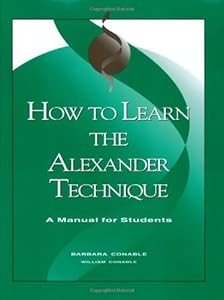
“How to Learn the Alexander Technique” by Barbara Conable

July 20, 2013 by Sonia Connolly 1 Comment

Subtitle: A Manual for Students

Recommended to me by: reading Conable’s previous book, What Every Musician Needs to Know About the Body

This book is less playful and more dense than What Every Musician Needs to Know About the Body, but it is not at all the dry instruction manual I thought it would be. It is full of lucid explanations about how the body really works, along with common errors in how we map our bodies. I think the subtitle should be, “A Manual for Humans.” I long for the freedom of movement and buoyant support she claims is possible for everyone.

There is a section titled “If You Have Suffered Abuse or Violence” which is sensitive, compassionate, and accurate (like the rest of the book).

“Persons who are healing learn to become very skillful inhibitors [an important Alexander Technique concept], not in the sense that they do nothing, but in the sense that they say no to habituated self destruction and wait for the more constructive response that was blocked by the habitual.”

I keep saying that the Alexander teachers I’ve tried don’t acknowledge the work I’ve already done, and I think this is why. Years of practice in stopping and waiting.

Some insights:

  • The weight-bearing part of the spine is inside the body, deep to the knobs we feel along our backs.
  • The pelvis is the lower part of the upper body, part of the torso. There is no internal anatomical structure at the waist.
  • The top of the sacrum transfers the weight of the upper body to the pelvis. The rest of the triangular sacrum and tailbone float free of weight.
  • Flexibility can be increased by putting all the joints gently through their range of motion once a day. The whole routine takes 5 minutes.
  • Give yourself permission to be a “flapdoodle” at night – to move freely in your sleep like a child.

Here is a brief interview with Barbara Conable with a pointed comment about “inhibiting” at the end.

Here’s her page at bodymap.org.

Highly, highly recommended for all humans with an interest in how to move comfortably and well.
Available at biblio.com.

Filed Under: nonfiction Tagged With: bodywork, illustrated, music

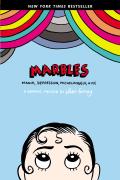
“Marbles: Mania, Depression, Michelangelo, and Me: A Graphic Memoir” by Ellen Forney

June 3, 2013 by Sonia Connolly Leave a Comment

The story and drawings quickly engaged me, despite the author’s sometimes bizarre, sometimes heavy journey through mania, depression, and eventually, balance. She has the fantastic support of her mom, friends, and psychiatrist, but still struggles for years before finding a set of meds that works for her.

In depression, she can barely get out of bed to sit under a blanket on the couch. At the same time, she still swims several times a week, goes to yoga, and draws her weekly comic strip. In mania, she struggles to control her racing thoughts and impulses. Her commitment to self-care is woven through the book, along with disarming candor about her daily experience.

Highly recommended to learn about one woman’s experience with bipolar disorder and creativity.

Available at bookshop.org.

Filed Under: nonfiction Tagged With: disability, illustrated, memoir, psychology

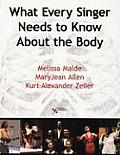
“What Every Singer Needs to Know About the Body” by Malde, Allen, Zeller

September 21, 2012 by Sonia Connolly 2 Comments

Authors: Melissa Malde, MaryJean Allen, Kurt-Alexander Zeller

I read this as a followup to What Every Musician Needs to Know About the Body, since I’m a singer, not a musician. I expected it to be similarly playful and filled with illustrations more than words. I also expected it to cover very similar material.

I was wrong on both counts. In careful detail, this book covers the anatomy and mechanics of breathing, phonation (making sound with the vocal cords), articulation (forming words with the mouth and tongue), and stage presence. Even the general material on the body is covered in more detail than in the Musician book.

Did you know that your tongue is rooted far below your teeth, extends to the back of your throat, and is much larger than that part you can see? It’s made up of many muscle fibers that can act independently of each other.

Did you know that if a letter sounds different in another language, it is made with different movements of the tongue and mouth? It makes sense, but I had never thought about it. The American English ‘T’ sound is made with the tongue touching the upper teeth. In Spanish (and other Romance languages), ‘T’ is made with the tongue touching farther back on the hard palate. I speak both languages, and had never been aware of that.

Did you know that your ribs are attached in back at your spine, and in front at your sternum, and move up and out as you breathe in, like bucket handles? I had heard that many times, but hadn’t felt the movement clearly.

Did you know that your ankle is in front of your heel, not right over it? Your heel forms part of a triangle that supports your weight, and your leg bones come down inside the triangle, not on the back point. Check your own foot and see. I’ve worked on a lot of feet, and never consciously noticed that.

This book is amazing. Highly recommended for anyone who wants to understand their body better from the inside and improve their singing along the way.

Available at biblio.com.

Filed Under: nonfiction Tagged With: fun, illustrated, music

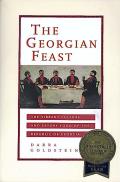
“The Georgian Feast” by Darra Goldstein

July 14, 2012 by Sonia Connolly Leave a Comment

Subtitle: The Vibrant Culture and Savory Food of the Republic of Georgia

In Georgian singing classes, we talked about the integral role of singing in Georgian feasts, or supras. However, this book only had a one-sentence aside about singing. The rest is a Georgian travelogue and recipe book. It seems that different travelers focus on different aspects of their experiences.

The book gave me a sense for Georgian geography and culture, and would be useful if I wanted to take up Georgian cooking.

Available at bookshop.org.

Filed Under: nonfiction Tagged With: food, fun, illustrated

“What Every Musician Needs to Know About the Body” by Barbara Conable

July 9, 2012 by Sonia Connolly 7 Comments

Subtitle: The Practical Application of Body Mapping and the Alexander Technique to Making Music

Recommended to me by: Rosi Goldsmith

This book is filled with detailed illustrations of the body’s structure and how the parts work together, presented in a playful, declarative way. “If you already have a very free neck, Celebrate!”

I was frustrated by admonitions like, “Freeing your neck is the key to freeing the whole of you!” without accompanying instructions on how to accomplish that. I’ve been working on freeing my neck for years.

Then I got to the page that begins, “Imagine your legs feeling as free and mobile as your arms.” In a paragraph about the similarities about arms and legs, I read, “Arms and legs are out at our sides.” Oh! Suddenly I could feel the joint between my femurs and pelvis from the inside. I’ve been looking for it for years, but I didn’t have the right mental image to find it.

That epiphany alone more than repays my investment in the book. I imagine that someday an accumulation of epiphanies will free my neck as well.

Recommended for anyone, musician or not, who wants to learn more about how the human body works and doesn’t mind some whimsy along the way.

Available at biblio.com.

Filed Under: nonfiction Tagged With: bodywork, illustrated, music

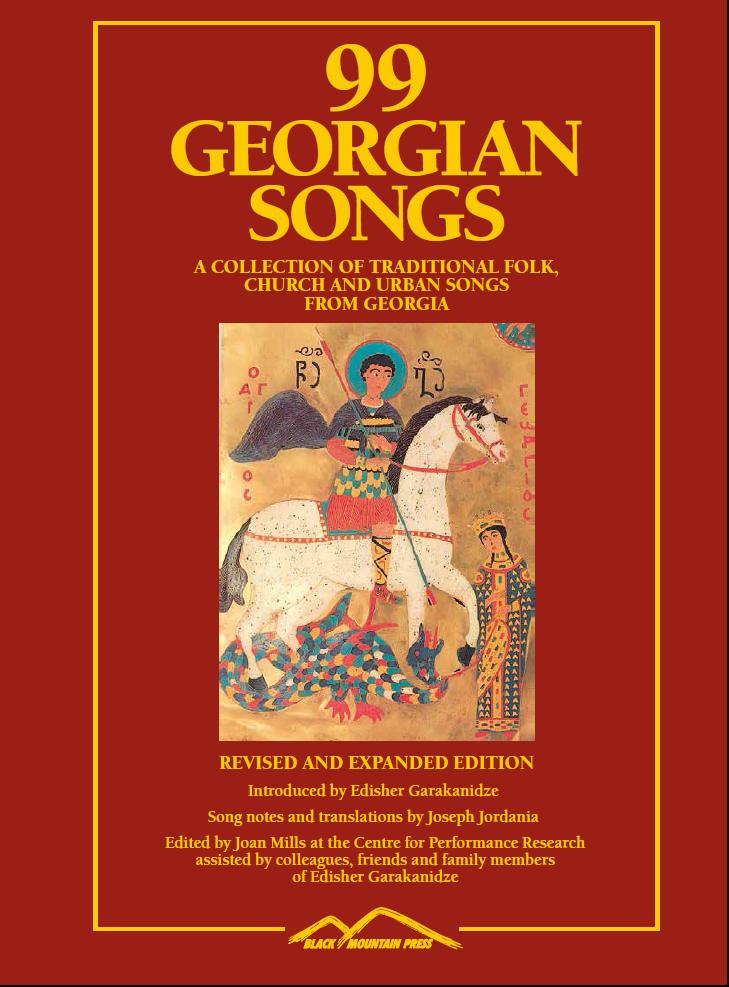
“99 Georgian Songs” by Edisher Garakanidze

June 30, 2012 by Sonia Connolly 1 Comment

Subtitle: A collection of traditional folk, church and urban songs from Georgia

Recommended to me by: Jen Morris

This is primarily a book of sheet music, so I have not read it cover to cover, but it contains a lot of background material on Georgian music, as well as useful nuggets of information with each song and the occasional photograph. I have paged through it looking for songs I recognize, and listened to recordings of included songs to find new ones I like.

Each song is transcribed in 3-part harmony with transliterated Georgian words and English translations.

This is a wonderful source of information for those interested in Georgian singing and Georgian singers. Highly recommended.

Available from the Centre for Performance Research.

Filed Under: nonfiction Tagged With: fun, illustrated, music

  • « Go to Previous Page
  • Page 1
  • Interim pages omitted …
  • Page 8
  • Page 9
  • Page 10
  • Page 11
  • Page 12
  • Interim pages omitted …
  • Page 15
  • Go to Next Page »

Primary Sidebar

Recent Books

  • “We Belong to the Drum” by Sandra Lamouche and Azby Whitecalf
  • “Atlas of the Heart” by Brene Brown
  • “Life After Cars” by Sarah Goodyear, Doug Gordon, Aaron Naparstek
  • “Tidy First?” by Kent Beck
  • “When You Had Power” and “You Knew the Price” by Susan Kaye Quinn
  • “Taproot” by Keezy Young
  • “The Tower at Stony Wood” by Patricia A McKillip
  • “Hospicing Modernity” by Vanessa Machado de Oliveira
  • “How We Show Up” by Mia Birdsong
  • “The Enchanted Greenhouse” by Sarah Beth Durst

Tags

activism aging anti-racism bodywork business childhood abuse childrens CivicTech communication disability domestic violence fantasy feminism finance Focusing food fun healing health at any size illustrated Judaism leadership lgbt marketing memoir music natural world neurodiversity politics psychology relationship romance science science fiction software spirituality survival story trauma writing young adult

Categories

Archives

Please note: bookshop.org and Amazon links are affiliate links. Copyright © 2026 · Genesis Sample on · WordPress