• Skip to primary navigation
  • Skip to main content
  • Skip to primary sidebar
Curious, Healing

Curious, Healing

Books about healing, business, and fun

  • About Sonia Connolly

illustrated

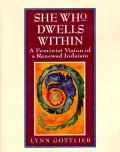
“She Who Dwells Within” by Lynn Gottlieb

May 24, 2015 by Sonia Connolly Leave a Comment

book cover

Subtitle: A Feminist Vision of a Renewed Judaism

Recommended to me by: Orasimcha Batdina

I loved this book. Lynn Gottlieb talks about exactly what I needed to hear, that other women find Judaism to be hostile ground. I cheered on her battle to make that hostile world hers in a new way, and winced at the ways men fought to suppress her.

“Women need a new situation. In a Jewish context, we need to transform the way we talk Torah, the way we practice ceremony and ritual, the way we tell and pass on stories, the way we codify laws, the way we organize our communities, and the way we envision sacred mysteries.” Yes!

Also it doesn’t hurt that she chooses a dragon (longtime favorite symbol of mine) to represent Shekhinah.

I appreciated the links between Judaism and the pre-existing Goddesses in the Middle East. I’ve worked with the Descent of Innana without realizing the story might be part of my heritage. Yes, we need stories about women that resolve in powerful, healing ways, not just, “And then she got married and had a son.”

I appreciated re-imagining keeping kosher as caring for the environment. I hadn’t viewed that as a directly spiritual act before, although it makes sense now that I think about it.

I also appreciated the section on recovering from violence and abuse, although there was a bit of “help them recover” about it.

Perhaps someday I’ll come back to the book for some of the re-imagined rituals it offers. For now, it’s the company I enjoy.

Highly recommended.
Available at bookshop.org.

Filed Under: nonfiction Tagged With: feminism, illustrated, Judaism, memoir, spirituality

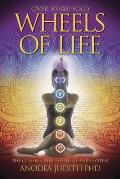
“Wheels of Life” by Anodea Judith

April 1, 2015 by Sonia Connolly 1 Comment

book cover

Subtitle: A User’s Guide to the Chakra System

Recommended to me by: Katherine Macomber Millman

This is a thorough, inclusive, grounded introduction to the chakra system. It includes Hindu history, symbolism, and interactions with yoga. It discusses both the “liberating” current, moving toward the upper chakras and universal energy, and the “manifesting” current, moving toward the lower chakras and individual energy. All the chakras are important, from the ones that ground us in our body to the ones that connect us with All That Is.

Each chakra has a long list of associations, from colors and sounds to Hindu divinities to ailments and body parts. The author includes specific yoga poses and movements to connect with the chakras. Each chapter also includes essays on related scientific ideas. While the connections between the science and the chakras might be debated, the science itself is carefully and accurately presented.

I noticed that I disagree with some of the associations the author proposes, like water and emotions for the second chakra, and air for the fourth chakra. They make sense if each chakra has an element, but that set of associations didn’t click for me. I was surprised to discover strong opinions on what the chakras do and don’t represent for me.

I looked at another book on the chakras which uses “he” and “man” everywhere. It was a relief to return to this book, which even-handedly mixes pronouns, and includes explicit anti-racism as well.

I also looked through The Sevenfold Journey: Reclaiming Mind, Body, and Spirit Through the Chakras by Anodea Judith and Selene Vega. This contains an abridged version of the material on each chakra from “Wheels of Life”, and adds stories, journal exercises, and rituals from the workshops they have held for people to work through each chakra in turn. The personal stories were a great addition, and this might be a better introduction for someone who wants to do personal work with the chakras.

Both books are accessible, interesting, and a great introduction to the New Age version of the chakra system.

This article contains a good summary of basic chakra information and associations: Asanas for the Chakra System

Anodea Judith’s website

Available at bookshop.org.

Filed Under: nonfiction Tagged With: healing, illustrated, spirituality

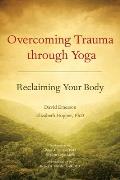
“Overcoming Trauma Through Yoga” by David Emerson and Elizabeth Hopper

February 12, 2015 by Sonia Connolly 1 Comment

Subtitle: Reclaiming Your Body

Recommended to me by: a client

This book is divided into three parts: a general introduction to the history of trauma treatment and PTSD, a suggested yoga practice for traumatized people, illustrated with photographs, and suggestions for offering trauma-sensitive yoga for clinicians and yoga teachers.

Throughout the book, it is clear that these people get it. They emphasize choice, empowerment, and reconnecting with the body. From Stephen Cope’s foreword: “Sometimes we encounter experiences that so violate our sense of safety, order, predictability, and right, that we feel utterly overwhelmed […]. Unable to bear reality. We have come to call these shattering experiences trauma.”

Trauma involves being helpless to avoid pain. In trauma-sensitive yoga, students are repeatedly encouraged to change postures if they are painful, and instructions emphasize choice and control over their own bodies. Students are encouraged to attend to their own experience, rather than trying to get postures “right”.

There were two instructions in the book that seemed less well-attuned to traumatized yoga students. One is to “lift the crown of the head,” without explaining how to find a balanced upright posture for the head. The other is to “hug in and around the lower belly” to activate core muscles. Many traumatized people chronically clench their bellies already.

Trauma-sensitive yoga classes move slowly to give students time to connect with their physical experience. “Physical assists” (touching students) is done rarely, with permission, and with careful attention to possible triggering effects. Thought is given to the props available – many trauma survivors find straps triggering because of having been restrained, so the book suggests not having straps in the room.

“In teaching trauma-sensitive yoga, the job of the yoga teacher is not to create artificial challenges—many of our students have already challenged themselves more than we may ever know just by showing up. The work of the teacher is to cultivate enough safety so that students can challenge themselves as they are ready, and in ways they feel safe.”

Highly recommended for its compassionate approach to anyone dealing with trauma or traumatized people.

Available at bookshop.org.

Filed Under: nonfiction Tagged With: bodywork, healing, illustrated, psychology, trauma

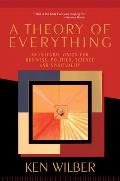
“A Theory of Everything” by Ken Wilber

October 4, 2014 by Sonia Connolly 2 Comments

Subtitle: An Integral Vision for Business, Politics, Science, and Spirituality

Recommended to me by: David Mitchell

I read this book to learn about Spiral Dynamics, a classification of cultures that makes room for change and values all levels, from bare subsistence to military control to cooperative and aware. The levels are labeled with colors and called “memes” (not the usual Internet meme definition).

A “Theory of Everything” includes these levels, mapped onto quadrants of Interior/Individual (“I”), Exterior/Individual (“IT”), Interior/Collective (“WE”), and Exterior/Collective (“ITS”). The quadrants are also described as Intentional, Behavioral, Cultural, and Social.

The book focuses on how to facilitate a cultural transformation to the next level, from green, relativistic and empathic, but narcissistic according to Wilber, to turquoise, truly holistic and less likely to wreak environmental disaster.

The second section describes various disciplines in “all-level, all-quadrant” ways. Medicine, for example, can look at someone’s emotional state, physical symptoms, availability of care, and social support.

Throughout the book, Wilber refers to his other books. In some ways, this is a condensed summary of his life’s work.

This book felt like an interesting intellectual exercise, ungrounded in intuition or the body. I might agree with some of the conclusions about how to lead a “good” life, but I arrive at them by trying different things and sensing what works for me, not constructing grand edifices and then reasoning from there.

Available at bookshop.org.

Filed Under: nonfiction Tagged With: illustrated

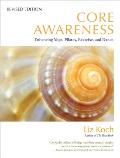
“Core Awareness” by Liz Koch

September 27, 2014 by Sonia Connolly Leave a Comment

Subtitle: Enhancing Yoga, Pilates, Exercise, and Dance

Recommended to me by: David Mitchell

I enthusiastically endorse this book’s focus on awareness, especially in core areas that we often learn to block out. The psoas muscles connects the front of the lumbar spine to the inside of the pelvis to the inner upper femur, all areas we largely ignore. I like the image of telling small children, “Sense yourself!” rather than, “Be careful!” to avoid injury. My own experience supports that the psoas does not like to be deeply palpated, but responds better to gentle invitations to relax.

At the same time, while Part I is nicely poetic, it desperately [needs citation], as well as an editor who knows how to spell muscle names and types of bodywork. The statement that the psoas only contracts eccentrically is simply false. (More information at wikipedia’s psoas article.)

Part II contains carefully described exploratory exercises to connect with and relax the psoas, illustrated with photographs of people with a diversity of body types.

I recommend this book to explore new ideas around internal awareness, as long as the first part is read as metaphorical. It is helpful to look at a good anatomy book such as Trail Guide to the Body to visualize the psoas muscle.

Available at bookshop.org.

Filed Under: fiction Tagged With: bodywork, illustrated

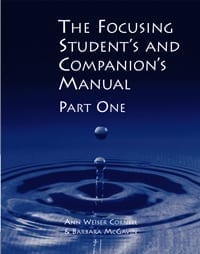
“The Focusing Student’s and Companion’s Manual” by Barbara McGavin and Ann Weiser Cornell

September 21, 2014 by Sonia Connolly Leave a Comment

Recommended to me by: Jael Emberley

I took Focusing classes I and II from Jael Emberley, and bought both parts of the manual, even though the second part is for classes III and IV. Both parts are written in clear, friendly language, and delightfully illustrated by Mary Ferris. Her expressive line drawings of anthropomorphized hares capture the subtleties and humor of Focusing.

Focusing is paying attention inside to an unfolding felt sense about an issue or situation. Somatic Experiencing includes a lot of Focusing. I read Part Two now to learn more about how to be present with merging and exiling of internal “something”s. Suggestions include

  • Use presence language. “I sense something in me that feels overwhelmed.”
  • Turn toward the Something that has Feelings about the Feeling, and might be saying things like, “I don’t want to be scared!” “It’s bad to be angry.”
  • Notice behaviors that come out of Feelings about Feelings, like rushing the process, forcing a choice, analyzing, diagnosing, deciding, fixing, doubting, arguing, and especially criticizing.
  • For critics, sense for what they’re not wanting.
  • Acknowledge parts that are trying to force other parts to Do It Right.
  • Exiling – something is judged as so bad and dangerous it is removed from awareness. As it comes back, the symbols for it might move from inanimate to animate.
  • Exiles need a lot of time and safety to gain trust and come back into inner relationship.

Recommended for learning about Focusing and being amused and touched by the line drawings.

Part One and Part Two are available from FocusingResources.com

Filed Under: nonfiction Tagged With: communication, Focusing, healing, illustrated, psychology

  • « Go to Previous Page
  • Page 1
  • Interim pages omitted …
  • Page 7
  • Page 8
  • Page 9
  • Page 10
  • Page 11
  • Interim pages omitted …
  • Page 15
  • Go to Next Page »

Primary Sidebar

Recent Books

  • “We Belong to the Drum” by Sandra Lamouche and Azby Whitecalf
  • “Atlas of the Heart” by Brene Brown
  • “Life After Cars” by Sarah Goodyear, Doug Gordon, Aaron Naparstek
  • “Tidy First?” by Kent Beck
  • “When You Had Power” and “You Knew the Price” by Susan Kaye Quinn
  • “Taproot” by Keezy Young
  • “The Tower at Stony Wood” by Patricia A McKillip
  • “Hospicing Modernity” by Vanessa Machado de Oliveira
  • “How We Show Up” by Mia Birdsong
  • “The Enchanted Greenhouse” by Sarah Beth Durst

Tags

activism aging anti-racism bodywork business childhood abuse childrens CivicTech communication disability domestic violence fantasy feminism finance Focusing food fun healing health at any size illustrated Judaism leadership lgbt marketing memoir music natural world neurodiversity politics psychology relationship romance science science fiction software spirituality survival story trauma writing young adult

Categories

Archives

Please note: bookshop.org and Amazon links are affiliate links. Copyright © 2026 · Genesis Sample on · WordPress