• Skip to primary navigation
  • Skip to main content
  • Skip to primary sidebar
Curious, Healing

Curious, Healing

Books about healing, business, and fun

  • About Sonia Connolly

illustrated

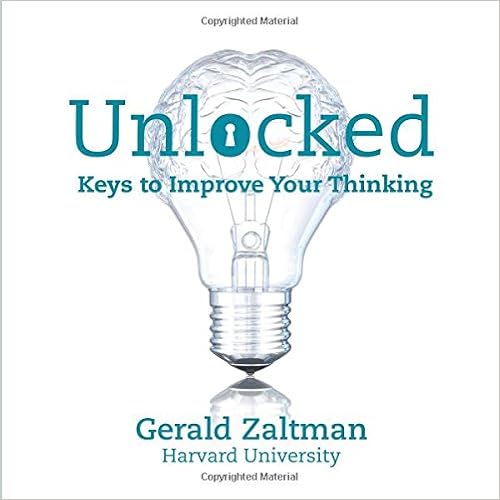
“Unlocked” by Gerald Zaltman

August 12, 2018 by Sonia Connolly Leave a Comment

book coverRecommended to me by: Received a copy from Asakiyume who edited it

Gerald Zaltman is a marketing consultant for corporate executives and a professor emeritus of business administration at Harvard. The idea for this book came out of interactions with his young grandchildren. I do not belong to these target audiences, and the book did not resonate with me. I realized as I read the first few sections that the author had not won my trust, so I was engaging with the thought exercises warily, waiting to be tricked and tripped up.

The book starts off with a couple of ethical dilemmas, and then the rest is about many ways our thinking can be influenced that we might be unaware of, and unconscious assumptions we might be making. There was no mention of racism, sexism, or any other -isms that lead to unconscious biases affecting our thinking and responses.

While there is a section on embodied cognition, it is more about how, for example, holding a warm drink can make us perceive a person more warmly, rather than about how our bodies and minds are integrated. The rest of the book is very much disembodied, based on the premise that, “You are how you think.”

There were links to a couple of interesting related videos:

Selective Attention Test: Count the number of passes between players dressed in white.
https://www.youtube.com/watch?v=vJG698U2Mvo

A Portrait Session with a Twist: 6 photographers, one subject, 6 different stories.
https://www.youtube.com/watch?v=F-TyPfYMDK8

The ebook contains live links and color illustrations. In one exercise, color names are printed in non-matching colors and the instruction is to say the color of the text rather than read the word. The gray-scale illustration in the printed book does not do the exercise justice.
Available at Amazon.

Filed Under: nonfiction Tagged With: business, communication, fun, illustrated, psychology

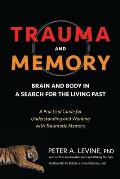
“Trauma and Memory” by Peter Levine

July 15, 2018 by Sonia Connolly 4 Comments

book cover

Subtitle: Brain and Body in a Search for the Living Past. A Practical Guide for Understanding & Working with Traumatic Memory

The first part of this book is a thorough introduction to different kinds of memories. There are explicit and implicit memories. Explicit (conscious) memories include declarative (like the times table) and episodic (stories with emotional content). Implicit (subconscious) memories include emotional and procedural memories. Implicit emotional memories are “flags.” Procedural memories are impulses, movements, and internal body sensations. Procedural memories can be further divided into skills like riding a bike, hardwired emergency responses, and basic approach/avoidance.

The writing is warm, engaging, informal, and filled with anecdotes.

The second part is an introduction to Levine’s trauma healing method of Somatic Experiencing, with several case studies, some including stills from videos of the sessions.

The third part is rants against more cathartic modalities of trauma healing, including support for the idea of false memories being induced by the “wrong” kind of trauma healing. I have only tentatively recommended Levine’s first book “Waking the Tiger” because it includes a section about false memories, and unfortunately I have to make the same caveat here.

Yes, false memories occur, just like false accusations of rape occur. Neither occur with enough frequency to deserve being addressed at length in a healing book, and both topics do a great deal of harm by undermining survivors’ already fragile hold on their truth.

Levine’s deeper point is to support trauma survivors to listen to their own bodies, and that is a message I can get behind.

Available at bookshop.org.

Filed Under: nonfiction Tagged With: healing, illustrated, psychology, trauma

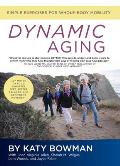
“Dynamic Aging” by Katy Bowman

July 10, 2018 by Sonia Connolly Leave a Comment

book cover

With: Joan Viginia Allen, Shelah M. Wilgus, Lora Woods, and Joyce Faber
Subtitle: Simple Exercises for Whole-Body Mobility

Recommended to me by: Amy Bennett

This is a kind, gentle book aimed at “goldeners” – also known as senior citizens – who don’t move much (anymore, or yet) but it can apply to any of us, since we’re all aging, and few of us move fluidly in all our joints. Katy Bowman is the teacher and main author, and four of her longtime class members, all in their seventies, contribute their experiences.

The first lesson is that fear and negative expectations can contribute to stiffness and immobility, which is why the people in Katy Bowman’s class choose to step away from the usual language for their age group and invent the new term “goldeners.” If we can’t imagine ourselves in motion, or we expect that motion leads to pain and injury, then we don’t move.

The book has easy, gentle exercises for each part of the body, starting at the feet, moving through knee and hip alignment and hip mobility, rib alignment and shoulder mobility. Balance, rising from a chair, confident walking, and movements needed for driving are emphasized. Line drawings help clarify each movement.

A note: Just because these exercises are simple and gentle, doesn’t mean you can’t overdo it. Start a little at a time!

The book is set in larger than usual type, double spaced, for ease of reading by older eyes. First the exercises are presented as part of a narrative about how they can fit into your life. Then a whole exercise routine is shown. Then each exercise is illustrated and described in a reference section. It’s a quick, enjoyable read, and has a lot of material for further exploration.

Recommended for anyone who wants to move more easily for more years, and especially for older people who need a reassuring re-introduction to movement.

Available at bookshop.org.

Filed Under: nonfiction Tagged With: aging, bodywork, healing, illustrated

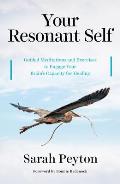
“Your Resonant Self” by Sarah Peyton

May 24, 2018 by Sonia Connolly 5 Comments

book cover

Subtitle: Guided Meditations and Exercises to Engage Your Brain’s Capacity for Healing

Recommended to me by: Amy Bennett

This book hooked me with, “The inner voice can be a constant flow of emotional warmth.” Yes please! Where do I sign up? It did take me a couple of months to get all the way through it, and would have taken longer if I hadn’t decided to finish reading it and write an article about it for May.

The book has a lot of detailed information about different parts of the brain, how they work together, and how trauma isolates them from each other. It’s not clear which parts of this are Interpersonal Neurobiology, but that’s in there. There are lots of TLAs (Three Letter Acronyms). Also lots of NVC (Non-Violent Communication), guessing about feelings and needs, which is one way to express empathy, but not the only way.

Emotional warmth is defined as being met or meeting others with affection and welcome, with a feeling of being cared for, nourished, and nurtured.

Resonance is defined as sensing that another being fully understands us and sees us with emotional warmth and generosity. Resonance is a two-person relational experience, being a “we.”

“We are social animals created to live in groups, like honey bees, ant colonies, or parades of elephants. Our brains are meant to be soothed by other human brains.”

The Default Mode Network (DMN) is the part of our brain that talks to us when we’re idle. It can be warmly kind, neutrally factual, or viciously negative.

We can choose to speak warmly to our attention as we watch it in meditation. We can begin to be warm toward parts of ourselves. We can find a part called Resonating Self Witness (RSW), and have that part resonate with other parts that need hearing and healing.

There are chapters on the inner critic, anxiety, editing old trauma narratives, anger, fears, dissociation, attachment, self-hate, depression, addiction, and community. There is a huge amount of material in the book, and I’m barely touching on what’s there and my responses to it.

The guided meditations that go with the chapters can be downloaded from yourresonantself.com. You get added to a marketing-heavy mailing list, but it’s easy to unsubscribe.

The way that criminality is associated with disorganized attachment sounds like the way some people say abusers abuse because they were abused themselves. No, plenty of us were abused and don’t go on to abuse anyone. Plenty of us had disorganized or disorganizing attachment and don’t end up in prison.

The Resonating Self Witness is similar to Self In Presence from Inner Relationship Focusing. That system’s way of listening and reflecting feels like a better fit for me than the questions about feelings and needs that this book suggests. Perhaps for people who do not yet have words for their emotions and needs, the NVC approach is more helpful.

I like the model that healing from trauma is about getting isolated parts of the brain back into connection. After working through all the guided meditations, I feel like I did learn more about how to be warm in relation to myself. I like the idea that resonance is available inside us rather than being dependent on finding it externally. I continue to be suspicious of the idea that internal resonance is just as good as interpersonal resonance, or even good enough, but I’m sure it’s better than nothing.

Recommended if you’re curious about interpersonal neurobiology and want to spend some quality time investigating and changing how you relate with yourself.

Available at bookshop.org.

Filed Under: nonfiction Tagged With: healing, illustrated, psychology

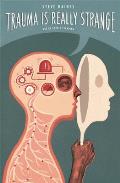
“Trauma Is Really Strange” by Steve Haines, art by Sophie Standing

December 24, 2017 by Sonia Connolly 2 Comments

book cover

Recommended to me by: boxofdelights

This is a graphic “novel” (although it’s non-fiction) or comic, or graphic medicine book. Each page is divided into panels with drawings and word bubbles, sometimes with additional explanations in tiny red print at the bottom of the page.

This is a solid introduction to the nervous system and how it responds to stress, including the sympathetic and parasympathetic nervous systems and Porges’ polyvagal theory, all in a friendly reassuring format. Trauma is defined as events that exceed our ability to cope with them. Healing is focused on being present and tolerating intense internal sensations, rather than reworking the past or experiencing big emotional catharsis. The goal is to tone down the reflexes of fight-or-flight and dissociation.

“Healing trauma is about meeting the body. In trauma, old parts of the brain change how the body works. By paying attention to feelings in the body and learning to self-regulate we can reboot the brain.”

The material is familiar to me, with a different emphasis than I’m used to, perhaps because the book is British.

The people in the drawings almost all come across as male. A few have more detail and come across as female. The people do have a wide range of skin colors, which is great. There is a drawing of a baby being born out of a disembodied blob – apparently it was too hard to draw a whole person giving birth. There was a surprisingly ableist use of “blindly” that brought me up short.

The book covers a lot of ground in a clear way. Of course it can’t cover everything. At the same time, I would have liked to see a disclaimer that everyone’s experience with trauma is different, and everyone’s healing path is different. Near the end, there is an entire page dedicated to Trauma Release Exercises (TRE), and the whole book feels skewed toward people for whom that’s the answer.

Yes, it’s less neat and reassuring to say, “This works for some people, not all,” but it is more honest, and more kind to those for whom it is all more complicated.  The last thing a traumatized person needs is to hear, “This works for everyone,” when that thing doesn’t work for them.

Available at bookshop.org.

Filed Under: nonfiction Tagged With: healing, illustrated, psychology, trauma

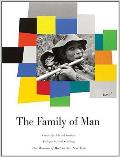
“The Family of Man” by Edward Steichen

November 24, 2017 by Sonia Connolly Leave a Comment

book cover

Recommended to me by: Asakiyume

A photo book from an exhibition in 1955 showing 503 photographs of people from around the world living their lives.

The use of “Man” for people bothered me at the outset, and I grumpily examined the book through the lens of inclusion and exclusion. There are women and people of color pictured, and the women get to be strong and active too. The places where men predominate, in suits in a courtroom for example, they predominated in 1955. There were many photos from the USA, where the exhibit was originally held.

This is a great book for children, to show them that people are essentially the same everywhere, and also that people and cultures have infinite variation. Also a great book to find prompts for stories. I wanted to know more about the people in each photo, to get to know a few of them in depth rather than move through the teeming crowd of them.

Asakiyume’s post has a great sampling of photos.

Available at bookshop.org.

Filed Under: nonfiction Tagged With: illustrated

  • « Go to Previous Page
  • Page 1
  • Interim pages omitted …
  • Page 4
  • Page 5
  • Page 6
  • Page 7
  • Page 8
  • Interim pages omitted …
  • Page 15
  • Go to Next Page »

Primary Sidebar

Recent Books

  • “We Belong to the Drum” by Sandra Lamouche and Azby Whitecalf
  • “Atlas of the Heart” by Brene Brown
  • “Life After Cars” by Sarah Goodyear, Doug Gordon, Aaron Naparstek
  • “Tidy First?” by Kent Beck
  • “When You Had Power” and “You Knew the Price” by Susan Kaye Quinn
  • “Taproot” by Keezy Young
  • “The Tower at Stony Wood” by Patricia A McKillip
  • “Hospicing Modernity” by Vanessa Machado de Oliveira
  • “How We Show Up” by Mia Birdsong
  • “The Enchanted Greenhouse” by Sarah Beth Durst

Tags

activism aging anti-racism bodywork business childhood abuse childrens CivicTech communication disability domestic violence fantasy feminism finance Focusing food fun healing health at any size illustrated Judaism leadership lgbt marketing memoir music natural world neurodiversity politics psychology relationship romance science science fiction software spirituality survival story trauma writing young adult

Categories

Archives

Please note: bookshop.org and Amazon links are affiliate links. Copyright © 2026 · Genesis Sample on · WordPress