• Skip to primary navigation
  • Skip to main content
  • Skip to primary sidebar
Curious, Healing

Curious, Healing

Books about healing, business, and fun

  • About Sonia Connolly

spirituality

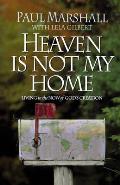
“Heaven is Not My Home” by Paul Marshall

December 24, 2009 by Sonia Connolly Leave a Comment

Recommended to me by: a client.

Learning about marketing has taught me a great phrase to avoid frustration with a business’s advertising, selection, or service: “not the target market.” I simply assume that I am not an intended customer of that business, and continue on my way.

Similarly, my Jewish background and mix of Buddhist and Pagan beliefs mean I am clearly not the target market of this book written for evangelical Christians. I had to constantly read around the assumptions that the reader is a Christian, that Christians are marginalized in modern society, and that it is a duty to convert others.

I deeply agree with the core message that, no matter what our beliefs about the hereafter, we need to create meaning in our lives and protect our environment in the here and now. I also agree that the best “witnessing” for any faith comes from daily actions, not words.

I enjoyed the colorful vignettes from the author’s travels as an exploratory geologist. I engaged with the discussion of how to live in the modern world in a principled and ethical way.

I had heard and struggled with the idea that 10% of one’s income should be tithed to charity. I like the Biblically-supported modification presented here, that the tithe includes community celebration, money spent to eat, drink, and be merry in the company of everyone who has lived to enjoy the day. My heart opens to the idea of giving back by celebrating in community.

In the end, the book felt like a handful of fragments rather than a coherent whole. I suspect the connections lie in the parts that did not apply to me.

Available at bookshop.org.

Filed Under: nonfiction Tagged With: spirituality

“Ask and It Is Given: Learning to Manifest Your Desires” by Esther and Jerry Hicks

December 20, 2009 by Sonia Connolly Leave a Comment

Recommended to me by: Emma McCreary, and Jeannette Maw

This is the original source for the term “Law of Attraction”, as described by “Abraham” (a collective of Non-Physical Beings) and conveyed through Esther Hicks.

The Law of Attraction is defined as:

  1. Ask (we are doing this all the time with our desires)
  2. Source answers immediately
  3. Allow the response (by matching its vibration – this is the hard part)

According to the book, humans are here to experience contrasts that illuminate our preferences, which lead to desires, which lead to manifestation. We are meant to exist in a state of joyous trust and expectation, which allows our desires to manifest.

If desires are not manifesting, it is because either our vibrations/emotions are not allowing them, or because our attention/requests are focusing on what we don’t want. It is easy to interpret this as victim-blaming, although the book tries to avoid that.

At the same time, it is clearly stated that we are here to experience contrasts, so there is nothing wrong with negative experiences.

It is also emphasized that our emotions are signposts for our thoughts and beliefs, so there is nothing to be gained by denying our emotions, and everything to be gained by noticing them. A list of 22 emotions is arranged from highest vibration (joy) to lowest (despair).

Thoughts are said to attract similar thoughts, so improving vibration is a gradual, incremental process.

The second half of the book contains exercises or games to improve our vibration. To my surprise, several of them are already an important part of my life.

  • Express appreciation and gratitude.
  • Notice how you feel, and look for thoughts that feel true and also make you feel slightly better. Repeat.
  • Meditate.
  • Clear clutter, gently and incrementally.
  • Notice the essence and feeling of what’s desired, and look for ways you already have that, or can easily bring it in.

One I plan to add to my toolbox:

  • At each transition in your day, pause and set an intention for the next segment.

I am less engaged by the games that involve pretending, or ignoring what is happening right now.

Before reading Jeannette Maw’s Good Vibe Blog, I was very skeptical about the Law of Attraction, in part because I had heard about it filtered through many layers of interpretation. I’m glad I encountered her non-judgmental take on it, and that Emma McCreary suggested reading the original source.

I still balk at the idea that reality is entirely malleable. I feel very uneasy and ungrounded with that thought, so I will continue to believe that there are essential truths underlying our experiences.

At the same time, I also believe that it is beneficial to notice our internal environment, and seek out thoughts and experiences that feel better. I see a lot of wisdom and power for healing in this book.

I am sitting with the question of whether our desires are all trustworthy. Is there truly enough abundance to accommodate everyone’s desires? What about environmental limitations, and desires which cause harm to others?

I recommend the book if you want clarity on what the Law of Attraction really is, and if you like reading new ideas and keeping the parts that work for you.

Available at bookshop.org.

Filed Under: Uncategorized Tagged With: psychology, spirituality

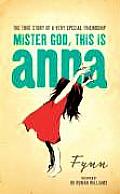
“Mister God this is Anna” by Fynn

September 26, 2009 by Sonia Connolly Leave a Comment

I bought this book about 20 years ago for the delightful drawing on the cover. At the time, I read it as a rescue story, set in the 1930’s in London’s East End. 5 year old Anna has run away from an intolerable home life, and is found and adopted by gruff, kind, 19 year old Fynn and his dependable mum.

Fynn makes an effort to educate his new best friend, and finds himself educated at the same time by her headlong explorations of physics and her effervescent ideas about Mister God.

I picked the book up recently and re-read it, and this time it reads more like an allegory, where Fynn and young Anna are vehicles for the Author’s Message about God.

The Wikipedia page about the book reveals that Fynn is a pseudonym for Syndey Hopkins, and gives more information about his life. He did grow up in the East End of London in the 1930’s.

In the book, as Fynn and Anna discuss philosophy and religion, they also explore the East End with all their senses, and share it with the reader. Those details, along with William Papas’ impressionistic line drawings, are my favorite parts of the book.

Available at bookshop.org.

Filed Under: fiction Tagged With: illustrated, spirituality, survival story, trauma

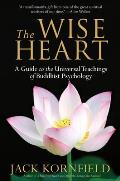
“The Wise Heart – A Guide to the Universal Teachings of Buddhist Psychology” by Jack Kornfield

August 5, 2009 by Sonia Connolly 2 Comments

Jack Kornfield, an experienced American meditation teacher, combines Buddhist philosophy, meditation exercises, and stories about his students and himself into a thorough introduction to Buddhist psychology.

The Buddhist therapeutic techniques for resolving trauma are strikingly similar to Somatic Experiencing techniques. One comes from self-observation, and one comes from observation of other animals. Perhaps it’s unsurprising that they have converged on a similar set of gentle, effective techniques.

I had a lot of reactions while reading the 400 pages of this book. Interest in people’s experiences with meditation and transformation. Boredom with the more esoteric details about Buddhism. Self-judgment about my own meditation experiences. Longing for the support of a meditative community. Relief when reading about self-acceptance.

One section describes the three personality types that cause suffering: grasping, aversive, and deluded. We all have elements of these types, and may lean strongly toward one of them. Fortunately, awareness and acceptance can mitigate the suffering they cause, and even bring positive benefits.

I felt defensive about recognizing the aversive type in myself. Yeah, okay, so I have a strong judgmental voice. At the same time, it’s a relief to realize that lots of people struggle with this. It’s normal, acceptable. The positive side of aversion is discernment.

I recommend this book if you’re interested in a warm, accessible, occasionally dry introduction to Buddhist thought. It can be fascinating to observe your reactions as you read!

Available at bookshop.org.

Filed Under: nonfiction Tagged With: memoir, psychology, spirituality

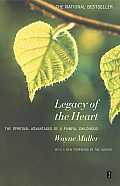
“Legacy of the Heart – the spiritual advantages of a painful childhood” by Wayne Muller

April 15, 2009 by Sonia Connolly 2 Comments

Recommended to me by: Emma McCreary

With warmth and care, Muller describes some of the outcomes of an abusive childhood, or “family of sorrow,” and some spiritual tools that can bring healing.

Near the beginning of the book, he proposes an exercise that resonated deeply with me. (Emphasis added.)

[F]or a single day: Resolve to go through an entire day assuming that you are trustworthy, that all your feelings are accurate, that all your perceptions and intuitions are reliable. As you approach each person or situation, ask yourself the questions, If I knew that I was absolutely trustworthy, how would I handle this moment? What would I do? What could I say that would be true? What would be the right action to settle this situation with safety and clarity?

I wish this exercise had been proposed to me by every healer I’ve seen. I wish everyone in confusion, doubt, and pain could be encouraged to try this, and begin to find their center again.

He takes spiritual insights from Christianity, Judaism, Sufism, Buddhism, and other faiths. As an ordained minister, he is clearly most familiar with Christianity, awkwardly referring to Jews as “Hebrews.”

Each chapter covers a different effect of a difficult childhood, including Pain and Forgiveness, Fear and Faith, Grandiosity and Humility, etc. Some chapters spoke to me more than others, despite his assumption that everyone would have all the issues he mentions.

He can also be prescriptive in some of his exercises, for example suggesting that one speak the words of forgiveness whether one feels them or not. While forgiveness can be powerfully healing, I believe that it cannot be rushed, and forcing the process only prolongs the pain.

Overall, I recommend this book to anyone who is struggling with creating meaning from a painful childhood. As the quote above recommends, keep a careful eye on what resonates for you, and skip over what does not. Different chapters may speak to you at different times.

Available at bookshop.org.

Filed Under: nonfiction Tagged With: childhood abuse, healing, psychology, spirituality, trauma

  • « Go to Previous Page
  • Page 1
  • Interim pages omitted …
  • Page 8
  • Page 9
  • Page 10

Primary Sidebar

Recent Books

  • “How We Show Up” by Mia Birdsong
  • “The Enchanted Greenhouse” by Sarah Beth Durst
  • “What It Takes to Heal” by Prentis Hemphill
  • Kitchens of Hope by Linda S. Svitak and Christin Jaye Eaton with Lee Svitak Dean
  • “Very Far Away From Anywhere Else” by Ursula K Le Guin
  • “Seaward” by Susan Cooper
  • “Surviving Domestic Violence” by Elaine Weiss
  • “The Book of Love” by Kelly Link
  • “Alexandra’s Riddle” by Elisa Keyston
  • “Weaving Hope” by Celia Lake

Tags

activism aging anti-racism bodywork business childhood abuse childrens CivicTech communication disability domestic violence fantasy feminism finance Focusing food fun healing health at any size illustrated Judaism leadership lgbt marketing memoir music natural world neurodiversity politics psychology relationship romance science science fiction software spirituality survival story trauma writing young adult

Categories

Archives

Please note: bookshop.org and Amazon links are affiliate links. Copyright © 2026 · Genesis Sample on · WordPress