• Skip to primary navigation
  • Skip to main content
  • Skip to primary sidebar
Curious, Healing

Curious, Healing

Books about healing, business, and fun

  • About Sonia Connolly

spirituality

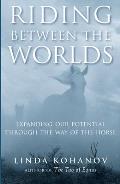
“Riding Between the Worlds” by Linda Kohanov

July 23, 2010 by Sonia Connolly 1 Comment

My response to The Tao of Equus doesn’t begin to express the impact it had on me. I immediately looked for Kohanov’s next book.

Riding Between the Worlds contains less abstract theory and more stories from clients and from her own life. It also contains a helpful adaptation of Karla McLaren’s work with emotions into an Emotional Message Chart.

For example:

Emotion Message Questions to Ask Intensification
Anger Proper boundaries should be maintained or rebuilt.

Incongruence.

What must be protected?

What must be restored

What is the emotion behind the mask, and is it directed toward me?

Rage, fury (exploding at those who’ve violated our boundaries)

Shame, guilt (anger toward self when we’ve violated others’ boundaries)

Boredom, apathy (masks anger that can’t be dealt with – a nonviolent coping strategy

Kohanov validates my experiences with transmission of emotions from one person to another, describing the many ways that happens with both people and horses in her practice.

She also talks extensively about congruence and how important it is to both horses and sensitive humans. Incongruence, a mismatch between what someone is feeling and expressing, can cause trouble both for the incongruent person who is suppressing feelings, and the beings around them who may be the target of deception or explosive release.

Kohanov also presents her hard-won list of skills for building community:

  1. Using emotion as information.
  2. Sitting in uncomfortable emotions without panicking.
  3. Sensing and flowing with the emotions of others, again without panicking.
  4. Reading “misbehavior” as a form of communication.
  5. Understanding the dynamics of shared emotion: distinguishing between instructive personal feelings, conditioned (False Self) emotional patterns, affect contagion, empathy, ambience, and emotional resonance.
  6. Resisting the temptation to aggressively “fix” people, horses, uncomfortable situations, etc.
  7. Creating a psychological container of support, what Kathleen Ingram calls “holding the sacred space of possibility.” This fully engaged form of patience is crucial to tapping innovative solutions that arise from the eighth ability:
  8. Activating the Authentic Self.

The only sour note in the book occurs when she creates a false sense of suspense by telling half a story and then inserts 30 pages of other material before returning to the story.

Highly recommended for anyone who believes they are too sensitive or too emotional.

Available at bookshop.org.

Filed Under: nonfiction Tagged With: healing, memoir, psychology, spirituality

“Hand Wash Cold” by Karen Maezen Miller

July 14, 2010 by Sonia Connolly Leave a Comment

Subtitle: Care Instructions for an Ordinary Life

Recommended to me by: Shambhala Sun excerpt.

Miller is a Zen Buddhist priest and teacher. This memoir is organized around three household tasks as metaphors for Zen living – laundry, dishes, and gardening. I enthusiastically agree with the premise that household maintenance is an integral part of life, rather than something to be suffered through or outsourced.

At the same time, I had trouble warming to this tale of unhappy high-powered businesswoman in one marriage turned Zen stay-at-home mom in another. She says about the second, current marriage: “No, ours is not a marriage of friends making nice. … Ours is a marriage of adversaries making peace.” I’m glad that works for her. I don’t think it would work for me.

I did like her take on parenting: “There is no right way to parent; only a right-now way. … Children always show us the present moment unfolding.”

Available at bookshop.org.

Filed Under: nonfiction Tagged With: memoir, spirituality

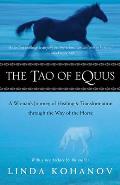
“The Tao of Equus” by Linda Kohanov

July 5, 2010 by Sonia Connolly 1 Comment

Subtitle: A Woman’s Journey of Healing and Transformation through the Way of the Horse

Recommended to me by: A client.

Linda Kohanov and her herd of sensitive horses offer equine facilitated psychotherapy. Together they help both horses and humans recover from trauma, regain their balance, and treat each other with more respect.

This many-layered book contains autobiography, horse stories, client case studies, myths, theories about emotions and the brain, and diatribes about traditional horse training.

Kohanov convincingly claims that horses are intelligent partners, extraordinarily capable of reading and reflecting the emotions around them. She contrasts postconquest thought, divorced from the body, with preconquest thought, congruent with the body. Horses respond to lack of congruence as a threat, thus giving feedback to help people reconnect with their body and emotions.

One case study highlighted how we tend to respond to agitation by mirroring it. Instead, we can consciously calm ourselves, inviting the other person (or horse) to become calm as well. I’ll keep that technique in mind.

Before reading this book, I had heard of equine facilitated therapy without much interest. As I was reading it, I wished Kohanov’s ranch were closer than Arizona so I could go try it out. Her combination of sensitivity and groundedness sounds similar to the healing work I do.

Available at bookshop.org.

Filed Under: nonfiction Tagged With: bodywork, healing, psychology, spirituality

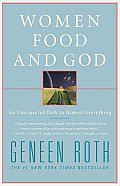
“Women Food and God” by Geneen Roth

May 31, 2010 by Sonia Connolly 2 Comments

Recommended to me by: a client.

The opening scene drew me in immediately. Geneen Roth shows eighty women furious at her because she is not yet letting them eat their tomato soup at a retreat about food and mindfulness. A few women bravely share their process of connecting to old pain and realizing that their adult selves can tolerate the pain without numbing themselves with excessive food.

Roth’s core message is transformative: how we relate to food is how we relate to our image of God. Until we bring conscious awareness to our process, how we relate to food and God is likely to be modeled on how our earliest caretakers related to us, and to themselves.

When we realize that we don’t need fixing, that our core self is already radiantly sacred, our obsessions and addictions fall away.

In my twenties, I hated my body, dieted regularly, and obsessed about food. In my thirties, I declared a moratorium on diets. I make my choices about food and exercise, and my body weighs whatever it’s going to weigh. It did that anyway, even when I counted calories.

Sometime after that, I declared that I don’t need fixing. I had hit bottom with allowing others to tell me what might be wrong with me. The message is spreading through me over time. Some parts of me continue to believe that it’s helpful to criticize or shame myself.

I wonder if Geneen Roth is experiencing something similar. Her overt message is about self-acceptance and compassion. At the same time, the book is sprinkled with half-joking self-denigrating comments.

There is a subtle negativity about being fat as well. One example: In the prologue where eighty women are waiting to eat their soup, one woman’s “tiny body” is described as “delicate, perfectly erect.” No one else’s body is described at all.

I hear the message as, “When you are self-accepting and self-aware, your healthy food and exercise choices will cause you to arrive at your natural weight, which will not be fat.” It is hard to be self-accepting as a fat person, while also believing that healthy, “natural weight” people are not fat.

I love Geneen Roth’s message that our adult selves can handle pain that was overwhelming in childhood. We’re not broken after all. I hope her next book will include more self-acceptance and compassion for compulsive eating and all our other “negative” avoidance behaviors.

I recommend Kate Harding’s blog Shapely Prose for more about fat acceptance. Two relevant articles are But Don’t You Realize Fat is Unhealthy and Why I Still Use the Term Fat Acceptance.

Previously reviewed: “When Food is Love” by Geneen Roth.

Available at bookshop.org.

Filed Under: nonfiction Tagged With: healing, health at any size, psychology, spirituality

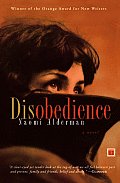
“Disobedience” by Naomi Alderman

May 18, 2010 by Sonia Connolly Leave a Comment

Recommended to me by: Spirituality Bookgroup.

This novel about convention, betrayal, growing up, and finding center is filled with wisdom and grace.

Ronit grew up in a tiny, insular Jewish Orthodox congregation within London. She is the rebellious daughter of their revered Rabbi. Aided by her father’s sending her to an American university, she has escaped to a secular life in New York City.

Now, her father has died, and she returns to encounter her cousin Dovid, the Rabbi’s heir apparent, and his wife Esti. Esti and Ronit were lovers as teen-agers. Despite her marriage and orthodox beliefs, Esti still carries a flame for Ronit.

The characters and the setting drew me in completely while I was reading. Where I expected the triumph of prejudice and small-minded cruelty, I saw instead surprising compassion and open-hearted possibilities. I celebrated that two couples found ways to re-commit to their marriages.

As I thought about the book afterwards, I started to wonder about the emphasis on marriage as sacred, leaving Ronit as the marriage-disturbing lesbian outsider. While I enjoyed the book, I strongly disagree with that (possibly unintentional) underlying message.

Naomi Alderman’s blog: naomialderman.com.

Available at bookshop.org.

Filed Under: fiction Tagged With: fun, Judaism, lgbt, spirituality

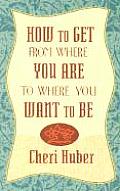
“How to Get From Where You Are to Where You Want To Be” by Cheri Huber

March 4, 2010 by Sonia Connolly 3 Comments

In connection with reading Being Bodies, I tracked down this book. It turns out I’d read it a long time ago and remembered many of the stories, although I’d forgotten their source.

Cheri Huber herself admits that the title is a bit of a trick. Rather than trying to move from Here to There, she advocates giving careful attention to Here, since that’s all there ever is.

She shares harrowing vignettes from her own life with a “that’s just how it is” tone. Her quest for meaning and peace led her to Zen meditation, where she encountered the simple instructions to sit in full lotus and count breaths up to 10, and then begin again.

Desperate for change, she sat in full lotus for hours, and counted breaths no matter what she was doing. After counting breaths during a 10-hour drive, she finally encountered the peace of the present moment. In time, she joined a Zen monastery, started teaching, and went on to found her own Zen center.

Woven with her own journey, she introduces gentle steps for becoming aware of social conditioning and self-hatred, and easing the grip of the resistance they cause. After each exercise, she implores “Please do not allow conditioning to use your awareness against you.”

For example, she introduces meditation by suggesting: Take three full breaths. What did you notice? Do it again. There, you’re meditating! I follow these non-instructions in my own meditation practice. Fortunately, full lotus position is optional!

She summarizes the steps for true, gentle change:

  1. Choose an issue you want to work with.
  2. Sit down, stay still, and be aware of all that goes on.
  3. Notice what belief systems are held in place with this issue.
  4. Notice which subpersonalities [and/or defense mechanisms] are involved.
  5. Listen to what the [internal judging] voices have to say about the issue about who you are for having it.
  6. Become aware of the projections made onto yourself and others because of this issue.
  7. Explore the emotions that keep this issue real.
  8. Find out where the issue is held in your body – where is the epicenter?
  9. Practice disidentifying by moving your focus of attention away from the issue and returning it to the breath.
  10. Remember to do this – and everything you do – in a context of compassionate acceptance of all that is.

She shares stories from her students’ journeys as well. One man at a Zen retreat became angry about a dirty mop bucket left on the steps, and each day muttered to himself, “Someone should do something about that!” Finally he realized that he was “someone” and cleaned the bucket.

This book is full of treasures. I recommend it to anyone looking for compassionate suggestions about how to find center and self-acceptance.

Available at bookshop.org.

Filed Under: nonfiction Tagged With: healing, memoir, psychology, spirituality

  • « Go to Previous Page
  • Page 1
  • Interim pages omitted …
  • Page 7
  • Page 8
  • Page 9
  • Page 10
  • Go to Next Page »

Primary Sidebar

Recent Books

  • “We Belong to the Drum” by Sandra Lamouche and Azby Whitecalf
  • “Atlas of the Heart” by Brene Brown
  • “Life After Cars” by Sarah Goodyear, Doug Gordon, Aaron Naparstek
  • “Tidy First?” by Kent Beck
  • “When You Had Power” and “You Knew the Price” by Susan Kaye Quinn
  • “Taproot” by Keezy Young
  • “The Tower at Stony Wood” by Patricia A McKillip
  • “Hospicing Modernity” by Vanessa Machado de Oliveira
  • “How We Show Up” by Mia Birdsong
  • “The Enchanted Greenhouse” by Sarah Beth Durst

Tags

activism aging anti-racism bodywork business childhood abuse childrens CivicTech communication disability domestic violence fantasy feminism finance Focusing food fun healing health at any size illustrated Judaism leadership lgbt marketing memoir music natural world neurodiversity politics psychology relationship romance science science fiction software spirituality survival story trauma writing young adult

Categories

Archives

Please note: bookshop.org and Amazon links are affiliate links. Copyright © 2026 · Genesis Sample on · WordPress