• Skip to primary navigation
  • Skip to main content
  • Skip to primary sidebar
Curious, Healing

Curious, Healing

Books about healing, business, and fun

  • About Sonia Connolly

memoir

“Alchemy of Illness” by Kat Duff

March 24, 2012 by Sonia Connolly Leave a Comment

Subtitle: A woman explores the transforming – and, paradoxically, healing – experience of being ill

Recommended to me by: a client

Alchemists strive to turn lead into gold by heating it alone in a sealed container, a crucible. In the crucible of Chronic Fatigue Syndrome, Kat Duff turned inward and found healing in the stillness and isolation forced by her illness.

Weaving together symptoms, dreams, mythology, Jungian psychology, and alchemy along with anthropological research into illness and healing, Duff reveals new perspectives on illness. Instead of being an assault or a punishment, illness can be a natural consequence of our history as individuals and communities. She sees her illness as an agent of healing both for sexual abuse she suffered as an infant, and for the land theft her forebears committed against the Sioux tribe in Minnesota.

Duff is careful to avoid the painful idea that “sick people are personally responsible for creating their illnesses through some kind of wrong-thinking or wrong-doing.” Sickness isn’t bad. It just is.

She relates a story about Nan Shin, a Zen nun diagnosed with cancer and struggling with guilt and remorse.

Then an old friend, who was also a Zen student, visited. He threw his arm around her shoulders and wisecracked, “Good Karma, huh? Brings you close to the Way.” Shin wrote later, “The jolt I felt then showed me very clearly that I had been thinking, Bad Karma. Within a fraction of a second the molecules turned themselves round and reorganized. I am flatly grateful to him forever.”

Unfortunately, Duff conflates illness with disability, and occasionally uses phrases like “confined to a wheelchair.” People are not confined by wheelchairs any more than people are confined by bicycles, cars, or any other device that assists mobility.

I recommend this book for its kaleidoscope of new perspectives about illness.
Available at bookshop.org.

Filed Under: nonfiction Tagged With: disability, memoir, spirituality, survival story, trauma

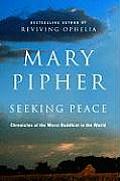
“Seeking Peace” by Mary Pipher

March 21, 2012 by Sonia Connolly Leave a Comment

Subtitle: Chronicles of the Worst Buddhist in the World

Recommended to me by: Bay Area Spirituality Bookgroup

Mary Pipher didn’t expect to become famous for writing “Reviving Ophelia” and she fell into despair after years of touring and speaking engagements. The book covers her despair, her parents, her childhood, and then her healing. She says she is the worst Buddhist in the world because she has trouble sitting still and paying attention.

In the introduction she apologizes at length for having a crisis as a happily married and successful career woman when other people have real problems and real traumas. Then she describes her childhood family’s real problems and real traumas. She did have a fairly ordinary college career and young adulthood, at which point I put the book aside in frustration at its circular approach to the initially-described crisis.

I did pick it up again and read quickly through her healing approach, which included slowing way down, spending a lot of time in nature, trying yoga and massage for the first time, and meditating. She notices her vicious self-critic who cares about whether she is helping others but not about whether she is happy. With time and attention the critic mellows and she comes to a place of more acceptance for herself as she is.

I wish she had noted in her introduction that comparing our crises and traumas to other people’s is a tool of self-criticism rather than compassion. Swallowing our pain because someone else has been hurt more helps no one.

Available at bookshop.org.

Filed Under: nonfiction Tagged With: memoir, spirituality

“The Armless Maiden” edited by Terri Windling

December 15, 2011 by Sonia Connolly Leave a Comment

Subtitle: And Other Tales for Childhood’s Survivors

This is an anthology of fairy tales retold for adults, with the scary bits left in, and also the bits about resilience and survival. Yes, her father cut off her arms, but then the armless maiden rescues herself and her child through quick wits as well as magic.

The stories vary widely from beautifully retold tales, to heart-wrenching realities, to clunky pieces using child abuse for cheap drama. I imagine each reader would put different stories in the three categories.

Some of my favorites are:

  • “The Session” by Steven Gould, where an adult Sleeping Beauty has a therapy session about who, exactly, gave her that poisoned apple.
  • “Knives” by Munro Sickafoose, where a girl is isolated in a tower by her beloved father, and has to learn about the outside world after he dies.
  • Terri Windling’s “The Green Children” about a young girl whose mother killed her abuser, and Terri Windling’s essay about her real mother, who didn’t.
  • “The Little Dirty Girl” by Joanna Russ rings true about what’s needed for healing.

This is a book to read slowly, with time for emotional processing, and plenty of permission to skip the stories that don’t resonate for you, or that resonate too much.

Available at biblio.com.

Filed Under: fiction Tagged With: childhood abuse, healing, memoir, survival story, trauma

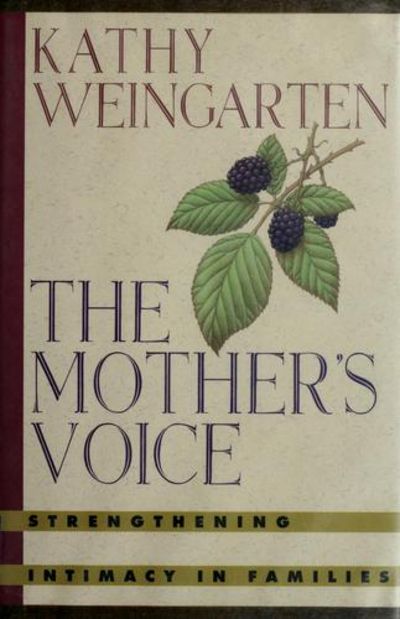
“The Mother’s Voice” by Kathy Weingarten

November 12, 2011 by Sonia Connolly Leave a Comment


Subtitle: Strengthening Intimacy in Families

I read this by coincidence, and it fits perfectly with themes I’ve been thinking about lately. Kathy Weingarten, a family therapist, addresses double binds that society creates for women around acceptable roles and definitions of success. She talks about dominating behaviors in men and how to address them. She weaves her personal story of motherhood, illness, and family together with societal trends. Throughout, she maintains awareness of intersectional issues of race, class, sexual orientation, and gender.

When she was diagnosed with breast cancer, she realized that her need to focus on her health conflicted directly with her need to be a “good mother” by focusing wholly on her pre-adolescent children. This contrast brought to light the invisible constraints society placed on her thoughts about mothering. She includes thoughts about the roles of wives and fathers as well.

At age 7, her son bullied her daughter, then 3 years old. She withdrew from his dominating behavior, and had to consciously reconnect with him. As she connects with him as “like her” rather than disconnecting as “alien, unlike her,” she has leverage to change the roles society prescribes for boys, sons, and men, as well as for mothers.

When she shares her true feelings and thoughts with her children in age-appropriate ways rather than maintaining a perfectly serene front, she builds real connections with them and allows them to see her as a separate person.

I appreciate how much consciousness and intention Weingarten brings to her mothering.

Some passages become repetitive, perhaps in an attempt to convince the reader, but that is a minor flaw. Overall, this is a beautifully written, carefully thought out, intimate gift of a book. Highly recommended.

Available at biblio.com

Filed Under: nonfiction Tagged With: communication, feminism, memoir, psychology

“I Thought We’d Never Speak Again” by Laura Davis

November 4, 2011 by Sonia Connolly 1 Comment

Subtitle: The Road from Estrangement to Reconciliation

Recommended to me by: Laura Davis’s website

Laura Davis is co-author of the classic book about healing from incest, “The Courage to Heal.”

This book is written with compassionate awareness that not all stories have happy endings and not all estrangements can be reconciled. Nevertheless, I cried while reading it, for all the estrangements I have been unable to reconcile, and for all the reconciliations that turned out to be grave mistakes, and for all the fears that I should have been able to do it all better.

It has concrete suggestions for how to evaluate the possibility of reconciliation and take steps toward it, as well as a variety of gritty, beautiful stories about others’ attempts and successes. Davis’ reconciliation with her mother is woven through the book.

Recommended, if you have the time and energy to work through the feelings it might bring up.

Available at bookshop.org.

Filed Under: nonfiction Tagged With: communication, healing, memoir, psychology

“Street Without a Name” by Kapka Kassabova

October 26, 2011 by Sonia Connolly Leave a Comment

Subtitle: Childhood and Other Misadventures in Bulgaria

Recommended to me by: Ceil Wirth on the EEFC mailing list

Kapka Kassabova’s chilling, yet engaging, personal memoir of growing up in communist Bulgaria, and then returning to visit shortly after Bulgaria joined the European Union. The characters are finely drawn, and each chapter covers a different aspect (home, school, summers) in overlapping chronologies. The childhood section focuses primarily on Sofia, the capital, and the adult section covers all the regions of Bulgaria, shading into travelogue more than memoir. Woven around personal details, she covers history, current events, communism, capitalism, and ever-present tensions and truces between different ethnicities (Bulgarians, Turks, Macedonians, Greeks).

Her family emigrated to New Zealand when Kassabova was 18, and the book was written in English and published in the US, with the occasional New Zealand turn of phrase.

Kassabova is a few years younger than I am. While she was growing up with her sister and parents in a 2-room (not 2 bedrooms, 2 rooms total) apartment, struggling for food and boots and sometimes electricity and water, I was growing up with relative plenty, vaguely aware but mostly oblivious of others’ struggles.

Coincidentally we also visited Bulgaria at around the same time in 2007, although I only went to Sofia and Bansko. We visited many of the same attractions in those places, and I appreciated learning more details about them. For example, I drank from the mineral spring in the center of Sofia, but didn’t know that it flooded the main street when they first accidentally dug into it.

My attention wandered occasionally while reading, but overall I recommend this book highly as a memoir and a source of information about Bulgaria then and now.

Available at bookshop.org.

Filed Under: Uncategorized Tagged With: fun, memoir

  • « Go to Previous Page
  • Page 1
  • Interim pages omitted …
  • Page 10
  • Page 11
  • Page 12
  • Page 13
  • Page 14
  • Interim pages omitted …
  • Page 17
  • Go to Next Page »

Primary Sidebar

Recent Books

  • “How We Show Up” by Mia Birdsong
  • “The Enchanted Greenhouse” by Sarah Beth Durst
  • “What It Takes to Heal” by Prentis Hemphill
  • Kitchens of Hope by Linda S. Svitak and Christin Jaye Eaton with Lee Svitak Dean
  • “Very Far Away From Anywhere Else” by Ursula K Le Guin
  • “Seaward” by Susan Cooper
  • “Surviving Domestic Violence” by Elaine Weiss
  • “The Book of Love” by Kelly Link
  • “Alexandra’s Riddle” by Elisa Keyston
  • “Weaving Hope” by Celia Lake

Tags

activism aging anti-racism bodywork business childhood abuse childrens CivicTech communication disability domestic violence fantasy feminism finance Focusing food fun healing health at any size illustrated Judaism leadership lgbt marketing memoir music natural world neurodiversity politics psychology relationship romance science science fiction software spirituality survival story trauma writing young adult

Categories

Archives

Please note: bookshop.org and Amazon links are affiliate links. Copyright © 2026 · Genesis Sample on · WordPress