• Skip to primary navigation
  • Skip to main content
  • Skip to primary sidebar
Curious, Healing

Curious, Healing

Books about healing, business, and fun

  • About Sonia Connolly

politics

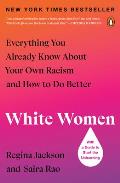
“White Women: Everything You Already Know About Your Own Racism and How to Do Better” by Regina Jackson and Saira Rao

July 2, 2023 by Sonia Connolly Leave a Comment

book cover
Subtitle: With a Guide to Start the Unlearning
Recommended to me by: Third Eye Books giveaway

On International Women’s Day in March 2023, I heard that Third Eye Books was giving away an anti-racist book for white women. I clicked on the link to receive one. After a few weeks, I realized it never arrived and looked back at their website. They had received 50,000 orders! I thought they would only send books to the first few (hundred) people who ordered, but just in time for Juneteenth 2023, the book arrived.

From the introduction:

“Race2Dinner was founded in 2019 as a dinner experience with Regina Jackson, a Black woman; Saira Rao, an Asian woman; and eight-to-ten white women. […] These dinners require white women to participate in direct, difficult conversations. It is not for the faint of heart.”

The preface speaks directly to white women.

“You know what you’re doing. But you pretend not to. […] So yes, we’ll explain to you how you’re racist. Even though we’re pretty sure you already know, whether you’re ready to admit it or not. […]

“White men may be on the throne. But you white women are shining it, fluffing the cushions, catching the coins that fall from their laps. […]

“YES. ALL. WHITE. WOMEN”

I kept reading with my eyebrows raised. A whole book of being yelled at did not sound pleasant or educational, no matter how true or justified the message. After the extended preface, the book shifts to tell the story of several of their dinner parties, and the way the conversations get derailed the same way over and over, all over the country. No wonder they’re yelling.

Saira Rao describes growing up as the daughter of Indian immigrants in a white community, aspiring to the perfection that white womanhood requires, but undermined from the start by her brown skin. The need for perfection and the endless backbiting and judgment undermine the white women around her as well. Anti-racism is only possible when mistakes are allowed, because unlearning racism and white supremacy is a difficult, mistake-ridden process.

White fragility, white tears, white allies, white saviors, white violence. They emphasize that silence is violence. Silently witnessing racism makes us an accomplice to it. We need to stand up and name what we see and speak against it, even though we are shamed and punished for breaking step with white supremacy.

Recommended as a refresher if you have already done a lot of anti-racist work. I don’t think this book would be palatable to someone just starting out.
Available at bookshop.org.

Filed Under: nonfiction Tagged With: activism, anti-racism, feminism, politics

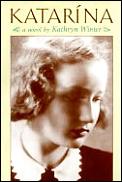
“Katarína” by Kathryn Winter

April 16, 2023 by Sonia Connolly Leave a Comment

book cover
Recommended to me by: Folk dancing with the author

I was chatting with Kathryn at a folk dance party, and explained how my grandparents had to leave Germany because of the Holocaust. She brightened in recognition and said, “I was a hidden child during the Holocaust.” Like Anne Frank, but she lived. I said, “That must have been hard!” She said no, at the time she thought the work camps were like summer camps.

Her lightly fictionalized memoir is beautifully written, a series of child’s-eye vignettes full of details about life in Slovakia at the time. It is also harrowing to read. Kathryn shows difficult events and physical and emotional pain in response, but doesn’t dwell on it. The child Katarína feels both joy and sorrow strongly, and keeps moving forward with fierce resilience. She survived through both inner strength and luck, through care from others and a loving response to care.

Highly recommended. In this time of rising fascism we need to understand fascism’s detailed cruelty to a child. This happened in living memory. We are well along on the road to it happening again. It needs to stop.

Available via Biblio.com

Filed Under: fiction, nonfiction Tagged With: memoir, politics, spirituality, survival story, trauma

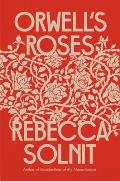
“Orwell’s Roses” by Rebecca Solnit

March 31, 2022 by Sonia Connolly Leave a Comment

book cover

Recommended to me by: It’s by Rebecca Solnit!

Rebecca Solnit starts from an encounter with rosebushes planted by George Orwell almost 100 years before, and expands with her usual grace and skill on his life as an essayist, activist, soldier in the Spanish Civil War, gardener, husband, and father. From there, she delves into his research into coal mining and its disastrous effects on the miners and on the environment; Stalin and his atrocities in the name of communism; Colombia’s greenhouses growing roses for export, with disastrous effects on the growers and the environment; and many more discursions on roses, beauty, totalitarianism, and history.

She shows that Orwell balanced the darkness in his writing and worldview with a joy in the natural world. He grew much of his own food, in addition to roses, in rural England.

Sometimes [Orwell] celebrated what was meant by the roses in “bread and roses”: the intangible, ordinary pleasure, the joy available in the here and now. [Page 92]

Bread can be managed by authoritarian regimes, but roses are something individuals must be free to find for themselves, discovered and cultivated rather than prescribed. “We know only that the imagination, like certain wild animals, will not breed in captivity,” Orwell declares at the end of “The Prevention of Literature.” [Page 100]

Clarity, precision, accuracy, honesty, and truthfulness are aesthetic values to [Orwell], and pleasures. […] Clarity, honesty, accuracy, truth are beautiful because in them representation is true to its subject, knowledge is democratized, people are empowered, doors are open, information moves freely, contracts are honored. That is, such writing is beautiful in itself, and beautiful in what flows from it. [Page 231]

I read Nineteen Eighty-Four as a twelve year old on a ten-hour flight between New York and Tel Aviv, alternating between reading a few more horrifying pages and staring blankly at the 747 bulkhead. I have avoided George Orwell ever since, even though the last few years have proved him more and more prescient. Rebecca Solnit fills in the background of how he came to write such a dark book shortly before his death from tuberculosis at 46, and shows him as a whole, extraordinary person.

Recommended to anyone who wants to be a better, more informed citizen of the world.

Available at bookshop.org.

Filed Under: nonfiction Tagged With: activism, natural world, politics

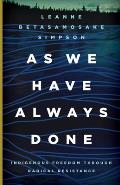
“As We Have Always Done” by Leanne Betasamosake Simpson

June 13, 2021 by Sonia Connolly 2 Comments

book cover

Subtitle: Indigenous Freedom through Radical Resurgence

Leanne Betasamosake Simpson is a renowned Michi Saagiig Nishnaabeg scholar, writer and artist who has taught and lectured across Canada. With story and analysis, she carefully lays out how Nishnaabeg ways of living, learning, and experiencing are intrinsically suited to reestablish their communities and place-relationship that have been intentionally disrupted and stolen by colonialist settlers.

A single quote out of context doesn’t do justice to the way she steps out of whiteness to center the Nishnaabeg way of thinking and doing, but here is a taste.

Governance was made every day. Leadership was embodied and acted out every day. Grounded normativity isn’t a thing; it is generated structure born and maintained from deep engagement with Indigenous processes that are inherently physical, emotional, intellectual, and spiritual. Processes were created and practiced. Daily life involved making politics, education, health care, food systems, and economy on micro- and macro-scales. […] The structural and material basis of Nishnaabeg life was and is process and relationship—again, resurgence is our original instruction.

The book addresses kwe – the embodied experience of being an Indigenous woman – and the ways capitalism, colonialism, and white supremacy have suppressed and damaged that experience. It also includes 2SQ – people who are Two Spirit and Queer.

I feel changed by reading this book. It affirms that there are right ways, sustainable ways of living, and Indigenous people still know and practice those ways. It supports my own search for connection to place and right ways to live. It reminds and teaches me that Indigenous people are brilliant modern thinkers and doers, interrupting the stereotypes of “primitive,” “lost,” and “in the past.”

Highly recommended!

Land as pedagogy: Nishnaabeg intelligence and rebellious transformation (pdf), an article by Leanne Betasamosake Simpson published in Decolonization: Indigeneity, Education & Society.

Leanne Betasamosake Simpson website

Available at bookshop.org.

Filed Under: nonfiction Tagged With: activism, anti-racism, feminism, lgbt, politics, relationship, spirituality, survival story

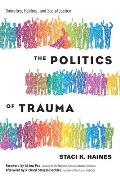
“The Politics of Trauma” by Staci K. Haines

December 26, 2020 by Sonia Connolly Leave a Comment

book cover

Subtitle: Somatics, Healing, and Social Justice

Recommended to me by: Darryl C.

This book rang true to me from beginning to end. Staci Haines combines embodied trauma work with social justice, and everything she says fits with what I already know and takes it further.

Many healing modalities view trauma and abuse as individual problems. Instead, Haines puts trauma and abuse in the context of our abusive social structures that put individuals in harm’s way. White supremacy, patriarchy, capitalism, and environmental destruction divide us from one another and keep us from learning the skills we need to treat each other with care. They keep us divided from ourselves as we try to heal.

Safety, belonging, and dignity are core needs that should be met together for everyone. Traumatic and abusive situations put one in conflict with another – we can choose either safety or dignity, either dignity or belonging. Our bodies deeply learn traumatized ways of responding to the world.

We can form declarations and commitments: statements about our core beliefs and goals that guide our healing. For example, “I am a commitment to be in my skin without apology.” (Lisa Thomas-Adeyemo) We can discover what commitments and declarations we have unconsciously adopted or had imposed upon us. Declarations can be personal or community-oriented or both.

We can find what supports us and practice resilience, reminding ourselves to come out of trauma mode. Social justice organizations can also collectively practice resilience. We can rebuild safety and trust at the embodied, physical level. We can relearn boundaries and requests.

To help someone heal, we blend with the patterns that are already true for them, and help them notice what the pattern has been taking care of for them. As the body is supported and honored, the underlying physical and emotional memories and holding patterns can be released. We can help someone feel allied with, exactly as their body needs to feel it.

For example, make a fist with one hand. With the other hand, try to pry it open. How does that feel? Instead, let your other hand support the fist with curiosity and kindness. How does that feel? What happens with your fist? With the rest of your body?

Trauma is held in the body through bands of tension, or absent slackness. A healthy body has relaxed presence. Somatic opening is encouraged by blending with what is there and allowing it to release and transform. While emotions often arise during a release, cathartic emotion is not the goal.

We can discern what shame is ours and what belongs to others. We can blend with shame, hearing its messages, and look underneath to what it is hiding or protecting. Often shame is preferable to feeling powerless, helpless, or abandoned. We can learn to take centered accountability rather than being over- or under-accountable for our actions. We can sit with the complex questions around our responsibilities. We can learn about forgiveness of others and self-forgiveness. “Even if … [shameful act or belief], I am forgivable.”

We can learn to be present with ourselves and with others at the same time. We can learn to hold contradictions and conflict. We can learn how to have generative rather than destructive conflicts.

Personal healing and social justice organizing can support and serve each other.

I loved this quote at the beginning.

The Church says: The body is a sin.
Science says: The body is a machine.
Advertising says: The body is a business.
The body says: I am a fiesta.
—Eduardo Galeano, from “Window on the Body”

In the original Spanish:

La Iglesia dice: El cuerpo es una culpa.
La ciencia dice: El cuerpo es una máquina.
La publicidad dice: El cuerpo es un negocio.
El cuerpo dice: Yo soy una fiesta.

Highly recommended for activists and healers!

Available at bookshop.org.

Filed Under: nonfiction Tagged With: activism, anti-racism, bodywork, domestic violence, feminism, healing, politics, psychology, trauma

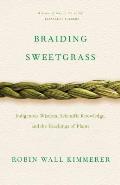
“Braiding Sweetgrass” by Robin Wall Kimmerer

May 6, 2020 by Sonia Connolly 1 Comment

book cover

Subtitle: Indigenous Wisdom, Scientific Knowledge and the Teachings of Plants

Recommended to me by: Amy Bennett

A set of essays loosely tied together in chronological order, with themes of sweetgrass and braiding all the way through. Each essay braids together personal memoir, Native American (specifically Potawatomi) ways of living, and colonialist ways of living.

Potawatomi ways developed over generations as people saw what works to live in balance with nature, as a part of nature. Humans are considered the young ones, the newcomers, learning from their more experienced plant and animal family members.

Sweetgrass is harvested in specific ways. Not the first plant you find, because that might be the only one. Take only what you need, up to half of the plants there, either by cutting half of each bunch, or taking whole bunches. Robin Wall Kimmerer is a Professor of Botany, and one of her PhD students showed in a set of careful experiments that sweetgrass thrives when harvested this way, and fails to propagate if it is left completely unharvested. Humans and sweetgrass have a cooperative, collaborative partnership.

White colonialists disastrously interrupted Native American ways of living by stealing Native Americans’ lands and pushing them into entirely different ecosystems, and by taking their children to residential schools and forcibly preventing them from speaking their own languages or practicing their spirituality. The Potawatomi people and other tribes are gathering together the fragments of what remains, and braiding them together anew.

The book ends on a hopeful note, that perhaps enough of us will turn toward collaborative, cooperative ways of living that we will not entirely destroy the ecosystems of this green earth. Fitting right in with that hope, the current Great Pause of this pandemic gives us time to consider what we want to add back in to our lives, and what we want to leave behind to allow cleaner skies, safer streets, and more sustainable lives.

I read this as an ebook, because that’s what I can get from the library in this time of pandemic. It’s an odd way to read a book so rooted in physical experience, and I would have much preferred to have a physical book in my hands. This is a long book that wants to be appreciated slowly, essay by essay, section by section, exploring how all the parts fit together to support each other.

Highly recommended!

Robin Wall Kimmerer: ‘People can’t understand the world as a gift unless someone shows them how’ interview by James Yeh, May 23, 2020

Available at bookshop.org.

Filed Under: nonfiction Tagged With: activism, food, healing, memoir, natural world, politics, science, spirituality

  • « Go to Previous Page
  • Page 1
  • Page 2
  • Page 3
  • Go to Next Page »

Primary Sidebar

Recent Books

  • “How We Show Up” by Mia Birdsong
  • “The Enchanted Greenhouse” by Sarah Beth Durst
  • “What It Takes to Heal” by Prentis Hemphill
  • Kitchens of Hope by Linda S. Svitak and Christin Jaye Eaton with Lee Svitak Dean
  • “Very Far Away From Anywhere Else” by Ursula K Le Guin
  • “Seaward” by Susan Cooper
  • “Surviving Domestic Violence” by Elaine Weiss
  • “The Book of Love” by Kelly Link
  • “Alexandra’s Riddle” by Elisa Keyston
  • “Weaving Hope” by Celia Lake

Tags

activism aging anti-racism bodywork business childhood abuse childrens CivicTech communication disability domestic violence fantasy feminism finance Focusing food fun healing health at any size illustrated Judaism leadership lgbt marketing memoir music natural world neurodiversity politics psychology relationship romance science science fiction software spirituality survival story trauma writing young adult

Categories

Archives

Please note: bookshop.org and Amazon links are affiliate links. Copyright © 2026 · Genesis Sample on · WordPress