• Skip to primary navigation
  • Skip to main content
  • Skip to primary sidebar
Curious, Healing

Curious, Healing

Books about healing, business, and fun

  • About Sonia Connolly

psychology

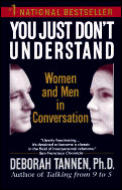
“You Just Don’t Understand” by Deborah Tannen, Ph.D.

August 31, 2024 by Sonia Connolly Leave a Comment

book cover
Subtitle: Women and Men in Conversation

Recommended to me by: a friend

My friend was telling me about a gathering where one person had a knee injury. All the women who stopped to chat with the injured person asked how she was doing and how she had gotten injured. All the men talked about their own knee injuries or other injuries they had experienced. My friend said the men were trying to save the injured person’s pride and equalize status by saying they had gotten injured too. I sputtered that that was a very generous interpretation, but I didn’t necessarily agree. She recommended this book.

The book was published in 1990, and it shows. There is an updated edition from 2007, but I got the older edition from the library.

Tannen’s thesis is that women talk to support intimacy, and men talk to compete for status. The first half of the book has many examples, without ever mentioning sexism or cultural influences, not to mention non-binary people. Men protect their independence at the same time as women are trying to build connection, causing discord in heterosexual relationships.

Just about when I was going to stop reading in frustration, Tannen says that Italian preschoolers of any gender debate heatedly with each other, because that is what Italian culture teaches and expects. She also talks about New York Jewish culture, where both women and men are more direct and outspoken, and less direct people interpret that as being rude and pushy.

Then she talks about sexism, where men who are direct and authoritative are interpreted as being powerful and appropriately masculine, whereas women are seen as overstepping their bounds and being arrogant or aggressive. She talks about how the press talked about Geraldine Ferraro in disparagingly gendered terms “but they didn’t mean to.” I wonder if she wanted to retract that generous interpretation after seeing how the press treated Hillary Clinton.

At the very end, she says that she is not advocating for anyone to change their style, but to keep in mind these differences and be open to believing in people’s good intentions. Like any less-dominant group, I think women already understand the status-oriented style quite well, and men need to pick up the slack by learning to work better with a collaborative style.

The book does have a few nods toward Not All Men, and Not All Women. It mentions gay and lesbian relationships once that I noticed. It has a terribly racist description of communication styles in a Mayan community in Mexico that I can only hope is improved in the 2007 edition.

My friend did a great job of summarizing the primary takeaway of the book (women talk for connection, men talk for status). It’s a useful thing to listen for.

Available at bookshop.org.

Filed Under: nonfiction Tagged With: communication, psychology, relationship

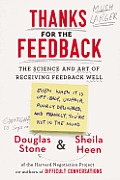
“Thanks for the Feedback” by Douglas Stone & Sheila Heen

October 17, 2022 by Sonia Connolly Leave a Comment

book cover

Subtitle: The Science and Art of Receiving Feedback Well (Even When it is Off Base, Unfair, Poorly Delivered, and, Frankly, You’re Not in the Mood.)

This book is surprisingly clear and helpful. It talks about how to listen for and clarify the underlying message, how to sit with whether some or all of the message is useful, and how to discern when the feedback dynamic itself is a problem.

As Kate Heddleston wrote in Criticism and Ineffective Feedback, women and other underrepresented groups in tech jobs get subjected to a lot of unwarranted and biased “feedback” about being too abrasive and not assertive enough, too friendly and not nice enough, too pushy and not contributing enough. Homa Mojtabai covered the can’t-win expectations succinctly in the McSweeney’s article Reasons You Were Not Promoted That Are Totally Unrelated to Gender.

I was expecting this book to pile on even more unmeetable expectations, but it is balanced and thoughtful instead.

There are three kinds of feedback, appreciation (“that’s great!”), coaching (“here’s how to do it better”), and evaluation (“here’s how you measure up”). Pay attention to which kind you’re getting, and which kind you need more or less of.

First seek to understand. Rather than arguing with everything that’s obviously wrong about the feedback, seek to understand better what the speaker means, needs, and wants. When given generic labels, ask for specific examples and requests. Be open and curious, and also share reactions like, “That’s upsetting to hear.” “That’s not how I see myself.”

Feedback can illuminate our blind spots. None of us can see how we look and come across to others. Feedback can give us information about how others see us, which is not necessarily how we are or intend to be, but is still useful information even when heavily mixed with others’ biases.

“Switchtracking” is starting a second conversation about a relationship (“how dare you bring that up when you…”) in the middle of a feedback conversation. Name that there is a second topic, and keep it separate from the first. The feedback might be a cover for a relationship issue too.

Identify the relationship system – take 3 steps back. 1) Look at the intersection between the two people, rather than trying to make one person or the other “the problem.” 2) Look at clashes in roles. Are roles clear and agreed to by both people? 3) Look at the bigger picture – other people, structures, policies, the whole environment. Looking at systems reduces judgment, enhances accountability (how our choices interact with the system), and uncovers root causes.

Wiring and temperament and past trauma affect our responses to feedback. Some people are more resilient in the face of negative feedback, and require less positive feedback.

Boundaries around feedback are crucial. We get to discern and choose what is healthy for us. Three boundaries: “I may not take your advice.” “I don’t want feedback about that subject right now.” “Stop, or I will leave the relationship.” Some signs that boundaries are needed: feedback attacks character, not behavior. It is unrelenting. There is always a new feedback topic. We can turn away feedback with grace and honesty. When appropriate, problem-solve with the other person around the decision not to change (or inability to change).

In response to feedback, add what’s left out, ask what matters to them, take a step back to reframe when needed.

Cultivate a growth mindset, and make choices about when and how to change. Don’t pretend to change, or make a superficial change when the request is about underlying attitudes. In the face of a flurry of feedback, choose one thing to focus on whenever possible.

Recommended!

Available at bookshop.org.

Filed Under: nonfiction Tagged With: business, communication, psychology

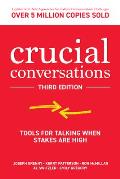
“Crucial Conversations Third Edition” by Patterson, Grenny, McMillan

September 4, 2022 by Sonia Connolly Leave a Comment

book cover

Subtitle: Tools For Talking When Stakes Are High

Recommended to me by: my boss

I read this book back in 2013 and decided to reread it when my boss mentioned it.

In addition to my summary in 2013, I noticed more about questioning inner stories. When we assign roles like Villain, Victim, and Helpless One, we close off avenues to potential solutions. When we can see everyone in a situation as a complex human with a mix of skills, past experiences, and motivations, we can see openings for solutions more clearly.

I wrote about a similar approach in 2018 in Offer a Collaborative Story.

Crucial Conversations has an oversimplified approach to emotions. The claim is that emotions are caused by our stories, and we have to change stories to change or quiet our emotions. While it is true that a negative story can escalate negative emotions, overall our emotions are signals about our inner truth. It is a mark of privilege to expect everyone to be calm in a difficult situation. Telling people they are causing a problem by having the “wrong story” can quickly shade into gaslighting.

The book has an extended example where a woman is silenced and talked over by a man in a business context. The message of the example is that we have to give everyone the benefit of the doubt and ask them for what we need without regard to privilege, sexism, and institutional power. We all exist in a sexist, racist, capitalist system, and people who act out those biases are not inherently evil. At the same time, putting responsibility on a less privileged individual to manage the situation without mentioning the systemic issues in play is oversimplified and imbalanced. The authors could have mentioned that the situation is stacked against the less privileged person, and that if their techniques don’t work, it doesn’t mean she did them wrong or didn’t try hard enough.

The book contains a lot of ableist and judgmental language. “Dumb” and other slurs are used liberally. Some behaviors are ascribed to “the worst at dialogue” (italics theirs) without noticing that they are failing at their own command to be generous and ascribe positive motives.

This is a recently published third edition. While it contains some useful ideas, I cannot recommend it wholeheartedly because of the shortcomings that have not been addressed.

Available at bookshop.org.

Filed Under: nonfiction Tagged With: business, communication, psychology, relationship

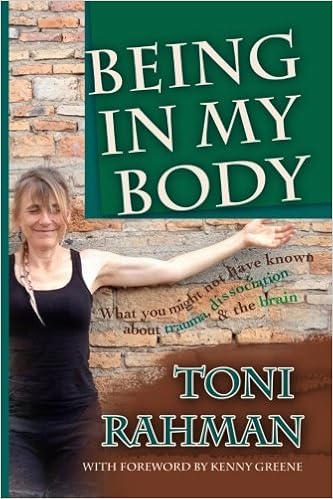
“Being In My Body” by Toni Rahman

January 29, 2022 by Sonia Connolly 1 Comment

book cover

Subtitle: What you Might Not Have Known about Trauma, Dissociation and the Brain

Recommended to me by: a client

This book covers a lot of ground, and does it well. Toni Rahman summarizes current research into developmental trauma, CPTSD, dissociation, emotions, attachment, and polyvagal theory, as well as sharing some of her own story and client stories. She applies this material to parenting, inhabiting the body, and healthy adult intimacy.

Some of the many ideas in the book:

  • We are designed, from birth, to take refuge in the trusting bonds we have with others.
  • What children need from their caring adults is flexibility and openness balanced with a strong enough sense of self and one’s own limits, with curiosity about who this child is.
  • Regression is leaving the present moment and reliving the past instead. This can also be called an emotional flashback.
  • Feeling an emotion is acknowledging it, allowing it to be in the body. Emoting is acting it out: yelling, crying, etc.
  • Via Karla McLaren, event trauma happens not just from something difficult or overwhelming, but from not being welcomed back into the tribe afterward. A full initiation includes both surviving challenging circumstances, and being received with adequate attention, empathy, and care afterwards.
  • For an infant or small child, chronic or prolonged parental misattunement without adequate repair represents a traumatic threat to life.
  • Feeling threatened by a parent who is also a source of care is a problem in itself, compounded by not having support to express or resolve the problem. This is disorganized attachment.
  • For someone with unhealed disorganized attachment or CPTSD, intimacy is triggering and terrifying rather than soothing and nurturing.
  • How your body responds to intimacy is an echo of your early experiences.
  • We can approach our own bodies with care to build secure attachment and intimacy with ourselves.
  • You will know what you like because just thinking of it will make you feel soft, relaxed, and light, not restricted, guarded, or confused.

There are a couple of distracting textual errors in the book: duplicated client quotes, and at least one misspelling of a place name.

Overall, highly recommended for anyone interested in trauma, inhabiting the body, and healthy intimacy.

Toni Rahman’s website.

Available at bookshop.org.

Filed Under: nonfiction Tagged With: childhood abuse, memoir, psychology, relationship, trauma

“You Don’t Look Adopted” by Anne Heffron

December 26, 2021 by Sonia Connolly 1 Comment

book cover

Recommended to me by: an adopted client

Anne Heffron shines a light on the seams that adoption leaves behind, by sharing her story and her thoughts with painful honesty. She was adopted into a “good” (white, middle class, well-intentioned) family and is pressured by her emotionally fragile mother and all of society to act like her adoption was a blip that no longer affected her. But she feels chaotic and terrified inside. When her life has entirely fallen apart, she finally writes the book she always wanted to write.

“In a parallel universe, the universe of my imagination, I was sitting at an entirely different table with entirely different people, eating entirely different food, so it seemed pointless to give myself one hundred percent to my life.”

“I have heard too many stories to think adoption is something that happens at birth or in childhood and then fades into I am part of this family with no repercussions—no emotional issues, no health issues, no fear of future abandonment, no fear of loss.”

“I want to write the book that, if I had read it at seventeen, I wouldn’t have felt so badly about myself, so wrong, so destined for a shaky future.”

The book is written in brief sections with all-caps headers. Distractingly, the headers are sometimes at the bottom of one page and the section continues on the next page. She says the book is written in fragments to express her sense of being fragmented inside.

Highly recommended to anyone who is involved with adoption (adoptee, birth family, adopted family) or wants to understand adoption better.

Anne Heffron’s website.

Available at Amazon.

Filed Under: nonfiction Tagged With: healing, memoir, psychology, relationship, survival story, trauma, writing

“Set Boundaries, Find Peace” by Nedra Glover Tawwab

November 22, 2021 by Sonia Connolly Leave a Comment

book cover

Subtitle: a guide to reclaiming yourself

Recommended to me by: Renay at Lady Business

Nedra Glover Tawwab is a therapist and an Instagram influencer. Her book is a solid introduction to boundaries and how to use them in a variety of contexts. She defines boundaries as “expectations and needs that help you feel safe and comfortable in your relationships.”

Among many heterosexual examples, her vignettes include two lesbian couples, where one of the couples breaks up. Gender roles are reasonably varied. Race wasn’t signaled in the examples. The author is Black.

She briefly addresses microaggressions as boundary violations. The suggested solutions are to assertively call out the problem, for example, “I notice that you said, ‘I don’t sound Black.’ What does that mean?” And/or suggest more appropriate behavior, for example, a woman CEO who is called “bossy” could say that she is simply assertive and willing to lead.

Boundaries are great! Assertiveness is great! Implying that they can solve discrimination, and saying outright that we need to teach others how to treat us, is less great. I agree that it’s worth explicitly asking for what one needs before giving up on a relationship. At the same time, Ask vs. Guess culture is not discussed, where Guess culture imposes a social penalty for explicitly expressing boundaries and needs.

There is an extended example where one person in a relationship blames the other for “poor communication” where the actual problem is that the blamer is using manipulation and guilt-tripping. Again the solution is to call it out as guilt-tripping. Gaslighting, abuse, and inappropriate blame are mentioned, with the same appearance of neat solutions.

This book explicitly puts the responsibility for policing boundaries on the boundary-setter. As someone who bought into “Boundaries will fix everything!” many years ago and worked very hard at them, it’s painful to find that assumption woven through the book. While it is important to take action where we can, it is also important to take a step back when it doesn’t work, rather than endlessly trying harder. That balancing act is not as straightforward as this book makes it seem.

This is a clear, detailed, encouraging manual for learning about boundaries. Recommended if the idea of assertive boundaries is new to you. They can definitely improve difficult situations and clear up problems with over-commitment and hidden assumptions.

There is a forthcoming Set Boundaries Workbook.

Nedra Glover Tawwab’s website

Available at bookshop.org.

Filed Under: nonfiction Tagged With: communication, psychology, relationship

  • « Go to Previous Page
  • Page 1
  • Page 2
  • Page 3
  • Page 4
  • Interim pages omitted …
  • Page 22
  • Go to Next Page »

Primary Sidebar

Recent Books

  • “We Belong to the Drum” by Sandra Lamouche and Azby Whitecalf
  • “Atlas of the Heart” by Brene Brown
  • “Life After Cars” by Sarah Goodyear, Doug Gordon, Aaron Naparstek
  • “Tidy First?” by Kent Beck
  • “When You Had Power” and “You Knew the Price” by Susan Kaye Quinn
  • “Taproot” by Keezy Young
  • “The Tower at Stony Wood” by Patricia A McKillip
  • “Hospicing Modernity” by Vanessa Machado de Oliveira
  • “How We Show Up” by Mia Birdsong
  • “The Enchanted Greenhouse” by Sarah Beth Durst

Tags

activism aging anti-racism bodywork business childhood abuse childrens CivicTech communication disability domestic violence fantasy feminism finance Focusing food fun healing health at any size illustrated Judaism leadership lgbt marketing memoir music natural world neurodiversity politics psychology relationship romance science science fiction software spirituality survival story trauma writing young adult

Categories

Archives

Please note: bookshop.org and Amazon links are affiliate links. Copyright © 2026 · Genesis Sample on · WordPress