• Skip to primary navigation
  • Skip to main content
  • Skip to primary sidebar
Curious, Healing

Curious, Healing

Books about healing, business, and fun

  • About Sonia Connolly

psychology

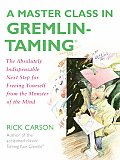
“A Master Class in Gremlin-Taming” by Rick Carson

April 27, 2010 by Sonia Connolly Leave a Comment

Subtitle: The Absolutely Indispensable Next Step for Freeing Yourself from the Monster of the Mind

Rick Carson’s prior book Taming Your Gremlin was transformative for me. “Simply notice” and “Play with options” have become touchstones in my own process.

Based on the title and subtitle of this book, I had high expectations.

Those expectations would have been better met if the title were “A Followup Seminar in Gremlin-Taming.” It gathers a series of informative articles on the topic, offering useful techniques in a commanding style. I would dispense with the subtitle altogether.

Advice for clear communication with yourself or others:

  • Simply Notice
  • Describe
  • Hush
  • Breathe
  • Listen

I like “Hush” as the middle step. It includes an expectant silence, as well as ceasing to speak. It evokes the natural world at evening for me, too.

Some types of disrespectful communication:

  • Overexplaining
  • Talking about someone instead of talking to him/her
  • Rushing to share a parallel experience
  • Interrupting
  • Habitual lateness
  • Not returning phone calls or emails within 24 hours
  • Not acknowledging acts of kindness
  • Avoiding eye contact
  • Mumbling
  • Fidgeting
  • Jumping to conclusions
  • Being phony
  • Sarcasm
  • Doing more than one thing in any breath’s worth of time
  • Asumming tha tthere is an unalterable truth and that you are the bearer of it
  • Huffing, puffing, and rolling of eyes
  • Inflection and intonation that implies that your comment could well end with “Stupid,” even though you’re not saying it
  • Spinning on one’s heels, storming off, and slamming doors and/or cabinets.

Seeing overexplaining at the top of that list was validating for me, since I’d just had several encounters with Overexplainers. At the same time, some of the list reads like a letter from a frustrated parent to a teenager.

The most useful tip for me was to accentuate what is already happening. Make those shoulders even more tight, rather than trying to make them open and relax. It’s a great way to stop fighting what is.

I highly recommend the first book, Taming Your Gremlin. Pick this one up for some extra tips, and a few stories from Rick Carson’s life.

Available at bookshop.org.

Filed Under: nonfiction Tagged With: healing, psychology

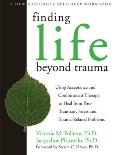
“Finding Life Beyond Trauma” by Victoria Follette, Ph.D. and Jacqueline Pistorello, Ph.D.

April 24, 2010 by Sonia Connolly 3 Comments

Subtitle: Using Acceptance and Commitment Therapy to Heal from Post-Traumatic Stress and Trauma-Related Problems

Acceptance and Commitment Therapy (abbreviated ACT, and pronounced as a whole word) invites clients to observe their own behaviors and let go of strategies which might be keeping them from living their most valued life. It includes a strong emphasis on mindfulness and compassion.

ACT assumes that trying to suppress or escape pain can generate more suffering. Paradoxically, facing pain and accepting it can be the best strategy to ease the pain.

This substantial workbook offers theory, illustrations, stories, metaphors, and exercises to help the reader observe existing strategies around pain, establish values, and choose strategies that move toward those values.

The book assumes that the reader is highly avoidant. Since we all use avoidance in overt or covert ways, it can be helpful for many of us.

My favorite metaphor from the book: You’re blindfolded, and one day you fall in a deep hole. All you have is a shovel, so you start digging. You dig to the right, to the left, and even under your feet, but you’re still in the (enlarged) hole. Eventually, even if someone brought you a ladder, you would think it was a different sort of shovel. Suggestion: put down the shovel and just stop digging.

Putting down the shovel looks different for each person. We all have our favorite strategies that work up to a point, but then we keep depending on them long after they’re just making things worse. The shovel contains all our current working assumptions. Putting down the shovel is a leap of faith into new assumptions.

One of my shovels is wondering what I’m doing wrong in any given situation. Before I put it down, it feels like a radical, risky act. After I put it down, it’s a huge relief.

Another useful metaphor: willingness is like jumping. We can say we’re jumping, we can think about jumping, we can try to jump, but either we’re jumping or we’re not. We can’t half-jump.

Willingness to change is similar. It is important to check whether we’re actually willing to make a change, and choose changes that are small enough that we are willing to risk them.

The book describes unwillingness in willingness’s clothing. One of many examples: “After experiencing a loss, I tried to accept it so that I could stop feeling so sad.”

There are many more useful metaphors and exercises in this book. I highly recommend it for anyone healing from trauma, or helping others heal.

Available at bookshop.org.

Filed Under: nonfiction Tagged With: healing, illustrated, psychology, trauma

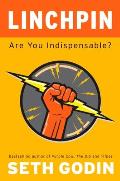
“Linchpin: Are You Indispensable?” by Seth Godin

March 6, 2010 by Sonia Connolly 1 Comment

Recommended to me by: Seth Godin’s blog

Seth Godin brings together several of his ideas about how to survive in our changed economy. His main premise is that non-thinking “factory” work is no longer the road to security. “Factory” is in quotes because he uses it to include any job which involves following the rules and doing what the boss says.

He redefines several other words, including “art” (a gift that changes the recipient), and “artist” (someone who gives such gifts in a business context).

I love his idea of “emotional work”, which is one of the possible ways to make “art.” Emotional work includes both confronting ones own resistance, and creating genuine connections with others. I know I’m much more likely to frequent a shop where the employees or owners give me the gift of emotional connection.

Which brings us to his main definition, “linchpin”: someone who does their emotional work, creates art, gives that little bit extra to both coworkers and customers, and becomes essential to a business.

He talks at length about the importance of “shipping” – completing the art or product and sending out into the world – and the “lizard brain” or resistance that gets in the way. This was the most problematic redefinition for me, because he makes it clear that he’s referring to the amygdala and limbic system, which evolved in mammals, not reptiles.

While it’s useful to think of resistance as a separate voice and notice what it’s saying without letting it take over, I was uncomfortable with the dismissive, combative attitude he seemed to be promoting. I’m more comfortable with the compassionate attitude in Cheri Huber’s How to Get From Where You Are to Where You Want to Be, which I happened to be reading at the same time.

The writing is choppy, reminiscent of his pithy, paragraph-long blog posts. I read his blog with interest every day, but find the style distracting in a full book.

Seth Godin has also published the book’s ideas in a freely available PDF.

Available at bookshop.org.

Filed Under: nonfiction Tagged With: business, marketing, psychology

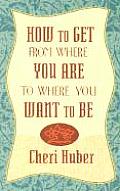
“How to Get From Where You Are to Where You Want To Be” by Cheri Huber

March 4, 2010 by Sonia Connolly 3 Comments

In connection with reading Being Bodies, I tracked down this book. It turns out I’d read it a long time ago and remembered many of the stories, although I’d forgotten their source.

Cheri Huber herself admits that the title is a bit of a trick. Rather than trying to move from Here to There, she advocates giving careful attention to Here, since that’s all there ever is.

She shares harrowing vignettes from her own life with a “that’s just how it is” tone. Her quest for meaning and peace led her to Zen meditation, where she encountered the simple instructions to sit in full lotus and count breaths up to 10, and then begin again.

Desperate for change, she sat in full lotus for hours, and counted breaths no matter what she was doing. After counting breaths during a 10-hour drive, she finally encountered the peace of the present moment. In time, she joined a Zen monastery, started teaching, and went on to found her own Zen center.

Woven with her own journey, she introduces gentle steps for becoming aware of social conditioning and self-hatred, and easing the grip of the resistance they cause. After each exercise, she implores “Please do not allow conditioning to use your awareness against you.”

For example, she introduces meditation by suggesting: Take three full breaths. What did you notice? Do it again. There, you’re meditating! I follow these non-instructions in my own meditation practice. Fortunately, full lotus position is optional!

She summarizes the steps for true, gentle change:

  1. Choose an issue you want to work with.
  2. Sit down, stay still, and be aware of all that goes on.
  3. Notice what belief systems are held in place with this issue.
  4. Notice which subpersonalities [and/or defense mechanisms] are involved.
  5. Listen to what the [internal judging] voices have to say about the issue about who you are for having it.
  6. Become aware of the projections made onto yourself and others because of this issue.
  7. Explore the emotions that keep this issue real.
  8. Find out where the issue is held in your body – where is the epicenter?
  9. Practice disidentifying by moving your focus of attention away from the issue and returning it to the breath.
  10. Remember to do this – and everything you do – in a context of compassionate acceptance of all that is.

She shares stories from her students’ journeys as well. One man at a Zen retreat became angry about a dirty mop bucket left on the steps, and each day muttered to himself, “Someone should do something about that!” Finally he realized that he was “someone” and cleaned the bucket.

This book is full of treasures. I recommend it to anyone looking for compassionate suggestions about how to find center and self-acceptance.

Available at bookshop.org.

Filed Under: nonfiction Tagged With: healing, memoir, psychology, spirituality

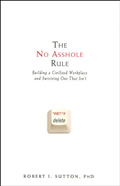
“The No Asshole Rule” by Robert Sutton, PhD

February 24, 2010 by Sonia Connolly Leave a Comment

Recommended to me by: Robert Sutton blog post (via Twitter)

It’s a rare business book that focuses on warmth, kindness, and peaceful, loving environments. This compassionate little book, subtitled Building a Civilized Workplace and Surviving One That Isn’t, does so with clarity and conviction.

In this book, you’ll find:

  • A definition of assholes (also known as jerks, bullies, tyrants, etc.)
  • The costs of employing them
  • How to implement and enforce a “no asshole” rule, including heartening positive examples
  • How to avoid behaving badly ourselves, including a self-test
  • Survival tips for unavoidable asshole-ridden situations
  • What people get out of behaving badly

The main message:

Treat the person right in front of you, right now, in the right way.

I am delighted to discover that some corporations and academic departments value respect and kindness. I highly recommend this book to anyone who wants to follow their example.

Available at bookshop.org.

Filed Under: nonfiction Tagged With: business, communication, psychology

“Being Bodies” edited by Lenore Friedman & Susan Moon

February 15, 2010 by Sonia Connolly 3 Comments

Recommended to me by: Catherine Holmes Clark, who also has a detailed site about her journey with environmental illness.

The sweet relief of reading about Buddhism from the perspective of women connected with their bodies took me by surprise. Until I read this book, I didn’t realize how much I’d been reading around a feeling of exclusion in The Wise Heart by Jack Kornfield and other books about Buddhism centered on male experience.

Thirty-three essays by different Buddhist women are divided into five sections:

  • Body as Suffering – bringing awareness to the experience of chronic illness.
  • Body as Nature – the feeling of failure because giving birth brought pain, even with awareness.
  • Body as Gender – helping a daughter remain aware as she navigates adolescent self-judgment of her body.
  • Body as Vehicle – dealing with difficulties through “no more struggle,” “using poison as medicine,” and “seeing whatever arises as enlightened wisdom.”
  • Body as Self – navigating addiction to alcohol, compulsive eating, and the loneliness of being embodied.

Images from the essays have woven themselves into my awareness.

At my cutting board chopping carrots or parsnips, I think of Darlene Cohen’s essay, “The Only Way I Know of to Alleviate Suffering.” She writes about helping people with arthritis discover that they can cut carrots by bringing their awareness to the details of their bodies’ experience with the board, the knife, and the carrots.

I recommend this book to anyone who wants to revel in the Buddhist perspective of women connected to their bodies.

Available at bookshop.org.

Filed Under: nonfiction Tagged With: disability, healing, psychology, spirituality

  • « Go to Previous Page
  • Page 1
  • Interim pages omitted …
  • Page 18
  • Page 19
  • Page 20
  • Page 21
  • Page 22
  • Go to Next Page »

Primary Sidebar

Recent Books

  • “We Belong to the Drum” by Sandra Lamouche and Azby Whitecalf
  • “Atlas of the Heart” by Brene Brown
  • “Life After Cars” by Sarah Goodyear, Doug Gordon, Aaron Naparstek
  • “Tidy First?” by Kent Beck
  • “When You Had Power” and “You Knew the Price” by Susan Kaye Quinn
  • “Taproot” by Keezy Young
  • “The Tower at Stony Wood” by Patricia A McKillip
  • “Hospicing Modernity” by Vanessa Machado de Oliveira
  • “How We Show Up” by Mia Birdsong
  • “The Enchanted Greenhouse” by Sarah Beth Durst

Tags

activism aging anti-racism bodywork business childhood abuse childrens CivicTech communication disability domestic violence fantasy feminism finance Focusing food fun healing health at any size illustrated Judaism leadership lgbt marketing memoir music natural world neurodiversity politics psychology relationship romance science science fiction software spirituality survival story trauma writing young adult

Categories

Archives

Please note: bookshop.org and Amazon links are affiliate links. Copyright © 2026 · Genesis Sample on · WordPress