• Skip to primary navigation
  • Skip to main content
  • Skip to primary sidebar
Curious, Healing

Curious, Healing

Books about healing, business, and fun

  • About Sonia Connolly

psychology

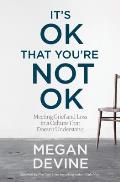
“It’s Ok that You’re Not Ok” by Megan Devine

February 19, 2019 by Sonia Connolly 3 Comments

book cover

Subtitle: Meeting Grief and Loss in a Culture That Doesn’t Understand

Recommended to me by: Robyn Posin

The way our culture deals with grief is vastly broken. We treat it as a problem to be solved rather than as an experience to be carried. We shame grieving people for not doing the process “right” (what does that even mean) rather than listening to and accompanying them. We spout platitudes like, “It’s all for the best,” to separate ourselves from the reality of loss.

Megan Devine shares about her own catastrophic grief at the accidental death of her husband at age 40, and offers support for others going through grief.

Pain is a healthy, normal response when someone you love is torn from your life. It hurts, but that doesn’t make pain wrong.

Suffering comes when we feel dismissed or unsupported in our pain, and when we thrash around inside our pain, questioning our choices, our “normalcy,” our actions and reactions.

She advises experimenting to see what helps even a tiny bit in the depths of grief. What lets you feel companioned in your pain. What lessens the suffering. What supports wellness and avoids “worseness.” What are your internal signals of overwhelm, and what to do about it.

She addresses how (and why) to stay alive, physical and mental effects of grief, how to manage anxiety, and why to make some kind of art to express your grief. Advice to supporters is: listen. Don’t try to fix, minimize, or put the focus on yourself. Listen.

The last section of the book addresses how to handle would-be supporters’ missteps, and how to help them be more helpful.

The word trauma is only mentioned once in the book, even though it focuses on traumatic sudden losses. I wonder how much the combination of trauma and grief can be eased with trauma healing techniques.

Highly recommended to anyone who has been knocked down by grief, or had a friend knocked down by grief. (That’s just about everyone.)

Megan Devine blogs and runs online Writing Your Grief support groups at her website, Refuge in Grief.

Available at bookshop.org.

Filed Under: nonfiction Tagged With: healing, memoir, psychology

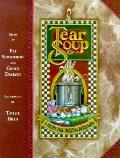
“Tear Soup” by Pat Schwiebert and Chuck DeKlyen, illustrated by Taylor Bills

January 7, 2019 by Sonia Connolly 1 Comment

book cover

Subtitle: A Recipe for Healing After Loss

Grandy, a “somewhat wise” grandmother with a long silver braid, has suffered a big loss. In gorgeous detailed illustrations we see her making tear soup with her tears, memories, and time. She grieves alone and with friends. She gives it all the time it needs, far longer than some people think it should take. Eventually she’s ready to put her soup in the freezer and only eat it occasionally.

A loving, compassionate look at grieving big losses in children’s book format, but appropriate for any age. Highly recommended.

Grief Watch website has more books, and a free download of the “cooking tips” and “recipe” from the back of this book.

Available at bookshop.org.

Filed Under: Uncategorized Tagged With: childrens, healing, illustrated, psychology

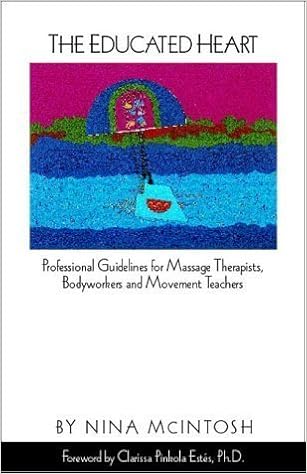
“The Educated Heart” by Nina McIntosh

November 24, 2018 by Sonia Connolly 1 Comment

book cover Subtitle: Professional Guidelines for Massage Therapists, Bodyworkers, and Movement Teachers

Recommended to me by: Ethics and Boundaries class in massage school

I re-read this book because I’m planning to write about dual relationships. Nina McIntosh writes lucidly about the need for clear boundaries as a bodyworker.

The book is filled with guidelines and anecdotes from her own practice and from extensive research and interviews with other bodyworkers. “Being professional is an educated way of being kind.” A strong framework around scheduling and fees helps clients feel safer and keeps practices running more smoothly. Attention to the daily small ethical and boundary decisions helps avoid big disasters.

Highly recommended for practitioners who use touch, and for clients who want to better understand their responses to different practitioners. This book is dear to my heart and had a big influence on how I run my practice.

This blog post by Laura Allen talks about meeting Nina McIntosh, and sadly, about her death from ALS in 2010. Laura Allen put out a 4th edition of “The Educated Heart” in 2017.

Available from biblio.com.

Filed Under: nonfiction Tagged With: bodywork, communication, healing, illustrated, psychology

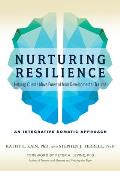
“Nurturing Resilience” by Kathy L. Kain and Stephen J. Terrell

October 27, 2018 by Sonia Connolly 1 Comment

book cover
Subtitle: Helping Clients Move Forward from Developmental Trauma, An Integrative Somatic Approach

Recommended to me by: Taking a class from Kathy Kain

I took a 3 day class from Kathy Kain last year and learned techniques that I use every day in my practice, so I was excited about this book. It turned out to be dry to read and only talked about a couple of techniques at the end, which I had already learned in the class. On the positive side, the extensive client examples include gay parents and genderqueer clients.

The first part introduces attachment, polyvagal theory, and neurological development. Interoception is perception of our internal state. Exteroception is perception of the external environment through vision, hearing, touch, etc. Neuroception is the perception of safety and threat. Interactions with parents and other caregivers help an infant make sense of incoming stimuli and assess safety vs. threat. Without playful and caring interactions, the infant develops a strong sense of what is a threat, but does not develop a sense of what feels safe.

They discuss the ACE study and the health effects of early trauma. The Window of Tolerance is the nervous system’s comfortable, functional, social state. Threats result in hyperarousal (fight or flight) and hypoarousal (freeze, immobility). Someone with a dysregulated nervous system has a very small window of tolerance. They may have a faux window of tolerance, where they manage to function despite being under physiological stress.

The second half of the book more directly discusses clinician interventions for clients with developmental trauma. The emphasis is on teaching the nervous system how to stay more regulated, and to offer co-regulation, where the client’s nervous system is steadied by the clinician’s regulation. The authors emphasize that developmental trauma is largely non-verbal, patterned in the body, so interventions need to address the body directly.

Interventions they discuss: gentle touch on the kidney area of the lower back, and helping the client practice noticing same/different around their triggers.

Recommended if you want a lot of information about developmental trauma, and don’t mind a somewhat uneven presentation.

Available at bookshop.org.

Filed Under: nonfiction Tagged With: bodywork, childhood abuse, healing, psychology, trauma

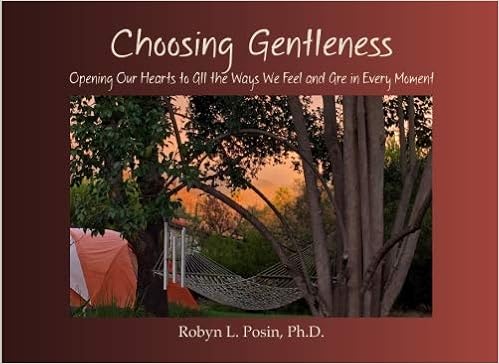
“Choosing Gentleness” by Robyn L. Posin, Ph.D.

September 3, 2018 by Sonia Connolly 1 Comment

book cover

Subtitle: Opening Our Hearts to All the Ways We Feel and Are in Every Moment

Recommended to me by: reading Robyn Posin’s website for the last 15+ years. Also I was an advance reviewer for this book.

This is a collection of line drawings and wise words that have appeared on Robyn Posin’s website over the years, along with some more recent essays. It was lovely to see the vibrant drawings of dancing, struggling, resting women and the encouraging words gathered in one place.

Robyn Posin’s work has been a big inspiration and support over the years. Most of her messages resonate powerfully for me. At the same time, I’m still arguing with a few of them.

The idea that our love-starved little ones inside can only get love from us, not from anyone outside us now that we are no longer children makes a lot of sense, and I still have a “Yes, but…” response. What about adult attachment? What about friendship, and care? I’m not saying she’s wrong, but something in me is still hoping.

I love the parts about accepting all our feelings, not just the warm fuzzy ones, and the firm rejection of the idea that acknowledging our anger just brings more of the same into our lives. Feelings are meant to live and move through, not be shoved down and frozen in place.

In this book, I found a message that I had remembered all this time, but not been able to find again on her website: “It does not matter whether how we are in the moment is born from our woundings or our wholeness.” What a revolutionary, liberating message! Even if we are “broken” in some way because of abuse or trauma, that’s how it is. We still have to exist in the world, with both our damage and our wholeness.

Living in the thinnest slice of now and trusting that my future self will be able to handle my future circumstances has also been a liberating idea.

Another idea I struggle with is that the Grandmothers (or other higher/deeper powers) are guiding my life. I’d love to feel so cherished and protected, but life seems too random, and too catastrophic for a lot of people, to believe that someone is in charge of what happens to each individual.

Highly recommended as a comforting and thought-provoking compilation of Robyn Posin’s many years of healing and helping others heal.

Available at Amazon.

Filed Under: nonfiction Tagged With: feminism, healing, illustrated, psychology, spirituality

“Unlocked” by Gerald Zaltman

August 12, 2018 by Sonia Connolly Leave a Comment

book coverRecommended to me by: Received a copy from Asakiyume who edited it

Gerald Zaltman is a marketing consultant for corporate executives and a professor emeritus of business administration at Harvard. The idea for this book came out of interactions with his young grandchildren. I do not belong to these target audiences, and the book did not resonate with me. I realized as I read the first few sections that the author had not won my trust, so I was engaging with the thought exercises warily, waiting to be tricked and tripped up.

The book starts off with a couple of ethical dilemmas, and then the rest is about many ways our thinking can be influenced that we might be unaware of, and unconscious assumptions we might be making. There was no mention of racism, sexism, or any other -isms that lead to unconscious biases affecting our thinking and responses.

While there is a section on embodied cognition, it is more about how, for example, holding a warm drink can make us perceive a person more warmly, rather than about how our bodies and minds are integrated. The rest of the book is very much disembodied, based on the premise that, “You are how you think.”

There were links to a couple of interesting related videos:

Selective Attention Test: Count the number of passes between players dressed in white.
https://www.youtube.com/watch?v=vJG698U2Mvo

A Portrait Session with a Twist: 6 photographers, one subject, 6 different stories.
https://www.youtube.com/watch?v=F-TyPfYMDK8

The ebook contains live links and color illustrations. In one exercise, color names are printed in non-matching colors and the instruction is to say the color of the text rather than read the word. The gray-scale illustration in the printed book does not do the exercise justice.

Available at Amazon.

Filed Under: nonfiction Tagged With: business, communication, fun, illustrated, psychology

  • « Go to Previous Page
  • Page 1
  • Interim pages omitted …
  • Page 4
  • Page 5
  • Page 6
  • Page 7
  • Page 8
  • Interim pages omitted …
  • Page 22
  • Go to Next Page »

Primary Sidebar

Recent Books

  • “We Belong to the Drum” by Sandra Lamouche and Azby Whitecalf
  • “Atlas of the Heart” by Brene Brown
  • “Life After Cars” by Sarah Goodyear, Doug Gordon, Aaron Naparstek
  • “Tidy First?” by Kent Beck
  • “When You Had Power” and “You Knew the Price” by Susan Kaye Quinn
  • “Taproot” by Keezy Young
  • “The Tower at Stony Wood” by Patricia A McKillip
  • “Hospicing Modernity” by Vanessa Machado de Oliveira
  • “How We Show Up” by Mia Birdsong
  • “The Enchanted Greenhouse” by Sarah Beth Durst

Tags

activism aging anti-racism bodywork business childhood abuse childrens CivicTech communication disability domestic violence fantasy feminism finance Focusing food fun healing health at any size illustrated Judaism leadership lgbt marketing memoir music natural world neurodiversity politics psychology relationship romance science science fiction software spirituality survival story trauma writing young adult

Categories

Archives

Please note: bookshop.org and Amazon links are affiliate links. Copyright © 2026 · Genesis Sample on · WordPress