• Skip to primary navigation
  • Skip to main content
  • Skip to primary sidebar
Curious, Healing

Curious, Healing

Books about healing, business, and fun

  • About Sonia Connolly

Sonia Connolly

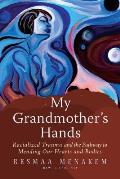
“My Grandmother’s Hands” by Resmaa Menakem

September 30, 2020 by Sonia Connolly Leave a Comment

book cover

Subtitle: Racialized Trauma and the Pathway to Mending Our Hearts and Bodies

Recommended to me by: Naomi Ardea

Resmaa Menakem is a Black psychotherapist and teacher. He addresses the ways white supremacy, which he calls white body supremacy, is perpetuated through trauma in Black, white, and police bodies. He says we each have to learn to settle our bodies, individually and collectively. He distinguishes the clean pain of addressing and healing trauma from the dirty pain of avoiding it.

I appreciate the insights and settling practices in this book. African-Americans have a history of trauma from slavery, as well as the day-to-day trauma and stress of racism. White people also had a history of trauma before colonizing the Americas. This trauma is passed down the generations through epigenetics and patterns of traumatizing behavior. He brings up the trauma of inflicting or witnessing violence, which afflicts police bodies.

He says white bodies and police bodies reflexively feel threatened by Black bodies. He talks about police saying they “couldn’t help it” and “feared for their lives” when talking about shooting and killing unarmed Black people, often in the back. He adds “annihilate” to “fight, flight, or freeze,” but never discusses it directly as a trauma or nervous system response.

He asserts that white bodies have generational trauma from historical conflicts in Europe. He does not address the trauma of immigration itself, abandoning all that is known for a wholly unfamiliar place, leaving behind family and social connections. In addition, his emphasis on generational trauma elides individual present-time trauma, letting individuals off the hook.

There are some metaphors and simplifications that don’t work for me. Calling the vagus nerve the “soul nerve.” Saying it causes or holds emotions that are held in the whole body. Saying that it is responsible for activation responses in the body, when those are caused by the sympathetic nervous system. Saying it makes us human. No, reptiles and mammals have vagus nerves.

Most of the suggested exercises in the book are intended to settle the body, or to mindfully and gently address an activating memory. And then, on page 199 of the hardcover edition, at the beginning of the chapter on Mending the White Heart and Body, a sickening, violent act is described with the specific invitation to put yourself in the scene. It is not even marked as an exercise in the same way as the other exercises, and there is no content warning.

I had a teacher in a massage class once who similarly ended a guided meditation in a shocking way. I think some people imagine that they need to show people what trauma feels like, when many of us have plenty of experience with it already. I am disappointed that the book was published with this mistaken assumption included.

The final chapters contain concrete advice for creating cohesive and resilient social justice groups and events.

Overall, this is an important book with important ideas. It takes a step forward into addressing the trauma of slavery, racism, policing, and white supremacy.

Available at bookshop.org.

Filed Under: nonfiction Tagged With: anti-racism, healing, psychology, trauma

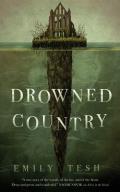
“Drowned Country” by Emily Tesh

September 13, 2020 by Sonia Connolly Leave a Comment

book cover

Recommended to me by: Reading Silver in the Wood

I loved the unusual aspects of the previous novella, “Silver in the Wood.” This one was also well-written, but more stereotypical (selfish young white man protagonist) and plot-driven rather than character-driven. Oddly I found it had less tension and horror, perhaps because it moved faster. The ending is warm and fuzzy, but leaves me concerned for the non-selfish characters. I was not convinced that any redemption arc had occurred, even if I were interested in redemption arcs of selfish young white men.

When I love the world-building and character-building of a first book, I’m noticing that the second book tends to be less satisfying for me, because the author seems to say, “Now that we got all that out of the way, let’s do things.” The characters get moved around rather than developed.

On the positive side, I was pleased by the matter-of-fact inclusion of queer characters. This novella is a good diversion while stuck inside due to pandemic + atrocious air quality from wildfire smoke. I got this as an ebook from the library, and that’s a good way to read it.

Available at bookshop.org.

Filed Under: fiction Tagged With: fun

“The Inner Work of Racial Justice” by Rhonda V. Magee

August 28, 2020 by Sonia Connolly 2 Comments

book cover

Subtitle: Healing Ourselves and Transforming Our Communities Through Mindfulness

Rhonda V. Magee is a Black woman law professor at the University of San Francisco. She has studied mindfulness in depth, and uses it to get through difficult conversations about race with students as well as live with ever-present microaggressions. She teaches mindfulness to help people pause before reacting, increase inner tolerance for strong emotions, and to stay connected with themselves and others.

The first half of the book very gently and slowly encourages the reader to admit that racism exists and might be part of their lives. This is the opposite of Layla Saad’s direct approach in Me and White Supremacy. I can see that different approaches work well for different people.

The strongest message of the book is that we need to stay in mindful, non-violent conversation with each other (and ourselves) about race. Not until the last chapter does she add a caveat about retreating from people who threaten violence. I would add a second caveat about people who are simply not listening or engaging in good faith. Most of her examples include students or workshop participants who have chosen to learn from her, or community members who have an existing motivation to stay connected.

With the addition of those caveats, I agree that we are all in the racist soup together, each learning at our own pace, and we can do our best to be kind to people who are not as knowledgeable as we are, just as more knowledgeable people continue to be kind to us. I wanted to see more about reaching one’s limits and reacting with anger and frustration. There is a place for that, as well as a lot of good work to be done in the world with mindful listening.

Highly recommended for people who are new to anti-racist work, or new to meditation, but not both. I think it would be difficult to learn both from a book at the same time. I have some experience with both and the pace felt slow, but I still got a lot from the book.

Meditations and articles at Rhonda V. Magee’s website

Available at bookshop.org.

Filed Under: nonfiction Tagged With: anti-racism, communication, memoir, psychology

“You Don’t Say” by Nate Powell

August 17, 2020 by Sonia Connolly Leave a Comment

book cover

Subtitle: Collected Stories

Recommended to me by: a friend

This collection of short story out-takes in comic form was recommended to me for “Cakewalk,” about a white girl who dressed in blackface for Halloween, and “Like Hell I Will,” about the 1921 arson and massacre of Tulsa’s “Black Wall Street,” a prosperous Black community. Tulsa race massacre on Wikipedia.

The Midwestern girl in “Cakewalk” is unaware of her transgression. She wants to be loved like Aunt Jemima, and doesn’t understand why the adults around her are horrified. No one explains it to her, even while she’s told to wash the charcoal off her face.

“Like Hell I Will” lays out the terrible, shameful history of the Tulsa race massacre. It is well-told and well-drawn, and at the same time minimized by its inclusion in this compendium of much less serious vignettes from white people’s perspectives.

Nate Powell is the illustrator for “March,” John Lewis’s autobiography in graphic novel form. That might be a better introduction to his work than this collection, which starts with comics drawing from his own life as a rootless young white man in the punk scene.

Available at bookshop.org.

Filed Under: Uncategorized Tagged With: anti-racism, illustrated, memoir

“Minor Feelings” by Cathy Park Hong

August 13, 2020 by Sonia Connolly Leave a Comment

book cover

Subtitle: An Asian American Reckoning

Recommended to me by: Jesse-the-k

Cathy Park Hong describes minor feelings as “the racialized range of emotions that are negative, dysphoric, and therefore untelegenic, built from the sediments of everyday racial experience and the irritant of having one’s perception of reality constantly questioned or dismissed.”

In this frank memoir, she describes growing up in LA’s Koreatown in a Korean immigrant family, complex friendships in college, and finding her voice as an artist in conversation with other artists, interwoven with Asian American experiences of racism.

Patiently educating a clueless white person about race is draining. It takes all your powers of persuasion. Because it’s more than a chat about race. It’s ontological. It’s like explaining to a person why you exist, or why you feel pain, or why your reality is distinct from their reality. Except it’s even trickier than that. Because the person has all of Western history, politics, literature, and mass culture on their side, proving that you don’t exist.

Cathy Park Hong pulls off that tricky feat, asserting her own reality and showing us her life while also explaining what it’s like to be Korean in America for clueless white folks. Highly recommended!

Random House Books summary

Available at bookshop.org.

Filed Under: nonfiction Tagged With: anti-racism, feminism, memoir

“Gathering Moss” by Robin Wall Kimmerer

July 13, 2020 by Sonia Connolly Leave a Comment

book cover

Subtitle: A Natural and Cultural History of Mosses

Recommended to me by: Reading Braiding Sweetgrass

A lyrical series of essays that weave together fascinating details about mosses and stories about Robin Wall Kimmerer’s life. She is an extraordinary storyteller.

Mosses are the most minimal plants. They survive by carefully funneling and holding onto water when it is available, and drying out without dying to await the next rainfall.

Mosses vary tremendously in shape and habitat. They match at a micro level the macro level of rainforests. Some mosses grow together with the old growth trees they drape along, and will not regrow if the moss is torn away. Some mosses persist along city sidewalks and buildings all over the world. Indigenous people use mosses where water absorbency is needed.

Highly recommended!

Available at bookshop.org.

Filed Under: nonfiction Tagged With: memoir, natural world, science

  • « Go to Previous Page
  • Page 1
  • Interim pages omitted …
  • Page 16
  • Page 17
  • Page 18
  • Page 19
  • Page 20
  • Interim pages omitted …
  • Page 71
  • Go to Next Page »

Primary Sidebar

Recent Books

  • “We Belong to the Drum” by Sandra Lamouche and Azby Whitecalf
  • “Atlas of the Heart” by Brene Brown
  • “Life After Cars” by Sarah Goodyear, Doug Gordon, Aaron Naparstek
  • “Tidy First?” by Kent Beck
  • “When You Had Power” and “You Knew the Price” by Susan Kaye Quinn
  • “Taproot” by Keezy Young
  • “The Tower at Stony Wood” by Patricia A McKillip
  • “Hospicing Modernity” by Vanessa Machado de Oliveira
  • “How We Show Up” by Mia Birdsong
  • “The Enchanted Greenhouse” by Sarah Beth Durst

Tags

activism aging anti-racism bodywork business childhood abuse childrens CivicTech communication disability domestic violence fantasy feminism finance Focusing food fun healing health at any size illustrated Judaism leadership lgbt marketing memoir music natural world neurodiversity politics psychology relationship romance science science fiction software spirituality survival story trauma writing young adult

Categories

Archives

Please note: bookshop.org and Amazon links are affiliate links. Copyright © 2026 · Genesis Sample on · WordPress