• Skip to primary navigation
  • Skip to main content
  • Skip to primary sidebar
Curious, Healing

Curious, Healing

Books about healing, business, and fun

  • About Sonia Connolly

Sonia Connolly

“Hand Wash Cold” by Karen Maezen Miller

July 14, 2010 by Sonia Connolly Leave a Comment

Subtitle: Care Instructions for an Ordinary Life

Recommended to me by: Shambhala Sun excerpt.

Miller is a Zen Buddhist priest and teacher. This memoir is organized around three household tasks as metaphors for Zen living – laundry, dishes, and gardening. I enthusiastically agree with the premise that household maintenance is an integral part of life, rather than something to be suffered through or outsourced.

At the same time, I had trouble warming to this tale of unhappy high-powered businesswoman in one marriage turned Zen stay-at-home mom in another. She says about the second, current marriage: “No, ours is not a marriage of friends making nice. … Ours is a marriage of adversaries making peace.” I’m glad that works for her. I don’t think it would work for me.

I did like her take on parenting: “There is no right way to parent; only a right-now way. … Children always show us the present moment unfolding.”

Available at bookshop.org.

Filed Under: nonfiction Tagged With: memoir, spirituality

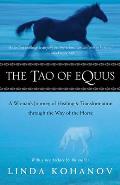
“The Tao of Equus” by Linda Kohanov

July 5, 2010 by Sonia Connolly 1 Comment

Subtitle: A Woman’s Journey of Healing and Transformation through the Way of the Horse

Recommended to me by: A client.

Linda Kohanov and her herd of sensitive horses offer equine facilitated psychotherapy. Together they help both horses and humans recover from trauma, regain their balance, and treat each other with more respect.

This many-layered book contains autobiography, horse stories, client case studies, myths, theories about emotions and the brain, and diatribes about traditional horse training.

Kohanov convincingly claims that horses are intelligent partners, extraordinarily capable of reading and reflecting the emotions around them. She contrasts postconquest thought, divorced from the body, with preconquest thought, congruent with the body. Horses respond to lack of congruence as a threat, thus giving feedback to help people reconnect with their body and emotions.

One case study highlighted how we tend to respond to agitation by mirroring it. Instead, we can consciously calm ourselves, inviting the other person (or horse) to become calm as well. I’ll keep that technique in mind.

Before reading this book, I had heard of equine facilitated therapy without much interest. As I was reading it, I wished Kohanov’s ranch were closer than Arizona so I could go try it out. Her combination of sensitivity and groundedness sounds similar to the healing work I do.

Available at bookshop.org.

Filed Under: nonfiction Tagged With: bodywork, healing, psychology, spirituality

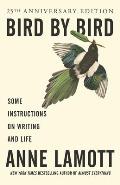
“Bird by Bird” by Anne Lamott

June 21, 2010 by Sonia Connolly 6 Comments

Subtitle: Some Instructions on Writing and Life

Anne Lamott’s writing process seems reassuringly similar to my own, and seems to include just as much struggle. She advises us to write everything that comes to mind, and then later refine it into clarity and grace. A lot of the book is devoted to all the ways we get in our own way, and how sorry she is that there isn’t a more direct route.

“Writing a first draft is very much like watching a Polaroid develop. You can’t – and in fact you’re not supposed to – know exactly what the picture is going to look like until it has finished developing.” Oh good. Maybe I’m doing it right after all.

She emphasizes both looking inside for our own truths, and observing the world around us to flesh out those truths. She reminds to do both with as much detached compassion as we can scrape together.

On character creation: “My friend Carpenter talks about the unconscious as the cellar where the little boy sits who creates the characters, and he hands them up to you through the cellar door. He might as well be cutting out paper dolls. He’s peaceful; he’s just playing.” … “You may want to come up with an image or a metaphor for this other part of you that is separate from your rational, conscious mind, this other person with whom you can collaborate. This may help you feel less alone.” I’ll have to try this – I’d love to feel less alone with my book-writing project!

She keeps a 1 inch square picture frame by her desk to remind her to focus in on one viewpoint and one scene at a time. A whole book is made up of paragraphs. Write the paragraphs, the sentences, the words.

Since I’m struggling with organizing my own book, I noticed that her chapter headings are laconic and her transitions brief. Each chapter meanders among writing class anecdotes, writing advice, snippets of poetry, and life anecdotes. I’m sure she spent many hours crafting each chapter to flow so casually and conversationally. At the same time, it’s good to notice that it reads just fine as it meanders, and my book might be allowed to meander too.

Somehow, at the end of reading this book, I feel less stuck around organizing my own, and more like I’m moving slowly. And that moving slowly is okay, fortunately, since that’s the way it is right now.

Available at bookshop.org.

Filed Under: nonfiction Tagged With: communication, memoir, writing

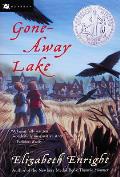
“Gone-Away Lake” by Elizabeth Enright

June 21, 2010 by Sonia Connolly Leave a Comment

Recommended to me by: Marissa Lingen

The title sounded familiar and I thought I read it as a child, but the story itself didn’t ring any bells. Published in 1957, the book features two half-grown kids interacting with two elderly people living in abandoned summer homes, surrounded by lots of nature and lots of kindness.

Portia visits her cousin Julian for the summer, way out in the country. At 11 and 12 years old, they blithely leave the house every morning to visit their new friends at Gone-Away Lake and don’t return until dinner, without accounting for their time to Julian’s parents.

Portia and Julian are close friends without a trace of romance or self-consciousness. They only quarrel once, late in the book. Although the quarrel seems resolved, they each spend more time with friends of their own gender after that.

There is some emphasis on the stereotypes of girls being afraid more often and talking more, and boys liking construction and dirt more. At the same time, the stereotypes are gently questioned by the boys admitting to being afraid too, and the girls exploring right along with them.

Minnehaha and Pindar live peacefully in abandoned houses beside the marsh which used to be Lake Tarrigo, without most modern conveniences. Their day to day activities gently question our assumptions about what is necessary for happiness.

It’s a relief to read a book about emotionally healthy people enjoying their world and each other.

Available at bookshop.org.

Filed Under: fiction Tagged With: childrens, fun, illustrated

“Explain Pain” by David Butler and Lorimer Moseley

June 8, 2010 by Sonia Connolly 2 Comments

Recommended to me by: Kim Hillis, PT

If this book didn’t cost $70, I would be telling every client and practitioner to buy one right now. Both scientific and playful, it offers the latest research about understanding and healing chronic pain.

The sensation of pain is the brain’s response to perceived threat. Until it is interpreted by the brain, pain is (just) an electrical and chemical signal.

Pain is initially associated with tissue damage and inflammation (acute pain). Sometimes the pain response continues after the tissue has gone through the healing process (chronic pain).

Pain does not always correlate with tissue damage, especially with chronic pain. As pain continues, the nervous system adapts by making the pain signal easier to trigger. Emotional stress and beliefs about pain can contribute to triggering pain in a frustrating negative cycle.

The body’s representation in the brain (the homonculus) becomes “smudged” in areas of chronic pain. This can be corrected with gentle movement, retraining the brain to represent the body more accurately.

“Hurt does not always equal harm.” A sensitized nervous system can be retrained and calmed through gradual increases in activity. Having fun and varying the context of a painful movement can help retrain the nervous system.

Explain Pain blog: explainpain.blogspot.com

Available from NOIGroup in Australia or OPTP in the US

Filed Under: nonfiction Tagged With: bodywork, healing, illustrated

“Torch” by Cheryl Strayed

June 8, 2010 by Sonia Connolly Leave a Comment

Recommended to me by: Willamette Writers Portland

In this novel, a rural Minnesota family reels from the mother’s cancer diagnosis. We see Theresa, only 38, and her partner and children grappling with her illness.

I loved the finely detailed setting. The trees, the bears, the snow, and the routinely-traveled distances all bring rural Minnesota to life. The characters not only see and hear, but also smell their environment, from the slightly rotten odor of the first spring thaw, to the shampoo and conditioner in their partner’s hair.

I was puzzled by the way the characters left their inner lives largely unexamined, and instead fell into casual sex, instant relationships, and sometimes drugs to manage their emotions.

Also, do they really have group and individual therapy in jail, even in rural Minnesota? It seems too practical and enlightened to be true in our punishment-oriented society.

This is a well-written book, but I found it hard to read. There is no physical violence, but the characters seem painfully unaware of the emotional violence they are doing to each other.

Available at bookshop.org.

Filed Under: fiction Tagged With: survival story

  • « Go to Previous Page
  • Page 1
  • Interim pages omitted …
  • Page 61
  • Page 62
  • Page 63
  • Page 64
  • Page 65
  • Interim pages omitted …
  • Page 72
  • Go to Next Page »

Primary Sidebar

Recent Books

  • “Untangling” by Barbara McGavin and Ann Weiser Cornell
  • “After Hours at Dooryard Books” by Cat Sebastian
  • “We Belong to the Drum” by Sandra Lamouche and Azby Whitecalf
  • “Atlas of the Heart” by Brene Brown
  • “Life After Cars” by Sarah Goodyear, Doug Gordon, Aaron Naparstek
  • “Tidy First?” by Kent Beck
  • “When You Had Power” and “You Knew the Price” by Susan Kaye Quinn
  • “Taproot” by Keezy Young
  • “The Tower at Stony Wood” by Patricia A McKillip
  • “Hospicing Modernity” by Vanessa Machado de Oliveira

Tags

activism aging anti-racism bodywork business childhood abuse childrens CivicTech communication disability domestic violence fantasy feminism finance Focusing food fun healing health at any size illustrated Judaism leadership lgbt marketing memoir music natural world neurodiversity politics psychology relationship romance science science fiction software spirituality survival story trauma writing young adult

Categories

Archives

Please note: bookshop.org and Amazon links are affiliate links. Copyright © 2026 · Genesis Sample on · WordPress