• Skip to primary navigation
  • Skip to main content
  • Skip to primary sidebar
Curious, Healing

Curious, Healing

Books about healing, business, and fun

  • About Sonia Connolly

illustrated

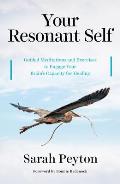
“Your Resonant Self” by Sarah Peyton

May 24, 2018 by Sonia Connolly 5 Comments

book cover

Subtitle: Guided Meditations and Exercises to Engage Your Brain’s Capacity for Healing

Recommended to me by: Amy Bennett

This book hooked me with, “The inner voice can be a constant flow of emotional warmth.” Yes please! Where do I sign up? It did take me a couple of months to get all the way through it, and would have taken longer if I hadn’t decided to finish reading it and write an article about it for May.

The book has a lot of detailed information about different parts of the brain, how they work together, and how trauma isolates them from each other. It’s not clear which parts of this are Interpersonal Neurobiology, but that’s in there. There are lots of TLAs (Three Letter Acronyms). Also lots of NVC (Non-Violent Communication), guessing about feelings and needs, which is one way to express empathy, but not the only way.

Emotional warmth is defined as being met or meeting others with affection and welcome, with a feeling of being cared for, nourished, and nurtured.

Resonance is defined as sensing that another being fully understands us and sees us with emotional warmth and generosity. Resonance is a two-person relational experience, being a “we.”

“We are social animals created to live in groups, like honey bees, ant colonies, or parades of elephants. Our brains are meant to be soothed by other human brains.”

The Default Mode Network (DMN) is the part of our brain that talks to us when we’re idle. It can be warmly kind, neutrally factual, or viciously negative.

We can choose to speak warmly to our attention as we watch it in meditation. We can begin to be warm toward parts of ourselves. We can find a part called Resonating Self Witness (RSW), and have that part resonate with other parts that need hearing and healing.

There are chapters on the inner critic, anxiety, editing old trauma narratives, anger, fears, dissociation, attachment, self-hate, depression, addiction, and community. There is a huge amount of material in the book, and I’m barely touching on what’s there and my responses to it.

The guided meditations that go with the chapters can be downloaded from yourresonantself.com. You get added to a marketing-heavy mailing list, but it’s easy to unsubscribe.

The way that criminality is associated with disorganized attachment sounds like the way some people say abusers abuse because they were abused themselves. No, plenty of us were abused and don’t go on to abuse anyone. Plenty of us had disorganized or disorganizing attachment and don’t end up in prison.

The Resonating Self Witness is similar to Self In Presence from Inner Relationship Focusing. That system’s way of listening and reflecting feels like a better fit for me than the questions about feelings and needs that this book suggests. Perhaps for people who do not yet have words for their emotions and needs, the NVC approach is more helpful.

I like the model that healing from trauma is about getting isolated parts of the brain back into connection. After working through all the guided meditations, I feel like I did learn more about how to be warm in relation to myself. I like the idea that resonance is available inside us rather than being dependent on finding it externally. I continue to be suspicious of the idea that internal resonance is just as good as interpersonal resonance, or even good enough, but I’m sure it’s better than nothing.

Recommended if you’re curious about interpersonal neurobiology and want to spend some quality time investigating and changing how you relate with yourself.
Available at bookshop.org.

Filed Under: nonfiction Tagged With: healing, illustrated, psychology

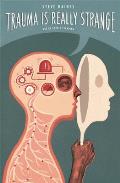
“Trauma Is Really Strange” by Steve Haines, art by Sophie Standing

December 24, 2017 by Sonia Connolly 2 Comments

book cover

Recommended to me by: boxofdelights

This is a graphic “novel” (although it’s non-fiction) or comic, or graphic medicine book. Each page is divided into panels with drawings and word bubbles, sometimes with additional explanations in tiny red print at the bottom of the page.

This is a solid introduction to the nervous system and how it responds to stress, including the sympathetic and parasympathetic nervous systems and Porges’ polyvagal theory, all in a friendly reassuring format. Trauma is defined as events that exceed our ability to cope with them. Healing is focused on being present and tolerating intense internal sensations, rather than reworking the past or experiencing big emotional catharsis. The goal is to tone down the reflexes of fight-or-flight and dissociation.

“Healing trauma is about meeting the body. In trauma, old parts of the brain change how the body works. By paying attention to feelings in the body and learning to self-regulate we can reboot the brain.”

The material is familiar to me, with a different emphasis than I’m used to, perhaps because the book is British.

The people in the drawings almost all come across as male. A few have more detail and come across as female. The people do have a wide range of skin colors, which is great. There is a drawing of a baby being born out of a disembodied blob – apparently it was too hard to draw a whole person giving birth. There was a surprisingly ableist use of “blindly” that brought me up short.

The book covers a lot of ground in a clear way. Of course it can’t cover everything. At the same time, I would have liked to see a disclaimer that everyone’s experience with trauma is different, and everyone’s healing path is different. Near the end, there is an entire page dedicated to Trauma Release Exercises (TRE), and the whole book feels skewed toward people for whom that’s the answer.

Yes, it’s less neat and reassuring to say, “This works for some people, not all,” but it is more honest, and more kind to those for whom it is all more complicated.  The last thing a traumatized person needs is to hear, “This works for everyone,” when that thing doesn’t work for them.

Available at bookshop.org.

Filed Under: nonfiction Tagged With: healing, illustrated, psychology, trauma

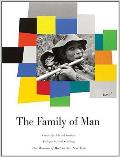
“The Family of Man” by Edward Steichen

November 24, 2017 by Sonia Connolly Leave a Comment

book cover

Recommended to me by: Asakiyume

A photo book from an exhibition in 1955 showing 503 photographs of people from around the world living their lives.

The use of “Man” for people bothered me at the outset, and I grumpily examined the book through the lens of inclusion and exclusion. There are women and people of color pictured, and the women get to be strong and active too. The places where men predominate, in suits in a courtroom for example, they predominated in 1955. There were many photos from the USA, where the exhibit was originally held.

This is a great book for children, to show them that people are essentially the same everywhere, and also that people and cultures have infinite variation. Also a great book to find prompts for stories. I wanted to know more about the people in each photo, to get to know a few of them in depth rather than move through the teeming crowd of them.

Asakiyume’s post has a great sampling of photos.

Available at bookshop.org.

Filed Under: nonfiction Tagged With: illustrated

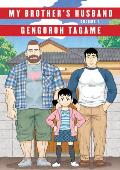
“My Brother’s Husband” by Gengoroh Tagame

October 1, 2017 by Sonia Connolly Leave a Comment

book cover

Translated from the Japanese by Anne Ishii

Recommended to me by: Yatima in the 50 books by POC community

Yatima found this graphic novel via its blurb by Alison Bechdel and recommended it enthusiastically. I loved it too.

Mike Flanagan, Canadian white guy, visits his dead husband’s brother and niece in Japan. They are both traditionally Japanese. Yaichi the brother has a lot of unexamined homophobia and buried emotions, but invites Mike to stay with them anyway. Kana the niece didn’t know that men could marry each other, but responds to Mike warmly.

The book handles relationships and emotions tenderly. Kana is adorable. This book is about the small things in life, meals and sleeping and showers, and the largest things, death and loss and love and relationships and coming out as gay.

The characters are kind to one another. There is something to be said for polite emotional reserve. Some drawings show what Yaichi is yelling inside his head, and the neutral things he says out loud.

As is traditional for Manga, the book reads right to left. I had to be careful to read the panels in the right order on each page. Apparently there are more volumes to come!

Highly recommended.

Available at bookshop.org.

Filed Under: fiction Tagged With: fun, illustrated, lgbt

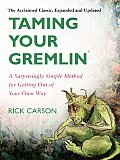
“Taming Your Gremlin” by Rick Carson

October 1, 2017 by Sonia Connolly 2 Comments

book cover

Subtitle: A Surprisingly Simple Method for Getting Out of Your Own Way

The first time I got laid off, back in 1998, we were given day passes to a career center. I dutifully leafed through binders of possible jobs, until a slim book caught my eye. I sat and read all of the first edition of Taming Your Gremlin, enticed by the playful illustrations and clear writing. “Simply noticing” and “playing with options” were exactly the tools I needed.

I ran across it again later and got my own copy, eventually joined by the expanded edition published in 2003. I’ve recommended it a lot since then.

I dug it out recently because I was writing about being nice, and I remembered the “nice person act” in this book. It turns out to be called the “pleasant person act,” but it’s still relevant. We mask our essential selves by acting the way we think we should.

The gremlin is the Inner Critic, the one who tells us that we are unlovable, unworthy, and need to work on ourselves all the time. We can’t get rid of it, but we can tame it by simply noticing, playing with options, and being in process.

Highly recommended!

Available at bookshop.org.

Filed Under: nonfiction Tagged With: illustrated, psychology

“The Thirteen Clocks” by James Thurber

November 22, 2016 by Sonia Connolly Leave a Comment

book cover

Recommended to me by: My college roommate

In times of extreme stress, my college roommate gathered a group of us together and read aloud this delightful, illustrated, untraditional fairytale. She tracked down a used copy for me, and it is one of my treasured possessions.

As an antidote to extreme election anxiety, I read the story aloud recently over a couple of evenings. The lyrical language and satisfying conclusion are still soothing all these years later.

I would like a Golux to fix the election please.

Back in print! Available at bookshop.org.

Filed Under: fiction Tagged With: childrens, fun, illustrated

  • « Go to Previous Page
  • Page 1
  • Interim pages omitted …
  • Page 4
  • Page 5
  • Page 6
  • Page 7
  • Page 8
  • Interim pages omitted …
  • Page 15
  • Go to Next Page »

Primary Sidebar

Recent Books

  • “How We Show Up” by Mia Birdsong
  • “The Enchanted Greenhouse” by Sarah Beth Durst
  • “What It Takes to Heal” by Prentis Hemphill
  • Kitchens of Hope by Linda S. Svitak and Christin Jaye Eaton with Lee Svitak Dean
  • “Very Far Away From Anywhere Else” by Ursula K Le Guin
  • “Seaward” by Susan Cooper
  • “Surviving Domestic Violence” by Elaine Weiss
  • “The Book of Love” by Kelly Link
  • “Alexandra’s Riddle” by Elisa Keyston
  • “Weaving Hope” by Celia Lake

Tags

activism aging anti-racism bodywork business childhood abuse childrens CivicTech communication disability domestic violence fantasy feminism finance Focusing food fun healing health at any size illustrated Judaism leadership lgbt marketing memoir music natural world neurodiversity politics psychology relationship romance science science fiction software spirituality survival story trauma writing young adult

Categories

Archives

Please note: bookshop.org and Amazon links are affiliate links. Copyright © 2026 · Genesis Sample on · WordPress