• Skip to primary navigation
  • Skip to main content
  • Skip to primary sidebar
Curious, Healing

Curious, Healing

Books about healing, business, and fun

  • About Sonia Connolly

relationship

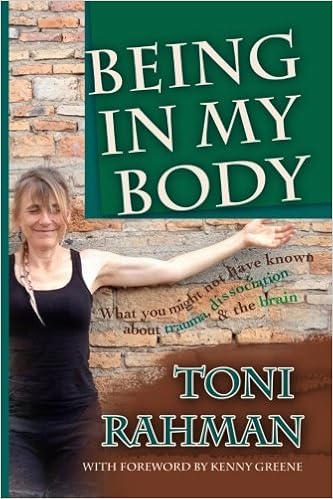
“Being In My Body” by Toni Rahman

January 29, 2022 by Sonia Connolly 1 Comment

book cover

Subtitle: What you Might Not Have Known about Trauma, Dissociation and the Brain

Recommended to me by: a client

This book covers a lot of ground, and does it well. Toni Rahman summarizes current research into developmental trauma, CPTSD, dissociation, emotions, attachment, and polyvagal theory, as well as sharing some of her own story and client stories. She applies this material to parenting, inhabiting the body, and healthy adult intimacy.

Some of the many ideas in the book:

  • We are designed, from birth, to take refuge in the trusting bonds we have with others.
  • What children need from their caring adults is flexibility and openness balanced with a strong enough sense of self and one’s own limits, with curiosity about who this child is.
  • Regression is leaving the present moment and reliving the past instead. This can also be called an emotional flashback.
  • Feeling an emotion is acknowledging it, allowing it to be in the body. Emoting is acting it out: yelling, crying, etc.
  • Via Karla McLaren, event trauma happens not just from something difficult or overwhelming, but from not being welcomed back into the tribe afterward. A full initiation includes both surviving challenging circumstances, and being received with adequate attention, empathy, and care afterwards.
  • For an infant or small child, chronic or prolonged parental misattunement without adequate repair represents a traumatic threat to life.
  • Feeling threatened by a parent who is also a source of care is a problem in itself, compounded by not having support to express or resolve the problem. This is disorganized attachment.
  • For someone with unhealed disorganized attachment or CPTSD, intimacy is triggering and terrifying rather than soothing and nurturing.
  • How your body responds to intimacy is an echo of your early experiences.
  • We can approach our own bodies with care to build secure attachment and intimacy with ourselves.
  • You will know what you like because just thinking of it will make you feel soft, relaxed, and light, not restricted, guarded, or confused.

There are a couple of distracting textual errors in the book: duplicated client quotes, and at least one misspelling of a place name.

Overall, highly recommended for anyone interested in trauma, inhabiting the body, and healthy intimacy.
Toni Rahman’s website.

Available at bookshop.org.

Filed Under: nonfiction Tagged With: childhood abuse, memoir, psychology, relationship, trauma

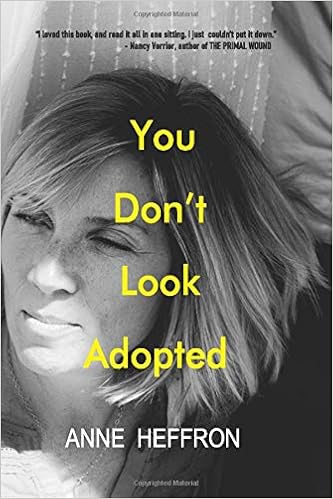
“You Don’t Look Adopted” by Anne Heffron

December 26, 2021 by Sonia Connolly 1 Comment

book cover

Recommended to me by: an adopted client

Anne Heffron shines a light on the seams that adoption leaves behind, by sharing her story and her thoughts with painful honesty. She was adopted into a “good” (white, middle class, well-intentioned) family and is pressured by her emotionally fragile mother and all of society to act like her adoption was a blip that no longer affected her. But she feels chaotic and terrified inside. When her life has entirely fallen apart, she finally writes the book she always wanted to write.

“In a parallel universe, the universe of my imagination, I was sitting at an entirely different table with entirely different people, eating entirely different food, so it seemed pointless to give myself one hundred percent to my life.”

“I have heard too many stories to think adoption is something that happens at birth or in childhood and then fades into I am part of this family with no repercussions—no emotional issues, no health issues, no fear of future abandonment, no fear of loss.”

“I want to write the book that, if I had read it at seventeen, I wouldn’t have felt so badly about myself, so wrong, so destined for a shaky future.”

The book is written in brief sections with all-caps headers. Distractingly, the headers are sometimes at the bottom of one page and the section continues on the next page. She says the book is written in fragments to express her sense of being fragmented inside.

Highly recommended to anyone who is involved with adoption (adoptee, birth family, adopted family) or wants to understand adoption better.

Anne Heffron’s website.

Available at Amazon.

Filed Under: nonfiction Tagged With: healing, memoir, psychology, relationship, survival story, trauma, writing

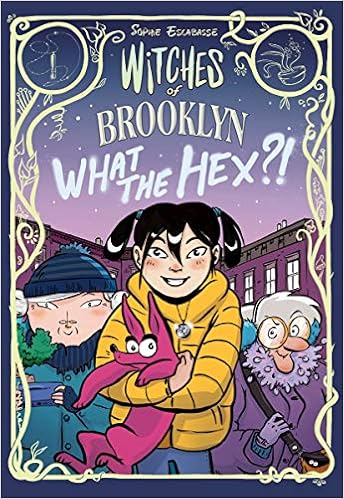
“Witches of Brooklyn: What the Hex?!” by Sophie Escabasse

December 5, 2021 by Sonia Connolly Leave a Comment

book cover

Recommended to me by: Soph

A playful graphic novel about witches in Brooklyn with an underlying message about building friendship through patience and conversation. The cast of characters is delightfully multi-racial, as is fitting for New York, and young Effie’s grandmothers are more notable for being witches than for being a couple. In fact their relationship is left a little vague, but they’re probably not just housemates.

The drawings of people are expressive and funny and the backgrounds are full of Brooklyn details.

I was just going to look at the first few pages, and got pulled into reading the whole thing. Recommended!

Available at Amazon.

Filed Under: art, fiction Tagged With: fantasy, fun, illustrated, lgbt, relationship, young adult

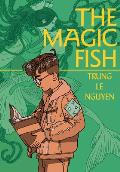
“The Magic Fish” by Trung Le Nguyen

December 5, 2021 by Sonia Connolly Leave a Comment

book cover

Recommended to me by: Soph

What a lovely, powerful graphic novel. Tien is growing up in the US with Vietnamese immigrant parents. He speaks mostly English, and they speak mostly Vietnamese. It’s a close, loving family and they read fairy tales together when they have time. The graphic novel interweaves slant-wise takes on three familiar fairy tales with Tien’s adventures in high school and as he struggles to communicate important truths about himself to his parents.

The art is gorgeous. Fairy tale dresses are especially elaborate, and the end of the book contains notes on the time periods the dresses are drawn from. The one thing I found confusing is that something about the proportions of the characters made them look younger to me. Tien looked like a much younger child, and his mom looked like his teen older sister, even though the story communicates that Tien is in high school and his mom is in her 30s.

The love in the book makes me cry, along with the difficult times around immigration and grief, conveyed with kindness. Highly recommended!

Content notes: brief homophobia, not endorsed by the author, and fairy tale violence.

Available at bookshop.org.

Filed Under: art, fiction Tagged With: childrens, fantasy, fun, healing, illustrated, lgbt, relationship, young adult

“Set Boundaries, Find Peace” by Nedra Glover Tawwab

November 22, 2021 by Sonia Connolly Leave a Comment

book cover

Subtitle: a guide to reclaiming yourself

Recommended to me by: Renay at Lady Business

Nedra Glover Tawwab is a therapist and an Instagram influencer. Her book is a solid introduction to boundaries and how to use them in a variety of contexts. She defines boundaries as “expectations and needs that help you feel safe and comfortable in your relationships.”

Among many heterosexual examples, her vignettes include two lesbian couples, where one of the couples breaks up. Gender roles are reasonably varied. Race wasn’t signaled in the examples. The author is Black.

She briefly addresses microaggressions as boundary violations. The suggested solutions are to assertively call out the problem, for example, “I notice that you said, ‘I don’t sound Black.’ What does that mean?” And/or suggest more appropriate behavior, for example, a woman CEO who is called “bossy” could say that she is simply assertive and willing to lead.

Boundaries are great! Assertiveness is great! Implying that they can solve discrimination, and saying outright that we need to teach others how to treat us, is less great. I agree that it’s worth explicitly asking for what one needs before giving up on a relationship. At the same time, Ask vs. Guess culture is not discussed, where Guess culture imposes a social penalty for explicitly expressing boundaries and needs.

There is an extended example where one person in a relationship blames the other for “poor communication” where the actual problem is that the blamer is using manipulation and guilt-tripping. Again the solution is to call it out as guilt-tripping. Gaslighting, abuse, and inappropriate blame are mentioned, with the same appearance of neat solutions.

This book explicitly puts the responsibility for policing boundaries on the boundary-setter. As someone who bought into “Boundaries will fix everything!” many years ago and worked very hard at them, it’s painful to find that assumption woven through the book. While it is important to take action where we can, it is also important to take a step back when it doesn’t work, rather than endlessly trying harder. That balancing act is not as straightforward as this book makes it seem.

This is a clear, detailed, encouraging manual for learning about boundaries. Recommended if the idea of assertive boundaries is new to you. They can definitely improve difficult situations and clear up problems with over-commitment and hidden assumptions.

There is a forthcoming Set Boundaries Workbook.

Nedra Glover Tawwab’s website

Available at bookshop.org.

Filed Under: nonfiction Tagged With: communication, psychology, relationship

“disarming the narcissist” by Wendy T. Behary, LCSW

October 28, 2021 by Sonia Connolly 1 Comment

book cover

Subtitle: Surviving & Thriving with the Self-Absorbed

Wendy Behary specializes in psychotherapy for narcissists and their struggling family members. She can be firm and kind while not being overwhelmed by negative behaviors.

She suggests using “we” language (“Our common goals are…”), offering the benefit of the doubt (“I know you didn’t mean to be hurtful”), and still giving honest feedback (“and it’s hurtful when you interrupt and criticize me.”) If you want the narcissist to agree to something in a negotiation, preemptively give them credit for the idea.

She suggests: Plant seeds of more kind and considerate behavior by calmly mentioning what you expect many times and hoping it pays off years in the future. Offer a good example by being kind and considerate yourself. In my experience, narcissists aren’t paying attention, so the ongoing good example goes unnoticed or is taken for granted.

For the terrible self-doubt that narcissists’ oblivious certainty awakens, she suggests understanding your “schemas,” patterns and expectations from childhood. It gives a framework to recognize triggers, separate past from present, and offer gentle care for the hurt child within. She recommends understanding the schemas of the narcissist as well.

Wendy Behary collaborates with Jeffrey Young, who created Schema Therapy. His 18 schemas are:

  1. Abandonment/instability
  2. Mistrust/abuse
  3. Emotional deprivation – lack of nurturance, empathy, protection
  4. Defectiveness/shame
  5. Social isolation/alienation
  6. Dependence/incompetence
  7. Vulnerability to harm or illness
  8. Enmeshment/undeveloped self
  9. Failure
  10. Entitlement/grandiosity
  11. Insufficient self-control/self-discipline
  12. Subjugation of needs, emotions
  13. Self-sacrifice
  14. Approval-seeking/recognition-seeking
  15. Negativity/pessimism
  16. Emotional inhibition
  17. Unrelenting standards/hypercriticalness – perfectionism, rules and shoulds, preoccupation with time and efficiency
  18. Punitiveness

“Heal your childhood schemas. Don’t get triggered by the narcissist. Be sturdy and calm.” Sure, sounds great. Takes a little more than reading one book.

She often mentions seeing a therapist, but does not mention getting bodywork. There is a half-page section titled Somatic Experiencing that mentions body work and describes one Somatic Experiencing technique, without mentioning Peter Levine who originated that work.

She offers a mindfulness technique I liked: Feel your abdomen expand as you breathe in. On the next breath, feel your lungs expand. On the next breath feel the cool incoming air and warm outgoing air at your nostrils. Repeat. She adds paying attention to each of your senses as well.

She states several times during the book that if you are in danger, don’t try to reform the narcissist. Make a safety plan and work on getting out. The book is written for those who have decided to stay, at least for the moment, or are in the process of getting a divorce or co-parenting afterward.

She discusses hypersexual and perilous narcissists. The connection between what is usually called malignant narcissism and sexual acting out makes sense. However, the negative stereotypes about sex workers made this section hard to get through.

This is a thorough, knowledgeable book about how to live or work with a mild to moderate narcissist as an adult. It does not really address people who were raised by narcissists and can be emotionally difficult to read. Recommended if you need more tools to handle narcissists, and have already done enough healing to tolerate the slightly breezy tone about the healing process.

Available at bookshop.org.

Filed Under: nonfiction Tagged With: communication, psychology, relationship, trauma

  • « Go to Previous Page
  • Page 1
  • Page 2
  • Page 3
  • Page 4
  • Page 5
  • Go to Next Page »

Primary Sidebar

Recent Books

  • “How We Show Up” by Mia Birdsong
  • “The Enchanted Greenhouse” by Sarah Beth Durst
  • “What It Takes to Heal” by Prentis Hemphill
  • Kitchens of Hope by Linda S. Svitak and Christin Jaye Eaton with Lee Svitak Dean
  • “Very Far Away From Anywhere Else” by Ursula K Le Guin
  • “Seaward” by Susan Cooper
  • “Surviving Domestic Violence” by Elaine Weiss
  • “The Book of Love” by Kelly Link
  • “Alexandra’s Riddle” by Elisa Keyston
  • “Weaving Hope” by Celia Lake

Tags

activism aging anti-racism bodywork business childhood abuse childrens CivicTech communication disability domestic violence fantasy feminism finance Focusing food fun healing health at any size illustrated Judaism leadership lgbt marketing memoir music natural world neurodiversity politics psychology relationship romance science science fiction software spirituality survival story trauma writing young adult

Categories

Archives

Please note: bookshop.org and Amazon links are affiliate links. Copyright © 2026 · Genesis Sample on · WordPress