• Skip to primary navigation
  • Skip to main content
  • Skip to primary sidebar
Curious, Healing

Curious, Healing

Books about healing, business, and fun

  • About Sonia Connolly

spirituality

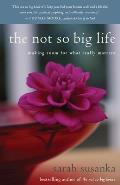
“The Not So Big Life” by Sarah Susanka

August 2, 2011 by Sonia Connolly Leave a Comment

Subtitle: Making Room For What Really Matters

Sarah Susanka is a renowned architect, author of the “Not So Big House” series. This book is beautifully architected with parallels between life remodeling and house remodeling. For the target audience of people with plenty of money and a shortage of time, the book offers substantial, detailed advice on how to make satisfying life choices.

The topics include, among others, noticing inspiration, removing clutter, meditation, dream analysis, and maintenance of your newly remodeled life.

Susanka uses a Jungian approach to dreams where every element of the dream represents the dreamer in some way. She also espouses the Jungian belief that the external world is a perfect mirror of the internal world. I am wary of Jungian psychology since a session with a Jungian therapist whose only tool was to ask me how the abuse I received had benefited me.

I read this book because I have already chosen to lead a “not so big life” and I was looking for validation of my choices. Since I’m not in the target market for the book, I was left with the feeling that it is more valid to be wealthy, overwhelmed, and in need of life-downsizing than it is to have already chosen a less lucrative, more meditative path.

One thing I did get from the book is the idea that whatever I’m doing now is my life. I don’t have to keep looking around to check if I’m doing the right thing or not.

In summary, if you’re in the target audience of this book, I think you’ll get a lot out of it.

A typographical note: Since I’m designing my own book, I’ve been paying close attention to book typesetting. Oddly, this book is set in a sans serif font, Quadraat Sans. It grabs my attention every time I open the book (although I had to look at the colophon for the name of the font).
Available at bookshop.org.

Filed Under: nonfiction Tagged With: psychology, spirituality

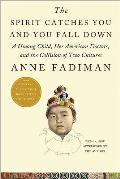
“The Spirit Catches You and You Fall Down” by Anne Fadiman

March 31, 2011 by Sonia Connolly Leave a Comment

Subtitle: A Hmong child, her American doctors, and the collision of two cultures

Recommended to me by: Emily Ross

This is a beautifully written history of the Hmong people from Laos in the 20th century, interwoven with the story of one Hmong family who took refuge in Merced, California. Their daughter Lia Lee had her first epileptic seizure at age 4 months. Both the family and Lia’s doctors struggle with her illness and with the communication barriers between their cultures.

The Lees are frustrated because Lia continues to have seizures, and her prescribed medicines cause side-effects they don’t expect. The doctors are frustrated because the Lees don’t speak English and “aren’t compliant” with the medicine schedule. Also, the Lees have very little money.

Dr. Arthur Kleinman, a psychiatrist and medical anthropologist at Harvard Medical School, developed a set of eight questions to elicit a patient’s “explanatory model.” After getting to know the Lees, Anne Fadiman answers the eight questions from their perspective. The American doctors continue full-tilt in their own medical explanatory model, unable to consider a different model.

  1. What do you call the problem?
    Qaug dab peg. That means the spirit catches you and you fall down.
  2. What do you think has caused the problem?
    Soul loss.
  3. Why do you think it started when it did?
    Lia’s sister Yer slammed the door and Lia’s soul was frightened out of her body.
  4. What do you think the sickness does? How does it work?
    It makes Lia shake and fall down. It works because a spirit called a dab is catching her.
  5. How severe is the sickness? Will it have a short or long course?
    Why are you asking us those questions? If you are a good doctor, you should know the answers yourself.
  6. What kind of treatment do you think the patient should receive? What are the most important results you hope she receives from this treatment?
    You should give Lia medicine to take for a week but no longer. After she is well, she should stop taking the medicine. […]
  7. What are the chief problems the sickness has caused?
    It has made us sad to see Lia hurt, and it has made us angry at Yer.
  8. What do you fear most about the sickness?
    That Lia’s soul will never return.

My only issue with the book is that chapters about Hmong history are inserted at cliff-hanger portions of Lia’s story, causing me to flip ahead and find out what happens to her. The history is worth reading in its own right and doesn’t need manufactured suspense to pull the reader through it.

Recommended to anyone who wants to learn about Hmong culture and history, medical communication at its worst and best, and the story of one much-loved child.

Available at bookshop.org.

Filed Under: nonfiction Tagged With: communication, disability, spirituality, trauma

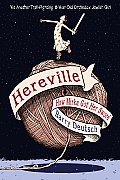
“Hereville: How Mirka Got Her Sword” by Barry Deutsch

October 31, 2010 by Sonia Connolly 2 Comments

Subtitle: Yet Another Troll-Fighting 11-Year-Old Orthodox Jewish Girl

Recommended to me by: Barry Deutsch’s Alas, A Blog

A graphic novel set in an Orthodox Jewish town called Hereville, in a blended family with many girls and one little brother. The facial expressions and other details in the drawings are captivating – I read the book twice and noticed a lot that I’d missed the first time. The characters are realistic even while engaged in unrealistic adventures.

The strict rules of Orthodox Judaism are included in the story, with only the occasional pictorial editorial comment, such as the bored expressions of the youth having “vibrant, passionate discussions” on Shabbat. Yiddish terms are translated in footnotes.

The fantastic elements of witch encounters and troll fights contrast oddly with the Orthodox background, sibling arguments about reputation, and a step-mother’s efforts to manage a large family. The ending is decidedly unexpected.

Mirka is portrayed as reaching for a knife, sword, or tree-branch to violently solve her problems. She is also portrayed as being so immersed in Jewish culture that she didn’t recognize a pig when she saw one.

I’m not sure what to think of the book. It draws me in, and at the same time leaves me wondering if the author’s message is subtly derogatory toward Judaism. While I wouldn’t want to live in an Orthodox community myself, I don’t want to see one exposed to ridicule, either.

Barry Deutsch is a cartoonist in Portland, Oregon.

Available at bookshop.org.

Filed Under: fiction Tagged With: fun, illustrated, spirituality, young adult

“Mastering Life’s Energies” by Maria Nemeth, PhD

September 20, 2010 by Sonia Connolly Leave a Comment

Subtitle: Simple Steps to a Luminous Life at Work and Play

Recommended to me by: Aubrie De Clerck

Maria Nemeth offers step-by-step instructions on how to move from a fog of confusion to living with “clarity, focus, ease, and grace.”

I do want to live with clarity, focus, ease, and grace, but I didn’t start reading in a fog of confusion. I did find some useful insights in this book.

She distinguishes between unhelpful Monkey Mind and helpful voice of wisdom. She characterizes Monkey Mind as insistent, survival-oriented, tensing the body, carrying a sense of dread or impending doom, defensive, and humorless.

By contrast, the voice of wisdom tends to be compassionate toward self and others, spacious, the heart relaxes, contains gentle good humor, generosity of spirit, kindness, open-heartedness, and the sense that all is well.

She reminds us to see people as whole and complete in themselves, rather than in need of fixing or rescuing.

She asks how you see your body, and then how does your body see you? I had never thought about that. I paused to ask myself this question, and my body says it misses me when I’m not present to myself. She proposes that our bodies love us, and my experience agrees.

I also found parts of the book condescending or irrelevant. She sometimes seems to forget that her reader does not need fixing.  Her strangely short list of Life Intentions reads more as her personal definition of How To Be A Good Person rather than as a generally applicable list. There is far too much talk about dieting, even when she notes that “weight loss” is not a positive goal. Repeated mentions of her “thousands of clients” did not strengthen the book’s message for me.

Recommended, with some skimming.

Available at bookshop.org.

Filed Under: nonfiction Tagged With: spirituality

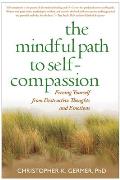
“The Mindful Path to Self-Compassion” by Christopher K. Germer, PhD

July 26, 2010 by Sonia Connolly 1 Comment

Subtitle: Freeing Yourself from Destructive Thoughts and Emotions.

This “un-self-help” book by a clinical psychologist shows how to stop fighting uncomfortable emotions and accept them with self-compassion instead. Step by step, Germer shows how to be kind to ourselves, listen to our bodies, and bring in difficult emotions.

I liked his analysis of the stages of acceptance (as distinct from the stages of grief):

Stages of Acceptance:

  1. Aversion – resistance, avoidance, rumination
  2. Curiosity – turning toward discomfort with interest
  3. Tolerance – safely enduring
  4. Allowing – letting feelings come and go
  5. Friendship – embracing, seeing hidden value

He carefully notes pitfalls along the path for trauma survivors. For example, it can be triggering to focus on the breath during meditation, so an external focus such as holding a stone or watching a candle could be more calming.

I was pleasantly surprised by his awareness of diversity and discrimination. Even a few mentions of those issues go a long way toward fostering my trust of a white male author as I read. For example, his stories contain some same-sex couples. On the subject of medication, he advocates deciding what’s most kind for yourself.

The second half of the book describes metta or loving-kindness meditation. Phrases like “May I be safe. May I be happy. May I be healthy. May I live with ease.” are directed first toward the self, then toward a loved one, then toward someone neutral, then to a difficult person or enemy.

He describes the backdraft which can occur with this meditation, a rush of feelings similar to the rush of flame from opening a door on a fire.

I had a hard time staying with this part of the book. Perhaps it was from a backdraft of feelings. Perhaps it was my reaction to the instructional tone. I’m having a strong response to being told what to think or how to feel lately, even when I’m reading a self-help book.

Overall, I recommend this book. It has much less fixing and more compassion than most self-help books. It’s a delight to see a psychologist advocating self-kindness and acceptance as a way toward healing.

Available at bookshop.org.

Filed Under: nonfiction Tagged With: psychology, spirituality

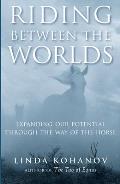
“Riding Between the Worlds” by Linda Kohanov

July 23, 2010 by Sonia Connolly 1 Comment

My response to The Tao of Equus doesn’t begin to express the impact it had on me. I immediately looked for Kohanov’s next book.

Riding Between the Worlds contains less abstract theory and more stories from clients and from her own life. It also contains a helpful adaptation of Karla McLaren’s work with emotions into an Emotional Message Chart.

For example:

Emotion Message Questions to Ask Intensification
Anger Proper boundaries should be maintained or rebuilt.

Incongruence.

What must be protected?

What must be restored

What is the emotion behind the mask, and is it directed toward me?

Rage, fury (exploding at those who’ve violated our boundaries)

Shame, guilt (anger toward self when we’ve violated others’ boundaries)

Boredom, apathy (masks anger that can’t be dealt with – a nonviolent coping strategy

Kohanov validates my experiences with transmission of emotions from one person to another, describing the many ways that happens with both people and horses in her practice.

She also talks extensively about congruence and how important it is to both horses and sensitive humans. Incongruence, a mismatch between what someone is feeling and expressing, can cause trouble both for the incongruent person who is suppressing feelings, and the beings around them who may be the target of deception or explosive release.

Kohanov also presents her hard-won list of skills for building community:

  1. Using emotion as information.
  2. Sitting in uncomfortable emotions without panicking.
  3. Sensing and flowing with the emotions of others, again without panicking.
  4. Reading “misbehavior” as a form of communication.
  5. Understanding the dynamics of shared emotion: distinguishing between instructive personal feelings, conditioned (False Self) emotional patterns, affect contagion, empathy, ambience, and emotional resonance.
  6. Resisting the temptation to aggressively “fix” people, horses, uncomfortable situations, etc.
  7. Creating a psychological container of support, what Kathleen Ingram calls “holding the sacred space of possibility.” This fully engaged form of patience is crucial to tapping innovative solutions that arise from the eighth ability:
  8. Activating the Authentic Self.

The only sour note in the book occurs when she creates a false sense of suspense by telling half a story and then inserts 30 pages of other material before returning to the story.

Highly recommended for anyone who believes they are too sensitive or too emotional.

Available at bookshop.org.

Filed Under: nonfiction Tagged With: healing, memoir, psychology, spirituality

  • « Go to Previous Page
  • Page 1
  • Interim pages omitted …
  • Page 6
  • Page 7
  • Page 8
  • Page 9
  • Page 10
  • Go to Next Page »

Primary Sidebar

Recent Books

  • “How We Show Up” by Mia Birdsong
  • “The Enchanted Greenhouse” by Sarah Beth Durst
  • “What It Takes to Heal” by Prentis Hemphill
  • Kitchens of Hope by Linda S. Svitak and Christin Jaye Eaton with Lee Svitak Dean
  • “Very Far Away From Anywhere Else” by Ursula K Le Guin
  • “Seaward” by Susan Cooper
  • “Surviving Domestic Violence” by Elaine Weiss
  • “The Book of Love” by Kelly Link
  • “Alexandra’s Riddle” by Elisa Keyston
  • “Weaving Hope” by Celia Lake

Tags

activism aging anti-racism bodywork business childhood abuse childrens CivicTech communication disability domestic violence fantasy feminism finance Focusing food fun healing health at any size illustrated Judaism leadership lgbt marketing memoir music natural world neurodiversity politics psychology relationship romance science science fiction software spirituality survival story trauma writing young adult

Categories

Archives

Please note: bookshop.org and Amazon links are affiliate links. Copyright © 2026 · Genesis Sample on · WordPress