• Skip to primary navigation
  • Skip to main content
  • Skip to primary sidebar
Curious, Healing

Curious, Healing

Books about healing, business, and fun

  • About Sonia Connolly

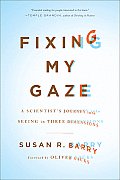
“Fixing My Gaze” by Susan R. Barry

August 29, 2011 by Sonia Connolly 1 Comment

Subtitle: A Scientist’s Journey into Seeing in Three Dimensions

Recommended to me by: jesse-the-k (in a locked post)

This book was a revelation for me. At last, a book for which I am the perfect target audience! Susan R. Barry writes about the experience of having crossed eyes since infancy, and thus lacking stereoscopic (3-D) vision. After practicing a series of vision therapy exercises prescribed by an optometrist, she gains stereoscopic vision.

In addition to the convenience of being able to judge distances easily, she feels a part of the world she can see all around her rather than an observer of the world “out there.” She looks at the spaces between leaves with fascination. The steering wheel of her car “pops out” at her rather than appearing flat against the dashboard. Astonishing!

In addition to describing her experiences of monocular and binocular vision, she covers the neuroscience of vision, and the possible explanation for her ability to regain stereoscopic vision more than 40 years after the “critical period” of early childhood.

I also have slightly crossed eyes and lack stereoscopic vision. I believe I lost the ability around 4-5 years of age. I would love to get it back!

As both a memoir and a scientific overview, this book worked well for me. Because the author was present with her story, I felt included as well.

The only downside was the casual reference to animal experimentation. “Of course they can’t experiment on humans – so they harmed monkeys and cats instead!” (paraphrase) As much as I enjoyed the book, I almost stopped reading there.

Nevertheless, highly recommended.

fixingmygaze.com has a good resources section.
Available at bookshop.org.

Filed Under: nonfiction Tagged With: disability, healing, memoir

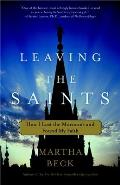
“Leaving the Saints” by Martha Beck

August 27, 2011 by Sonia Connolly 1 Comment

Subtitle: How I Lost the Mormons and Found My Faith

Recommended to me by: Reading Martha Beck’s older books

I first read this years ago and loved it. I came back to it while writing a (forthcoming) article about spiritual abuse and faith. Since I last read it, I read her newer book “Steering by Starlight” and saw that her latest book is about weight-loss, so I started re-reading with trepidation. I still like this one, though!

This book is honest about extreme sexual and spiritual abuse and its effects, side by side with humorous details about daily life. She talks about forgiveness without preaching (much). She talks about how crazymaking it is to have someone casually deny reality. She talks about how wrenching it is to lose family connections because she tells the truth.

She also talks about her personal search for faith, first as the seeking camel, then as the discerning lion, then as the innocent, playful child.

In her last act as a practicing Mormon, she spoke to a huge crowd about domestic violence. “If something I said feels right to you, believe it. If it feels wrong, disbelieve it. The choice to believe or disbelieve, that’s what makes you free.”

Available at bookshop.org.

Filed Under: Uncategorized Tagged With: childhood abuse, healing, memoir, spirituality, survival story, trauma

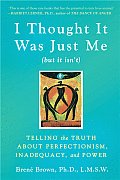
“I Thought It Was Just Me (but it isn’t)” by Brene Brown

August 27, 2011 by Sonia Connolly 1 Comment

Subtitle: Telling the Trust About Perfectionism, Inadequacy, and Power

Recommended to me by: Pam Lyons

Brene Brown researches shame by listening to people’s stories. This book focuses on women for the most part, although she mentions how men’s experience of shame differs at the end of the book. The content overlaps with The Gifts of Imperfection quite a bit.

She describes shame as a “full-contact” emotion because it includes visceral and physical responses. Yes, emotions are physical. All of them. I became suddenly wary of an author who seems to live primarily in her head.

The writing tone is breezy and casual, overlaying the formal language of research. I can see the effort she put into structuring the anecdotes and creating the ideas of the shame web (people who engender shame) and connection network (people who support shame resilience) complete with cute iconic drawings.

On page 9 she puts in an “early call for compassion,” acknowledging that stories about shame are difficult to read, so we often leap to judgment rather than compassion to distance ourselves. I wonder how much of my reactions to the book fall in that category.

I appreciated her explicit inclusion of diverse women across race, class, sexual orientation, age, and religious identity. She includes a lot of her own stories, so there is a pronounced tilt toward mid/upper class white educated heterosexual married mothers of young children, but other voices are represented as well. She specifically mentions hair texture and skin tone as issues for women of color, for example.

One helpful bit for me was the typical responses to shame: moving toward, moving away, or moving against. I seem to have a lot of the moving toward response, and I hadn’t seen that reflected before. It’s not just me!

I’ve done a lot of personal work with shame and authenticity over the years. I suspect this book would be more useful for someone who has not thought about the subject as much. As I think about the fairly basic material and its presentation as earth-shaking new discoveries, I continue to get a sense that the author is disconnected from ongoing work about shame and community. Maybe no one else is pursuing that work in an academic context.

Edited to add: I thought a lot about the sense of distancing I got from the book, and the early disclaimer about shame being distancing. I decided my experience was valid (imagine that!) and the early disclaimer was the equivalent of “I don’t mean to be offensive, but [something offensive].” “I don’t mean to be distancing, but [distancing book].” I find it interesting that it took so much thought to validate my own experience.

Available at bookshop.org.

Filed Under: nonfiction Tagged With: psychology

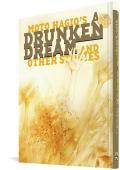
“A Drunken Dream and other stories” by Moto Hagio

August 19, 2011 by Sonia Connolly Leave a Comment

Subtitle: 10 Stories of the Human Heart

Recommended to me by: laughingrat.dreamwidth.org

Moto Hagio is one of the most renowned Japanese artists of shojo manga, high-quality comics for teen girls. She was one of only a few women in the genre in the seventies, and she continues creating art today.

This is a chronological collection spanning 1977-2007. The elegant art conveys emotion and movement with fine pen strokes. With a light touch and few words, the stories address the emotional nuances of abandonment, nonconformity, abortion, conjoined twins, abusive mothers, dead mothers, loving mothers, love through time, gossip, friendship, and marriage.

The words are translated into English, but the pages and the panels run right-to-left, and the sounds emanating from the art are unfamiliar. Instead of “BAM!” and “lub-dub” we see “P-P-PAM” and “TMP!” Each panel invites careful attention, revealing more layers at each reading.

I highly recommend this collection.

Available at bookshop.org.

Filed Under: fiction Tagged With: fun, illustrated, young adult

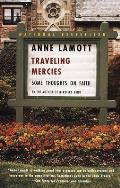
“Traveling Mercies” by Anne Lamott

August 19, 2011 by Sonia Connolly Leave a Comment

Subtitle: Some thoughts on faith

I stumbled across this book while looking for a quote about forgiveness. I usually find Anne Lamott’s books laugh-out-loud funny, reassuringly insightful, or disturbingly insightful. This book, a series of autobiographical essays about faith and religion, left me cold.

Maybe it was the large daily consumption of alcohol and other drugs she reports before she got sober. I can’t tell if she’s exaggerating or not!

Maybe it was the pretend conversion to Judaism in college, where one of the questions was “Do Jews camp?” The response was, “No, we should be at home where it’s comfortable.” She has to memorize a recipe for “Candle Salad” which includes an upright banana with a maraschino cherry on top. The vignette screeches right past funny into ugly stereotypes and cultural appropriation.

Maybe it was the later conversion to Christianity, where she describes Jesus following her everywhere like “a little cat running along at my heels.” I’m glad she found a spiritual home at St. Andrew Presbyterian Church, and at the same time the description sounds a little too much like spiritual stalking to me.

Reading this book felt like having tea with a distraught, judgmental friend who is telling me every little detail of her troubles, including mean physical descriptions of the people involved, without pausing to ask how I’m doing.

Available at bookshop.org.

Filed Under: nonfiction Tagged With: memoir, spirituality

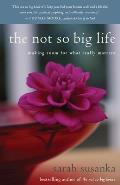
“The Not So Big Life” by Sarah Susanka

August 2, 2011 by Sonia Connolly Leave a Comment

Subtitle: Making Room For What Really Matters

Sarah Susanka is a renowned architect, author of the “Not So Big House” series. This book is beautifully architected with parallels between life remodeling and house remodeling. For the target audience of people with plenty of money and a shortage of time, the book offers substantial, detailed advice on how to make satisfying life choices.

The topics include, among others, noticing inspiration, removing clutter, meditation, dream analysis, and maintenance of your newly remodeled life.

Susanka uses a Jungian approach to dreams where every element of the dream represents the dreamer in some way. She also espouses the Jungian belief that the external world is a perfect mirror of the internal world. I am wary of Jungian psychology since a session with a Jungian therapist whose only tool was to ask me how the abuse I received had benefited me.

I read this book because I have already chosen to lead a “not so big life” and I was looking for validation of my choices. Since I’m not in the target market for the book, I was left with the feeling that it is more valid to be wealthy, overwhelmed, and in need of life-downsizing than it is to have already chosen a less lucrative, more meditative path.

One thing I did get from the book is the idea that whatever I’m doing now is my life. I don’t have to keep looking around to check if I’m doing the right thing or not.

In summary, if you’re in the target audience of this book, I think you’ll get a lot out of it.

A typographical note: Since I’m designing my own book, I’ve been paying close attention to book typesetting. Oddly, this book is set in a sans serif font, Quadraat Sans. It grabs my attention every time I open the book (although I had to look at the colophon for the name of the font).

Available at bookshop.org.

Filed Under: nonfiction Tagged With: psychology, spirituality

  • « Go to Previous Page
  • Page 1
  • Interim pages omitted …
  • Page 52
  • Page 53
  • Page 54
  • Page 55
  • Page 56
  • Interim pages omitted …
  • Page 70
  • Go to Next Page »

Primary Sidebar

Recent Books

  • “How We Show Up” by Mia Birdsong
  • “The Enchanted Greenhouse” by Sarah Beth Durst
  • “What It Takes to Heal” by Prentis Hemphill
  • Kitchens of Hope by Linda S. Svitak and Christin Jaye Eaton with Lee Svitak Dean
  • “Very Far Away From Anywhere Else” by Ursula K Le Guin
  • “Seaward” by Susan Cooper
  • “Surviving Domestic Violence” by Elaine Weiss
  • “The Book of Love” by Kelly Link
  • “Alexandra’s Riddle” by Elisa Keyston
  • “Weaving Hope” by Celia Lake

Tags

activism aging anti-racism bodywork business childhood abuse childrens CivicTech communication disability domestic violence fantasy feminism finance Focusing food fun healing health at any size illustrated Judaism leadership lgbt marketing memoir music natural world neurodiversity politics psychology relationship romance science science fiction software spirituality survival story trauma writing young adult

Categories

Archives

Please note: bookshop.org and Amazon links are affiliate links. Copyright © 2025 · Genesis Sample on · WordPress