• Skip to primary navigation
  • Skip to main content
  • Skip to primary sidebar
Curious, Healing

Curious, Healing

Books about healing, business, and fun

  • About Sonia Connolly

feminism

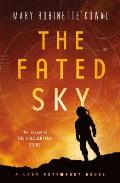
“The Fated Sky” by Mary Robinette Kowal

September 9, 2018 by Sonia Connolly Leave a Comment

book cover
Recommended to me by: Sequel to The Calculating Stars

Elma York goes to Mars. Like in The Calculating Stars, the characters in this book do not flinch from talking about racism and sexism in a system and society they can’t fight or escape.

The plot is more action-driven than the first book. Some characters grow and change in surprising ways. Grief is included as a major emotional force, rather than being glossed over as happens in many books.

The subject is brought up directly in the book, but there is still a big hand-wave on the impracticality of evacuating even a small percentage of the earth’s population to another planet, and how the resources required for that would take away from resources to address problems on earth. Of course the usual biases would affect who stays, who goes, who gets help and who doesn’t.

I still love that Elma’s Judaism weaves through the book with an ongoing cascade of familiar details. I love the conscious inclusiveness of Black characters, a Muslim character, a relationship between men, (minor) characters with disabilities.

I can’t imagine that an organization would put people with known major relational stresses on a 3 year mission together in a small ship. I can’t imagine that people would be able to manage that. Makes me wonder how sailors handle it on long trips.

My suspension of disbelief wobbled on this book. The contrast between doing calculations by hand and making a colonizing mission to Mars was too big. Still a fun read!
Available at bookshop.org.

Filed Under: fiction Tagged With: anti-racism, feminism, fun

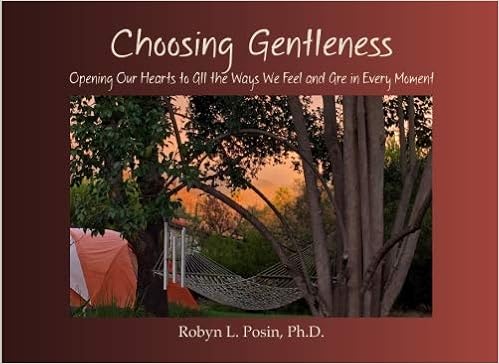
“Choosing Gentleness” by Robyn L. Posin, Ph.D.

September 3, 2018 by Sonia Connolly 1 Comment

book cover

Subtitle: Opening Our Hearts to All the Ways We Feel and Are in Every Moment

Recommended to me by: reading Robyn Posin’s website for the last 15+ years. Also I was an advance reviewer for this book.

This is a collection of line drawings and wise words that have appeared on Robyn Posin’s website over the years, along with some more recent essays. It was lovely to see the vibrant drawings of dancing, struggling, resting women and the encouraging words gathered in one place.

Robyn Posin’s work has been a big inspiration and support over the years. Most of her messages resonate powerfully for me. At the same time, I’m still arguing with a few of them.

The idea that our love-starved little ones inside can only get love from us, not from anyone outside us now that we are no longer children makes a lot of sense, and I still have a “Yes, but…” response. What about adult attachment? What about friendship, and care? I’m not saying she’s wrong, but something in me is still hoping.

I love the parts about accepting all our feelings, not just the warm fuzzy ones, and the firm rejection of the idea that acknowledging our anger just brings more of the same into our lives. Feelings are meant to live and move through, not be shoved down and frozen in place.

In this book, I found a message that I had remembered all this time, but not been able to find again on her website: “It does not matter whether how we are in the moment is born from our woundings or our wholeness.” What a revolutionary, liberating message! Even if we are “broken” in some way because of abuse or trauma, that’s how it is. We still have to exist in the world, with both our damage and our wholeness.

Living in the thinnest slice of now and trusting that my future self will be able to handle my future circumstances has also been a liberating idea.

Another idea I struggle with is that the Grandmothers (or other higher/deeper powers) are guiding my life. I’d love to feel so cherished and protected, but life seems too random, and too catastrophic for a lot of people, to believe that someone is in charge of what happens to each individual.

Highly recommended as a comforting and thought-provoking compilation of Robyn Posin’s many years of healing and helping others heal.

Available at Amazon.

Filed Under: nonfiction Tagged With: feminism, healing, illustrated, psychology, spirituality

“The Calculating Stars” by Mary Robinette Kowal

August 14, 2018 by Sonia Connolly 1 Comment

book cover
Recommended to me by: Marissa Lingen

Elma York is a math whiz with a Ph.D. in math and physics now working as a computer (as in, one who computes) for the space program in the US in the 1950’s. She deals with run-of-the-mill, life-is-just-like-that sexism, and also I’m-out-to-get-you intentional harassment. By the way she’s also a crack pilot who can land a plane after the motor goes out.

She’s also married to the lead engineer of the program, and they have a lovely supportive passionate relationship. She has a supportive relationship with her brother, too. I find myself reading for supportive relationships these days.

Also they are both Jewish, and the book addresses both the positive details and the negative anti-semitism that arises from that. Also they stay with an African-American couple, and they learn to recognize their racist biases and notice when a group “just happens” to be all white.

This book is both old-time spaceflight science fiction, and modern inclusive science fiction, which means it grapples with all the ways that women and people of color are kept out, and still manage to succeed despite that. It addresses global warming and the lack of political will to do something about it. It addresses anxiety as an illness that deserves compassion and treatment. The world-building details are satisfyingly solid.

I was also a Jewish younger female student who was really good at math. (Not as good as Elma!) It feels good to see myself reflected in a book like this, even if I responded differently to the stresses of the situation and took a different turning in my life.

Recommended as a quick, exciting read that’s both heart-warming and heart-rending in the ways it reflects minority and marginalized experiences.

Available at bookshop.org.

Filed Under: fiction Tagged With: feminism, fun

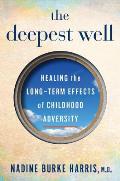
“The Deepest Well” by Nadine Burke Harris, MD

July 10, 2018 by Sonia Connolly Leave a Comment

book cover

Subtitle: Healing the Long-Term Effects of Childhood Adversity

Recommended to me by: listening to Nadine Burke Harris’s TED talk

This is a skillful blend of memoir and scientific information about the effects of trauma, presented for the layperson. Nadine Burke Harris shares how as a newly licensed doctor she founded a pediatric clinic in Bayview, the poorest section of San Francisco with the most at-risk patients, and how that clinic came to focus on trauma as the underlying cause of a lot of medical issues, especially for children. Later she founded the Center for Youth Wellness, also in San Francisco.

She does not dwell on the effects of being a Black woman, but she does not skip over them either. She notes the benefits of networking with other women and offering each other support. While marginalization and racism contribute to people’s load of trauma, trauma is not only a “poor, Black issue.” Privilege does not exempt people from trauma or its long-term effects.

There is a strong correlation between Adverse Childhood Experiences (ACEs) and health issues caused by the body’s ongoing stress response. The stress response can be buffered by strong relationships with caring adults.

Nadine Burke Harris developed a screening tool that asks a parent about the number of a child’s ACEs, but does not ask them to disclose the stories involved. She advocates for this screening tool to be used everywhere, just as infants are now universally screened for hypothyroid and jaundice.

The treatments for a body dysregulated by trauma are sleep, mental health, healthy relationships, exercise, nutrition, and meditation. Schools that help children regulate their nervous systems rather than punishing them for “acting out” enjoy both a more peaceful atmosphere and higher success rates by every measure.

(While screening is catching on in medical offices, I hear from nurses that treatment is catching on less quickly, leaving them in the frustrating position of knowing that people’s issues are caused by trauma, but not having the time and resources to help them.)

Highly recommended both for the information about the effects on trauma, and the memoir of a groundbreaking scientist and doctor who is radically improving how we care for both children and adults affected by trauma.

Available at bookshop.org.

Filed Under: nonfiction Tagged With: activism, anti-racism, childhood abuse, feminism, healing, memoir, psychology, survival story, trauma

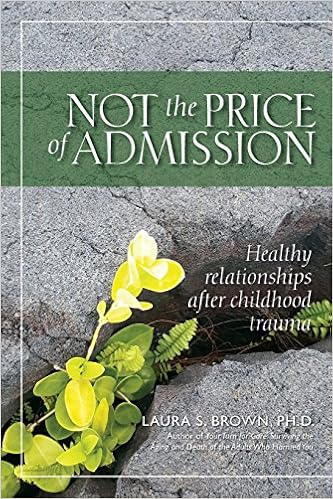
“Not the Price of Admission” by Laura S. Brown PhD

May 8, 2018 by Sonia Connolly Leave a Comment

book cover

Subtitle: Healthy relationships after childhood trauma

Recommended to me by: a client

Relationships are hard for everyone. For people with less-than-adequate caregivers early in life, the difficulty feels personal, a cause for shame as well as sadness. Laura Brown, a feminist psychologist, kindly lays out the likely consequences of early attachment wounds and repeatedly advocates for self-compassion.

Feminist therapy looks at people’s experiences in the context of marginalized identities that often lead to disempowerment and maltreatment, rather than saying that all the problems are inside the individual. The first example in the book is about a same-sex couple. And they’re not the only ones. The book fairly bursts with same-sex couples, as well as emotionally important friendships and work relationships, not just heterosexual romantic partnerships, in a matter-of-fact, “you are all welcome here” way.

I also felt welcomed by seeing quotes from Jewish scholars and traditions. She translates Yom Kippur as “Day of Return,” day of mending connections. And, even though I never watched it, quotes from “Deep Space Nine,” a science-fiction TV show felt welcoming as well.

There is a lot of great material densely packed into this book. It does not skip disorganized attachment like many relationship books do. It shifts the focus to disorganizing caregivers, since the disorganization is not inherent to the child.

Frozen-in-time child states are called EPs, short for Emotional Parts. The book also emphasizes that emotions are positive and useful, so that didn’t seem like the most helpful terminology. EPs are in contrast to ANPs, Apparently Normal Parts that handle day-to-day adult tasks like going to work.

Relationships similar to what we experienced as babies will have limbic resonance and feel “right,” even when they hurt.

The goal is to mindfully notice when a pattern from childhood has taken over, and compassionately self-soothe and notice what is happening in the present, both positive and negative. It’s okay to be imperfect. We don’t have to be abused or used or ignored to be in relationship. We can tolerate conflict that has the goal of reaching better understanding, rather than causing more hurt.

Highly recommended. There is so much more useful material in the book than I can even begin to summarize.

Available at bookshop.org.

Filed Under: nonfiction Tagged With: feminism, healing, psychology, relationship, trauma

“Hope in the Dark” by Rebecca Solnit

February 28, 2017 by Sonia Connolly 2 Comments

book cover

Subtitle: Untold Histories, Wild Possibilities

Recommended to me by: reading Rebecca Solnit’s essay “Men Explain Things to Me”, and also Haymarket Books was giving away free copies of the ebook on the occasion of the November 2016 election results

I rarely read ebooks. I prefer to hold the book in my hands and have a physical context for what I’m reading and how much is left. Ebooks feel disorientingly abstract. I put this one on my phone and have been reading it in little bits when I wait for an appointment or ride a bus. The book is a series of short chapters and essays, linked together.

Oddly (for a professional publisher) Haymarket Books used an irritating variable font so that letter size and style varies within words, and they also tagged the book repeatedly with my name and email address. I guess they wanted to make really sure I didn’t share the book with anyone, but what they did is distract me while I was reading and repeatedly remind me not to buy any ebooks from Haymarket Books.

Format issues aside, “Hope in the Dark” is an affirming, well-researched, engagingly written anodyne for the current political situation. It was written on the occasion of Bush’s contested election in 2004, and the problems and dynamics then sound remarkably like the current disasters (except Bush wasn’t, as far as we know, in league with a foreign government).

Solnit talks about how powerful entities in the limelight look immovable, but ideas and movements at the edges, on the margins, in the shadows engender change. We forget our victories because they look like they’ve always been that way, and also because those in power want us to forget and despair. Victories build slowly, happen partially, arise suddenly from years of background work.

Activist movements that practice what they want to see in the world (consensus, equity, respect for all) are already winning even if the current battle is lost. Living the way we want to live *is* activism. Distributed movements that share strategies globally but meet and act locally are finding more and more success.

I found support here for living the way I want to live. I also found urging to reach out, connect with local groups, act! The last essay is about climate change and its urgency. Hope is the determination to keep working toward the world we want to live in, non-violently, non-idealogically, peacefully, cooperatively, joyously.

Highly recommended for anyone distressed by current politics.

Available at bookshop.org.

Filed Under: nonfiction Tagged With: anti-racism, feminism

  • « Go to Previous Page
  • Page 1
  • Page 2
  • Page 3
  • Page 4
  • Page 5
  • Page 6
  • Page 7
  • Go to Next Page »

Primary Sidebar

Recent Books

  • “How We Show Up” by Mia Birdsong
  • “The Enchanted Greenhouse” by Sarah Beth Durst
  • “What It Takes to Heal” by Prentis Hemphill
  • Kitchens of Hope by Linda S. Svitak and Christin Jaye Eaton with Lee Svitak Dean
  • “Very Far Away From Anywhere Else” by Ursula K Le Guin
  • “Seaward” by Susan Cooper
  • “Surviving Domestic Violence” by Elaine Weiss
  • “The Book of Love” by Kelly Link
  • “Alexandra’s Riddle” by Elisa Keyston
  • “Weaving Hope” by Celia Lake

Tags

activism aging anti-racism bodywork business childhood abuse childrens CivicTech communication disability domestic violence fantasy feminism finance Focusing food fun healing health at any size illustrated Judaism leadership lgbt marketing memoir music natural world neurodiversity politics psychology relationship romance science science fiction software spirituality survival story trauma writing young adult

Categories

Archives

Please note: bookshop.org and Amazon links are affiliate links. Copyright © 2026 · Genesis Sample on · WordPress