• Skip to primary navigation
  • Skip to main content
  • Skip to primary sidebar
Curious, Healing

Curious, Healing

Books about healing, business, and fun

  • About Sonia Connolly

feminism

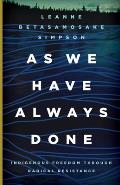
“As We Have Always Done” by Leanne Betasamosake Simpson

June 13, 2021 by Sonia Connolly 2 Comments

book cover

Subtitle: Indigenous Freedom through Radical Resurgence

Leanne Betasamosake Simpson is a renowned Michi Saagiig Nishnaabeg scholar, writer and artist who has taught and lectured across Canada. With story and analysis, she carefully lays out how Nishnaabeg ways of living, learning, and experiencing are intrinsically suited to reestablish their communities and place-relationship that have been intentionally disrupted and stolen by colonialist settlers.

A single quote out of context doesn’t do justice to the way she steps out of whiteness to center the Nishnaabeg way of thinking and doing, but here is a taste.

Governance was made every day. Leadership was embodied and acted out every day. Grounded normativity isn’t a thing; it is generated structure born and maintained from deep engagement with Indigenous processes that are inherently physical, emotional, intellectual, and spiritual. Processes were created and practiced. Daily life involved making politics, education, health care, food systems, and economy on micro- and macro-scales. […] The structural and material basis of Nishnaabeg life was and is process and relationship—again, resurgence is our original instruction.

The book addresses kwe – the embodied experience of being an Indigenous woman – and the ways capitalism, colonialism, and white supremacy have suppressed and damaged that experience. It also includes 2SQ – people who are Two Spirit and Queer.

I feel changed by reading this book. It affirms that there are right ways, sustainable ways of living, and Indigenous people still know and practice those ways. It supports my own search for connection to place and right ways to live. It reminds and teaches me that Indigenous people are brilliant modern thinkers and doers, interrupting the stereotypes of “primitive,” “lost,” and “in the past.”

Highly recommended!

Land as pedagogy: Nishnaabeg intelligence and rebellious transformation (pdf), an article by Leanne Betasamosake Simpson published in Decolonization: Indigeneity, Education & Society.

Leanne Betasamosake Simpson website

Available at bookshop.org.

Filed Under: nonfiction Tagged With: activism, anti-racism, feminism, lgbt, politics, relationship, spirituality, survival story

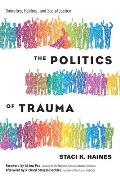
“The Politics of Trauma” by Staci K. Haines

December 26, 2020 by Sonia Connolly Leave a Comment

book cover

Subtitle: Somatics, Healing, and Social Justice

Recommended to me by: Darryl C.

This book rang true to me from beginning to end. Staci Haines combines embodied trauma work with social justice, and everything she says fits with what I already know and takes it further.

Many healing modalities view trauma and abuse as individual problems. Instead, Haines puts trauma and abuse in the context of our abusive social structures that put individuals in harm’s way. White supremacy, patriarchy, capitalism, and environmental destruction divide us from one another and keep us from learning the skills we need to treat each other with care. They keep us divided from ourselves as we try to heal.

Safety, belonging, and dignity are core needs that should be met together for everyone. Traumatic and abusive situations put one in conflict with another – we can choose either safety or dignity, either dignity or belonging. Our bodies deeply learn traumatized ways of responding to the world.

We can form declarations and commitments: statements about our core beliefs and goals that guide our healing. For example, “I am a commitment to be in my skin without apology.” (Lisa Thomas-Adeyemo) We can discover what commitments and declarations we have unconsciously adopted or had imposed upon us. Declarations can be personal or community-oriented or both.

We can find what supports us and practice resilience, reminding ourselves to come out of trauma mode. Social justice organizations can also collectively practice resilience. We can rebuild safety and trust at the embodied, physical level. We can relearn boundaries and requests.

To help someone heal, we blend with the patterns that are already true for them, and help them notice what the pattern has been taking care of for them. As the body is supported and honored, the underlying physical and emotional memories and holding patterns can be released. We can help someone feel allied with, exactly as their body needs to feel it.

For example, make a fist with one hand. With the other hand, try to pry it open. How does that feel? Instead, let your other hand support the fist with curiosity and kindness. How does that feel? What happens with your fist? With the rest of your body?

Trauma is held in the body through bands of tension, or absent slackness. A healthy body has relaxed presence. Somatic opening is encouraged by blending with what is there and allowing it to release and transform. While emotions often arise during a release, cathartic emotion is not the goal.

We can discern what shame is ours and what belongs to others. We can blend with shame, hearing its messages, and look underneath to what it is hiding or protecting. Often shame is preferable to feeling powerless, helpless, or abandoned. We can learn to take centered accountability rather than being over- or under-accountable for our actions. We can sit with the complex questions around our responsibilities. We can learn about forgiveness of others and self-forgiveness. “Even if … [shameful act or belief], I am forgivable.”

We can learn to be present with ourselves and with others at the same time. We can learn to hold contradictions and conflict. We can learn how to have generative rather than destructive conflicts.

Personal healing and social justice organizing can support and serve each other.

I loved this quote at the beginning.

The Church says: The body is a sin.
Science says: The body is a machine.
Advertising says: The body is a business.
The body says: I am a fiesta.
—Eduardo Galeano, from “Window on the Body”

In the original Spanish:

La Iglesia dice: El cuerpo es una culpa.
La ciencia dice: El cuerpo es una máquina.
La publicidad dice: El cuerpo es un negocio.
El cuerpo dice: Yo soy una fiesta.

Highly recommended for activists and healers!

Available at bookshop.org.

Filed Under: nonfiction Tagged With: activism, anti-racism, bodywork, domestic violence, feminism, healing, politics, psychology, trauma

“Invisible Women” by Caroline Criado Perez

November 28, 2020 by Sonia Connolly Leave a Comment

book cover

Subtitle: Data Bias in a World Designed for Men

Recommended to me by: Dave C

This is an engagingly written, data-driven compilation of all the ways women are left out of important scientific and civic decisions, to our serious detriment. Often data isn’t even collected in a way that shows relevant differences between men and women. Men are considered the default, “typical,” “normal” person, while women (51% of the population) are the atypical awkward exceptions. It includes language (does “Man” mean everyone, or not?), budgeting decisions, bathrooms, safety equipment design and size, public transit, cleaning chemicals, medical treatments, political expectations and judgments, etc.

Despite its calm, matter-of-fact tone, it is infuriating to read.

I usually don’t add books here that I haven’t read in full, but I want to keep track of this one as a reference and highly recommend it even though I don’t have the emotional stamina to read it now.

Available at bookshop.org.

Filed Under: nonfiction Tagged With: activism, feminism, science

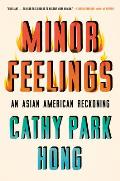
“Minor Feelings” by Cathy Park Hong

August 13, 2020 by Sonia Connolly Leave a Comment

book cover

Subtitle: An Asian American Reckoning

Recommended to me by: Jesse-the-k

Cathy Park Hong describes minor feelings as “the racialized range of emotions that are negative, dysphoric, and therefore untelegenic, built from the sediments of everyday racial experience and the irritant of having one’s perception of reality constantly questioned or dismissed.”

In this frank memoir, she describes growing up in LA’s Koreatown in a Korean immigrant family, complex friendships in college, and finding her voice as an artist in conversation with other artists, interwoven with Asian American experiences of racism.

Patiently educating a clueless white person about race is draining. It takes all your powers of persuasion. Because it’s more than a chat about race. It’s ontological. It’s like explaining to a person why you exist, or why you feel pain, or why your reality is distinct from their reality. Except it’s even trickier than that. Because the person has all of Western history, politics, literature, and mass culture on their side, proving that you don’t exist.

Cathy Park Hong pulls off that tricky feat, asserting her own reality and showing us her life while also explaining what it’s like to be Korean in America for clueless white folks. Highly recommended!

Random House Books summary

Available at bookshop.org.

Filed Under: nonfiction Tagged With: anti-racism, feminism, memoir

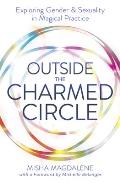
“Outside the Charmed Circle” by Misha Magdalene

March 24, 2020 by Sonia Connolly Leave a Comment

book cover

Subtitle: Exploring Gender & Sexuality in Magical Practice

Recommended to me by: Sam L-G

Misha Magdalene (they/them pronouns) asserts that magic is queer. In writing by turns academic and conversational, they explore viewing magic through the lenses of gender and sexuality.

They describe their experience with growing up queer, as well as their gradual introduction to magical practice, including the whisper networks that say, “Avoid this established teacher, he’s creepy.” Of course Misha went and found out for themselves, fortunately without being harmed.

They talk about consent, and how important it is in matters both sexual and magical, and definitely in the mix of both. As a practitioner of the Feri tradition, they directly address some of the deep issues with consent in that tradition.

They list some gender-queer and non-heterosexual gods and goddesses in various flavors of paganism.

In the end, magic is queer because it is non-mainstream, not the default religion, outside a lot of people’s lived experiences.

The book includes practical writing and magical exercises to explore the covered topics.

Highly recommended as an interesting, eclectic, and principled exploration of gender, sexuality, and magical practice.

Misha Magdalene’s blog at Patheos, Outside the Charmed Circle explores some of the same ideas. There are posts that forthrightly challenge the pagan community to address its problems with racism, homophobia, and lack of consent, sexual predation and abuse.

Available at bookshop.org.

Filed Under: nonfiction Tagged With: anti-racism, feminism, lgbt, spirituality

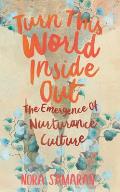
“Turn This World Inside Out” by Nora Samaran

July 2, 2019 by Sonia Connolly Leave a Comment

book cover

Subtitle: The Emergence of Nurturance Culture

Recommended to me by: Nora Samaran’s online essay The Opposite of Rape Culture is Nurturance Culture

This book contains three of Nora Samaran’s powerful essays (also available on her blog) and dialogues with other writers that expand on the themes of nurturance, attachment, shame, gaslighting, gendered violence, and repairing harm.

It is a short book that can be read quickly, and at the same time there are a lot of chewy ideas to take in over time. There are also references to more reading on these topics by people who are one or more of trans, Indigenous, and Black who have developed skills of sustainable, relational living. The book holds the question: how do we best move forward from and heal from white supremacy, colonialism, capitalism, and patriarchy.

What would it be like to live in a culture where we all could be socially embraced in this way, where we could speak up about harm, could say not to it, without fear, because we know without question that no one in our community will dehumanize another?

I admire Nora Samaran’s insights, and I long for the kinds of communities and relationships she describes. This book brings in more voices to deepen and expand the conversation. Highly recommended.

Available at bookshop.org.

Filed Under: nonfiction Tagged With: activism, anti-racism, communication, domestic violence, feminism, healing, politics, relationship

  • « Go to Previous Page
  • Page 1
  • Page 2
  • Page 3
  • Page 4
  • Page 5
  • Interim pages omitted …
  • Page 7
  • Go to Next Page »

Primary Sidebar

Recent Books

  • “We Belong to the Drum” by Sandra Lamouche and Azby Whitecalf
  • “Atlas of the Heart” by Brene Brown
  • “Life After Cars” by Sarah Goodyear, Doug Gordon, Aaron Naparstek
  • “Tidy First?” by Kent Beck
  • “When You Had Power” and “You Knew the Price” by Susan Kaye Quinn
  • “Taproot” by Keezy Young
  • “The Tower at Stony Wood” by Patricia A McKillip
  • “Hospicing Modernity” by Vanessa Machado de Oliveira
  • “How We Show Up” by Mia Birdsong
  • “The Enchanted Greenhouse” by Sarah Beth Durst

Tags

activism aging anti-racism bodywork business childhood abuse childrens CivicTech communication disability domestic violence fantasy feminism finance Focusing food fun healing health at any size illustrated Judaism leadership lgbt marketing memoir music natural world neurodiversity politics psychology relationship romance science science fiction software spirituality survival story trauma writing young adult

Categories

Archives

Please note: bookshop.org and Amazon links are affiliate links. Copyright © 2026 · Genesis Sample on · WordPress