• Skip to primary navigation
  • Skip to main content
  • Skip to primary sidebar
Curious, Healing

Curious, Healing

Books about healing, business, and fun

  • About Sonia Connolly

illustrated

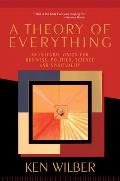
“A Theory of Everything” by Ken Wilber

October 4, 2014 by Sonia Connolly 2 Comments

Subtitle: An Integral Vision for Business, Politics, Science, and Spirituality

Recommended to me by: David Mitchell

I read this book to learn about Spiral Dynamics, a classification of cultures that makes room for change and values all levels, from bare subsistence to military control to cooperative and aware. The levels are labeled with colors and called “memes” (not the usual Internet meme definition).

A “Theory of Everything” includes these levels, mapped onto quadrants of Interior/Individual (“I”), Exterior/Individual (“IT”), Interior/Collective (“WE”), and Exterior/Collective (“ITS”). The quadrants are also described as Intentional, Behavioral, Cultural, and Social.

The book focuses on how to facilitate a cultural transformation to the next level, from green, relativistic and empathic, but narcissistic according to Wilber, to turquoise, truly holistic and less likely to wreak environmental disaster.

The second section describes various disciplines in “all-level, all-quadrant” ways. Medicine, for example, can look at someone’s emotional state, physical symptoms, availability of care, and social support.

Throughout the book, Wilber refers to his other books. In some ways, this is a condensed summary of his life’s work.

This book felt like an interesting intellectual exercise, ungrounded in intuition or the body. I might agree with some of the conclusions about how to lead a “good” life, but I arrive at them by trying different things and sensing what works for me, not constructing grand edifices and then reasoning from there.

Available at bookshop.org.

Filed Under: nonfiction Tagged With: illustrated

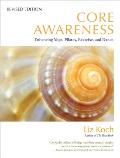
“Core Awareness” by Liz Koch

September 27, 2014 by Sonia Connolly Leave a Comment

Subtitle: Enhancing Yoga, Pilates, Exercise, and Dance

Recommended to me by: David Mitchell

I enthusiastically endorse this book’s focus on awareness, especially in core areas that we often learn to block out. The psoas muscles connects the front of the lumbar spine to the inside of the pelvis to the inner upper femur, all areas we largely ignore. I like the image of telling small children, “Sense yourself!” rather than, “Be careful!” to avoid injury. My own experience supports that the psoas does not like to be deeply palpated, but responds better to gentle invitations to relax.

At the same time, while Part I is nicely poetic, it desperately [needs citation], as well as an editor who knows how to spell muscle names and types of bodywork. The statement that the psoas only contracts eccentrically is simply false. (More information at wikipedia’s psoas article.)

Part II contains carefully described exploratory exercises to connect with and relax the psoas, illustrated with photographs of people with a diversity of body types.

I recommend this book to explore new ideas around internal awareness, as long as the first part is read as metaphorical. It is helpful to look at a good anatomy book such as Trail Guide to the Body to visualize the psoas muscle.

Available at bookshop.org.

Filed Under: fiction Tagged With: bodywork, illustrated

“The Focusing Student’s and Companion’s Manual” by Barbara McGavin and Ann Weiser Cornell

September 21, 2014 by Sonia Connolly Leave a Comment

Recommended to me by: Jael Emberley

I took Focusing classes I and II from Jael Emberley, and bought both parts of the manual, even though the second part is for classes III and IV. Both parts are written in clear, friendly language, and delightfully illustrated by Mary Ferris. Her expressive line drawings of anthropomorphized hares capture the subtleties and humor of Focusing.

Focusing is paying attention inside to an unfolding felt sense about an issue or situation. Somatic Experiencing includes a lot of Focusing. I read Part Two now to learn more about how to be present with merging and exiling of internal “something”s. Suggestions include

  • Use presence language. “I sense something in me that feels overwhelmed.”
  • Turn toward the Something that has Feelings about the Feeling, and might be saying things like, “I don’t want to be scared!” “It’s bad to be angry.”
  • Notice behaviors that come out of Feelings about Feelings, like rushing the process, forcing a choice, analyzing, diagnosing, deciding, fixing, doubting, arguing, and especially criticizing.
  • For critics, sense for what they’re not wanting.
  • Acknowledge parts that are trying to force other parts to Do It Right.
  • Exiling – something is judged as so bad and dangerous it is removed from awareness. As it comes back, the symbols for it might move from inanimate to animate.
  • Exiles need a lot of time and safety to gain trust and come back into inner relationship.

Recommended for learning about Focusing and being amused and touched by the line drawings.

Part One and Part Two are available from FocusingResources.com

Filed Under: nonfiction Tagged With: communication, Focusing, healing, illustrated, psychology

“How to Learn the Alexander Technique” by Barbara Conable

July 20, 2013 by Sonia Connolly 1 Comment

Subtitle: A Manual for Students

Recommended to me by: reading Conable’s previous book, What Every Musician Needs to Know About the Body

This book is less playful and more dense than What Every Musician Needs to Know About the Body, but it is not at all the dry instruction manual I thought it would be. It is full of lucid explanations about how the body really works, along with common errors in how we map our bodies. I think the subtitle should be, “A Manual for Humans.” I long for the freedom of movement and buoyant support she claims is possible for everyone.

There is a section titled “If You Have Suffered Abuse or Violence” which is sensitive, compassionate, and accurate (like the rest of the book).

“Persons who are healing learn to become very skillful inhibitors [an important Alexander Technique concept], not in the sense that they do nothing, but in the sense that they say no to habituated self destruction and wait for the more constructive response that was blocked by the habitual.”

I keep saying that the Alexander teachers I’ve tried don’t acknowledge the work I’ve already done, and I think this is why. Years of practice in stopping and waiting.

Some insights:

  • The weight-bearing part of the spine is inside the body, deep to the knobs we feel along our backs.
  • The pelvis is the lower part of the upper body, part of the torso. There is no internal anatomical structure at the waist.
  • The top of the sacrum transfers the weight of the upper body to the pelvis. The rest of the triangular sacrum and tailbone float free of weight.
  • Flexibility can be increased by putting all the joints gently through their range of motion once a day. The whole routine takes 5 minutes.
  • Give yourself permission to be a “flapdoodle” at night – to move freely in your sleep like a child.

Here is a brief interview with Barbara Conable with a pointed comment about “inhibiting” at the end.

Here’s her page at bodymap.org.

Highly, highly recommended for all humans with an interest in how to move comfortably and well.

Available at biblio.com.

Filed Under: nonfiction Tagged With: bodywork, illustrated, music

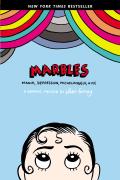
“Marbles: Mania, Depression, Michelangelo, and Me: A Graphic Memoir” by Ellen Forney

June 3, 2013 by Sonia Connolly Leave a Comment

The story and drawings quickly engaged me, despite the author’s sometimes bizarre, sometimes heavy journey through mania, depression, and eventually, balance. She has the fantastic support of her mom, friends, and psychiatrist, but still struggles for years before finding a set of meds that works for her.

In depression, she can barely get out of bed to sit under a blanket on the couch. At the same time, she still swims several times a week, goes to yoga, and draws her weekly comic strip. In mania, she struggles to control her racing thoughts and impulses. Her commitment to self-care is woven through the book, along with disarming candor about her daily experience.

Highly recommended to learn about one woman’s experience with bipolar disorder and creativity.

Available at bookshop.org.

Filed Under: nonfiction Tagged With: disability, illustrated, memoir, psychology

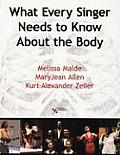
“What Every Singer Needs to Know About the Body” by Malde, Allen, Zeller

September 21, 2012 by Sonia Connolly 2 Comments

Authors: Melissa Malde, MaryJean Allen, Kurt-Alexander Zeller

I read this as a followup to What Every Musician Needs to Know About the Body, since I’m a singer, not a musician. I expected it to be similarly playful and filled with illustrations more than words. I also expected it to cover very similar material.

I was wrong on both counts. In careful detail, this book covers the anatomy and mechanics of breathing, phonation (making sound with the vocal cords), articulation (forming words with the mouth and tongue), and stage presence. Even the general material on the body is covered in more detail than in the Musician book.

Did you know that your tongue is rooted far below your teeth, extends to the back of your throat, and is much larger than that part you can see? It’s made up of many muscle fibers that can act independently of each other.

Did you know that if a letter sounds different in another language, it is made with different movements of the tongue and mouth? It makes sense, but I had never thought about it. The American English ‘T’ sound is made with the tongue touching the upper teeth. In Spanish (and other Romance languages), ‘T’ is made with the tongue touching farther back on the hard palate. I speak both languages, and had never been aware of that.

Did you know that your ribs are attached in back at your spine, and in front at your sternum, and move up and out as you breathe in, like bucket handles? I had heard that many times, but hadn’t felt the movement clearly.

Did you know that your ankle is in front of your heel, not right over it? Your heel forms part of a triangle that supports your weight, and your leg bones come down inside the triangle, not on the back point. Check your own foot and see. I’ve worked on a lot of feet, and never consciously noticed that.

This book is amazing. Highly recommended for anyone who wants to understand their body better from the inside and improve their singing along the way.

Available at biblio.com.

Filed Under: nonfiction Tagged With: fun, illustrated, music

  • « Go to Previous Page
  • Page 1
  • Interim pages omitted …
  • Page 7
  • Page 8
  • Page 9
  • Page 10
  • Page 11
  • Interim pages omitted …
  • Page 15
  • Go to Next Page »

Primary Sidebar

Recent Books

  • “How We Show Up” by Mia Birdsong
  • “The Enchanted Greenhouse” by Sarah Beth Durst
  • “What It Takes to Heal” by Prentis Hemphill
  • Kitchens of Hope by Linda S. Svitak and Christin Jaye Eaton with Lee Svitak Dean
  • “Very Far Away From Anywhere Else” by Ursula K Le Guin
  • “Seaward” by Susan Cooper
  • “Surviving Domestic Violence” by Elaine Weiss
  • “The Book of Love” by Kelly Link
  • “Alexandra’s Riddle” by Elisa Keyston
  • “Weaving Hope” by Celia Lake

Tags

activism aging anti-racism bodywork business childhood abuse childrens CivicTech communication disability domestic violence fantasy feminism finance Focusing food fun healing health at any size illustrated Judaism leadership lgbt marketing memoir music natural world neurodiversity politics psychology relationship romance science science fiction software spirituality survival story trauma writing young adult

Categories

Archives

Please note: bookshop.org and Amazon links are affiliate links. Copyright © 2026 · Genesis Sample on · WordPress