• Skip to primary navigation
  • Skip to main content
  • Skip to primary sidebar
Curious, Healing

Curious, Healing

Books about healing, business, and fun

  • About Sonia Connolly

memoir

“The Way to Rainy Mountain” by N. Scott Momaday

March 14, 2011 by Sonia Connolly Leave a Comment

Recommended to me by: veleda_k in 50books_poc

A series of impressions of the legends, history, and personal experiences of the Kiowas, a Native American tribe living in Oklahoma. Scott Momaday’s grandmother Aho attended the last full Sun Dance of the Kiowas as a child, and shared stories and traditions with him as he grew.

Each image is bright, clear, specific to its own time and place.

The aged visitors who came to my grandmother’s house when I was a child were made of lean and leather, and they bore themselves upright. They wore great black hats and bright ample shirts that shook in the wind. They rubbed fat upon their hair and wound their braids with strips of colored cloth.”

Highly recommended both for the beautiful writing, and for the information about the Kiowas in particular, in contrast to the generalized impression of Native Americans that many books contain.
Available at bookshop.org.

Filed Under: nonfiction Tagged With: illustrated, memoir

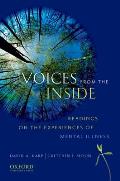
“Voices from the Inside” by David A. Karp and Gretchen E. Sisson

March 5, 2011 by Sonia Connolly Leave a Comment

Subtitle: Readings on the experiences of mental illness

I found this book because I was curious about Caroline Knapp’s writing after reading Gail Caldwell’s memoir about their friendship, and I read it because I wanted to learn about mental illness without its stereotype of causing violence. In fact, [v]iolence is not a symptom of psychotic illnesses such as bipolar disorder and schizophrenia.

Unfortunately, this book propagates rather than counters the stereotype. Many of the schizophrenic people’s stories include violent fantasies and actions. The essays also include violent treatment of people with mental illness in mental hospitals and prisons.

The book is intended for classroom use. Each essay is preceded by an introduction telling the reader how to interpret the essay, and followed by discussion questions which are clearly slanted toward preferred answers.

Caroline Knapp’s essay, “Denial and Addiction,” talks about the effortless contortions that make alcoholics’ drinking look acceptable to themselves. “Denial can make your drinking feel as elusive and changeable as Proteus, capable of altering form in the blink of an eye.” Calmly honest, she describes her own and others’ self-destructive behavior while addicted to alcohol.

Other essays describe the experiences of schizophrenic psychosis, depression, mania, taking Prozac for OCD, recovering from anorexia, and the aftermath of a spouse’s suicide.

While I applaud the authors’ venture into personal stories rather than aggregate statistics, I think academia has a long way to go in its attitudes toward people who have mental illnesses.

Available at bookshop.org.

Filed Under: Uncategorized Tagged With: disability, memoir, psychology, survival story

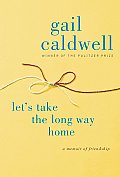
“Let’s Take the Long Way Home” by Gail Caldwell

February 16, 2011 by Sonia Connolly 1 Comment

Subtitle: a memoir of friendship

Recommended to me by: Courtney on the Feministing blog

I loved this book. I cried at the beginning, smiled in the middle, and sighed at the end.

Gail Caldwell describes first her grief at her best friend Caroline Knapp’s death, and then their daily joys together while she was alive. They trained their big dogs together, rowed on the Charles River together, and most of all, talked about everything, including both their writing careers, and both their past struggles with alcohol.

The writing is compressed, detailed, elegant, meandering across years within a page. Trying to find a representative sample, I ended up re-reading large swathes of the book. Here, I opened the book at random:

“I’m afraid that no one will ever love me again.” He leaned toward me with a smile of great kindness on his face, his hands clasped in front of him. “Don’t you know?” he asked gently. “The flaw is the thing we love.”

This book is about intimacy, connection, grief, and love. Go read it.

Available at bookshop.org.

Filed Under: nonfiction Tagged With: memoir, writing

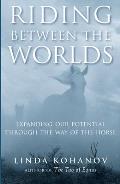
“Riding Between the Worlds” by Linda Kohanov

July 23, 2010 by Sonia Connolly 1 Comment

My response to The Tao of Equus doesn’t begin to express the impact it had on me. I immediately looked for Kohanov’s next book.

Riding Between the Worlds contains less abstract theory and more stories from clients and from her own life. It also contains a helpful adaptation of Karla McLaren’s work with emotions into an Emotional Message Chart.

For example:

Emotion Message Questions to Ask Intensification
Anger Proper boundaries should be maintained or rebuilt.

Incongruence.

What must be protected?

What must be restored

What is the emotion behind the mask, and is it directed toward me?

Rage, fury (exploding at those who’ve violated our boundaries)

Shame, guilt (anger toward self when we’ve violated others’ boundaries)

Boredom, apathy (masks anger that can’t be dealt with – a nonviolent coping strategy

Kohanov validates my experiences with transmission of emotions from one person to another, describing the many ways that happens with both people and horses in her practice.

She also talks extensively about congruence and how important it is to both horses and sensitive humans. Incongruence, a mismatch between what someone is feeling and expressing, can cause trouble both for the incongruent person who is suppressing feelings, and the beings around them who may be the target of deception or explosive release.

Kohanov also presents her hard-won list of skills for building community:

  1. Using emotion as information.
  2. Sitting in uncomfortable emotions without panicking.
  3. Sensing and flowing with the emotions of others, again without panicking.
  4. Reading “misbehavior” as a form of communication.
  5. Understanding the dynamics of shared emotion: distinguishing between instructive personal feelings, conditioned (False Self) emotional patterns, affect contagion, empathy, ambience, and emotional resonance.
  6. Resisting the temptation to aggressively “fix” people, horses, uncomfortable situations, etc.
  7. Creating a psychological container of support, what Kathleen Ingram calls “holding the sacred space of possibility.” This fully engaged form of patience is crucial to tapping innovative solutions that arise from the eighth ability:
  8. Activating the Authentic Self.

The only sour note in the book occurs when she creates a false sense of suspense by telling half a story and then inserts 30 pages of other material before returning to the story.

Highly recommended for anyone who believes they are too sensitive or too emotional.

Available at bookshop.org.

Filed Under: nonfiction Tagged With: healing, memoir, psychology, spirituality

“Hand Wash Cold” by Karen Maezen Miller

July 14, 2010 by Sonia Connolly Leave a Comment

Subtitle: Care Instructions for an Ordinary Life

Recommended to me by: Shambhala Sun excerpt.

Miller is a Zen Buddhist priest and teacher. This memoir is organized around three household tasks as metaphors for Zen living – laundry, dishes, and gardening. I enthusiastically agree with the premise that household maintenance is an integral part of life, rather than something to be suffered through or outsourced.

At the same time, I had trouble warming to this tale of unhappy high-powered businesswoman in one marriage turned Zen stay-at-home mom in another. She says about the second, current marriage: “No, ours is not a marriage of friends making nice. … Ours is a marriage of adversaries making peace.” I’m glad that works for her. I don’t think it would work for me.

I did like her take on parenting: “There is no right way to parent; only a right-now way. … Children always show us the present moment unfolding.”

Available at bookshop.org.

Filed Under: nonfiction Tagged With: memoir, spirituality

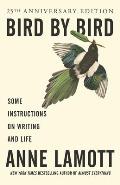
“Bird by Bird” by Anne Lamott

June 21, 2010 by Sonia Connolly 6 Comments

Subtitle: Some Instructions on Writing and Life

Anne Lamott’s writing process seems reassuringly similar to my own, and seems to include just as much struggle. She advises us to write everything that comes to mind, and then later refine it into clarity and grace. A lot of the book is devoted to all the ways we get in our own way, and how sorry she is that there isn’t a more direct route.

“Writing a first draft is very much like watching a Polaroid develop. You can’t – and in fact you’re not supposed to – know exactly what the picture is going to look like until it has finished developing.” Oh good. Maybe I’m doing it right after all.

She emphasizes both looking inside for our own truths, and observing the world around us to flesh out those truths. She reminds to do both with as much detached compassion as we can scrape together.

On character creation: “My friend Carpenter talks about the unconscious as the cellar where the little boy sits who creates the characters, and he hands them up to you through the cellar door. He might as well be cutting out paper dolls. He’s peaceful; he’s just playing.” … “You may want to come up with an image or a metaphor for this other part of you that is separate from your rational, conscious mind, this other person with whom you can collaborate. This may help you feel less alone.” I’ll have to try this – I’d love to feel less alone with my book-writing project!

She keeps a 1 inch square picture frame by her desk to remind her to focus in on one viewpoint and one scene at a time. A whole book is made up of paragraphs. Write the paragraphs, the sentences, the words.

Since I’m struggling with organizing my own book, I noticed that her chapter headings are laconic and her transitions brief. Each chapter meanders among writing class anecdotes, writing advice, snippets of poetry, and life anecdotes. I’m sure she spent many hours crafting each chapter to flow so casually and conversationally. At the same time, it’s good to notice that it reads just fine as it meanders, and my book might be allowed to meander too.

Somehow, at the end of reading this book, I feel less stuck around organizing my own, and more like I’m moving slowly. And that moving slowly is okay, fortunately, since that’s the way it is right now.

Available at bookshop.org.

Filed Under: nonfiction Tagged With: communication, memoir, writing

  • « Go to Previous Page
  • Page 1
  • Interim pages omitted …
  • Page 12
  • Page 13
  • Page 14
  • Page 15
  • Page 16
  • Page 17
  • Go to Next Page »

Primary Sidebar

Recent Books

  • “How We Show Up” by Mia Birdsong
  • “The Enchanted Greenhouse” by Sarah Beth Durst
  • “What It Takes to Heal” by Prentis Hemphill
  • Kitchens of Hope by Linda S. Svitak and Christin Jaye Eaton with Lee Svitak Dean
  • “Very Far Away From Anywhere Else” by Ursula K Le Guin
  • “Seaward” by Susan Cooper
  • “Surviving Domestic Violence” by Elaine Weiss
  • “The Book of Love” by Kelly Link
  • “Alexandra’s Riddle” by Elisa Keyston
  • “Weaving Hope” by Celia Lake

Tags

activism aging anti-racism bodywork business childhood abuse childrens CivicTech communication disability domestic violence fantasy feminism finance Focusing food fun healing health at any size illustrated Judaism leadership lgbt marketing memoir music natural world neurodiversity politics psychology relationship romance science science fiction software spirituality survival story trauma writing young adult

Categories

Archives

Please note: bookshop.org and Amazon links are affiliate links. Copyright © 2026 · Genesis Sample on · WordPress