• Skip to primary navigation
  • Skip to main content
  • Skip to primary sidebar
Curious, Healing

Curious, Healing

Books about healing, business, and fun

  • About Sonia Connolly

psychology

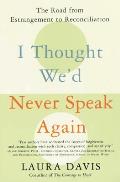
“I Thought We’d Never Speak Again” by Laura Davis

November 4, 2011 by Sonia Connolly 1 Comment

Subtitle: The Road from Estrangement to Reconciliation

Recommended to me by: Laura Davis’s website

Laura Davis is co-author of the classic book about healing from incest, “The Courage to Heal.”

This book is written with compassionate awareness that not all stories have happy endings and not all estrangements can be reconciled. Nevertheless, I cried while reading it, for all the estrangements I have been unable to reconcile, and for all the reconciliations that turned out to be grave mistakes, and for all the fears that I should have been able to do it all better.

It has concrete suggestions for how to evaluate the possibility of reconciliation and take steps toward it, as well as a variety of gritty, beautiful stories about others’ attempts and successes. Davis’ reconciliation with her mother is woven through the book.

Recommended, if you have the time and energy to work through the feelings it might bring up.

Available at bookshop.org.

Filed Under: nonfiction Tagged With: communication, healing, memoir, psychology

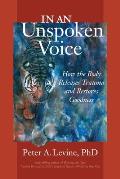
“In an Unspoken Voice” by Peter A. Levine, PhD

October 1, 2011 by Sonia Connolly Leave a Comment

Subtitle: How the Body Releases Trauma and Restores Goodness

This book is billed as a “culmination of his life’s work” on the back cover. It recapitulates material from Peter Levine’s earlier book “Waking the Tiger” about trauma and the nervous system, and uses many of the same case studies covered in the Somatic Experiencing curriculum. Somatic Experiencing is Levine’s protocol for healing trauma, taught through the Foundation for Human Enrichment.

I liked his emphasis on the need for therapists to be present, flexible, and cooperative, rather than distant, rigid, and controlling. I liked his quote from an (unidentified) soldier returned from Iraq: “I have a Post-Traumatic Stress Injury, not Disorder.”

I liked his distinction between awareness and introspection: awareness is experiencing the inner glow of an ember, while introspection is examining it with an external flashlight. Awareness allows; introspection dissects. He also distinguishes between feelings (bodily sensations), and emotions (fear, anger, etc.) which arise when impulses are interrupted.

There are some annoying aspects to the book, starting with overuse of italics for emphasis. When discussing the history of scientific discoveries about trauma, emotions, and the nervous system, he repeatedly uses the words “prescience” or “prescient” regarding earlier researchers, even though they clearly did actual science. When talking about the calming effect of being near a peaceful person, he names three specific famous men and the generic “loving mother peacefully nursing her infant.”

This book would make a good textbook for Somatic Experiencing classes (aside from the annoying bits). It is too dense for a layperson to enjoy, and yet doesn’t cover the healing process in enough detail to be a technical reference on its own.

Available at bookshop.org.

Filed Under: nonfiction Tagged With: bodywork, healing, psychology, trauma

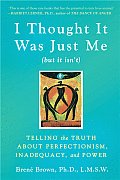
“I Thought It Was Just Me (but it isn’t)” by Brene Brown

August 27, 2011 by Sonia Connolly 1 Comment

Subtitle: Telling the Trust About Perfectionism, Inadequacy, and Power

Recommended to me by: Pam Lyons

Brene Brown researches shame by listening to people’s stories. This book focuses on women for the most part, although she mentions how men’s experience of shame differs at the end of the book. The content overlaps with The Gifts of Imperfection quite a bit.

She describes shame as a “full-contact” emotion because it includes visceral and physical responses. Yes, emotions are physical. All of them. I became suddenly wary of an author who seems to live primarily in her head.

The writing tone is breezy and casual, overlaying the formal language of research. I can see the effort she put into structuring the anecdotes and creating the ideas of the shame web (people who engender shame) and connection network (people who support shame resilience) complete with cute iconic drawings.

On page 9 she puts in an “early call for compassion,” acknowledging that stories about shame are difficult to read, so we often leap to judgment rather than compassion to distance ourselves. I wonder how much of my reactions to the book fall in that category.

I appreciated her explicit inclusion of diverse women across race, class, sexual orientation, age, and religious identity. She includes a lot of her own stories, so there is a pronounced tilt toward mid/upper class white educated heterosexual married mothers of young children, but other voices are represented as well. She specifically mentions hair texture and skin tone as issues for women of color, for example.

One helpful bit for me was the typical responses to shame: moving toward, moving away, or moving against. I seem to have a lot of the moving toward response, and I hadn’t seen that reflected before. It’s not just me!

I’ve done a lot of personal work with shame and authenticity over the years. I suspect this book would be more useful for someone who has not thought about the subject as much. As I think about the fairly basic material and its presentation as earth-shaking new discoveries, I continue to get a sense that the author is disconnected from ongoing work about shame and community. Maybe no one else is pursuing that work in an academic context.

Edited to add: I thought a lot about the sense of distancing I got from the book, and the early disclaimer about shame being distancing. I decided my experience was valid (imagine that!) and the early disclaimer was the equivalent of “I don’t mean to be offensive, but [something offensive].” “I don’t mean to be distancing, but [distancing book].” I find it interesting that it took so much thought to validate my own experience.

Available at bookshop.org.

Filed Under: nonfiction Tagged With: psychology

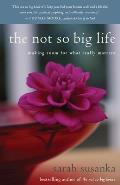
“The Not So Big Life” by Sarah Susanka

August 2, 2011 by Sonia Connolly Leave a Comment

Subtitle: Making Room For What Really Matters

Sarah Susanka is a renowned architect, author of the “Not So Big House” series. This book is beautifully architected with parallels between life remodeling and house remodeling. For the target audience of people with plenty of money and a shortage of time, the book offers substantial, detailed advice on how to make satisfying life choices.

The topics include, among others, noticing inspiration, removing clutter, meditation, dream analysis, and maintenance of your newly remodeled life.

Susanka uses a Jungian approach to dreams where every element of the dream represents the dreamer in some way. She also espouses the Jungian belief that the external world is a perfect mirror of the internal world. I am wary of Jungian psychology since a session with a Jungian therapist whose only tool was to ask me how the abuse I received had benefited me.

I read this book because I have already chosen to lead a “not so big life” and I was looking for validation of my choices. Since I’m not in the target market for the book, I was left with the feeling that it is more valid to be wealthy, overwhelmed, and in need of life-downsizing than it is to have already chosen a less lucrative, more meditative path.

One thing I did get from the book is the idea that whatever I’m doing now is my life. I don’t have to keep looking around to check if I’m doing the right thing or not.

In summary, if you’re in the target audience of this book, I think you’ll get a lot out of it.

A typographical note: Since I’m designing my own book, I’ve been paying close attention to book typesetting. Oddly, this book is set in a sans serif font, Quadraat Sans. It grabs my attention every time I open the book (although I had to look at the colophon for the name of the font).

Available at bookshop.org.

Filed Under: nonfiction Tagged With: psychology, spirituality

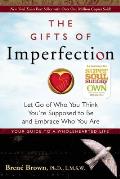
“The Gifts of Imperfection” by Brene Brown

July 13, 2011 by Sonia Connolly 3 Comments

Subtitle: Let Go of Who You Think You’re Supposed to Be and Embrace Who You Are

Addtional subtitle: Your guide to a wholehearted life

Recommended to me by: Brene Brown’s Ted talk on vulnerability

Brene Brown studies shame resilience and wholehearted living by collecting people’s stories and searching for patterns of what works and what doesn’t. It turns out that perfectionism doesn’t work. Neither does changing ourselves to fit in. Nor seeking certainty.

What does work? Worthiness, rest, play, trust, faith, intuition, hope, authenticity, love, belonging, joy, gratitude, creativity. Embracing tenderness and vulnerability.

The four elements of shame resilience: Name it. Talk about it. Own your story. Tell your story. But only to someone who has earned the right to hear it and won’t shame you further.

The gifts of imperfection: courage, compassion, and connection. Courage – originally “speaking one’s mind by telling all of one’s heart.” Compassionate boundaries and accountability. “Compassionate people are boundaried people.” “Love and belonging are always uncertain.”

“Revolution might sound a little dramatic, but in this world, choosing authenticity and worthiness is an absolute act of resistance. Choosing to live and love with our whole hearts is an act of defiance. You’re going to confuse, piss off, and terrify a lot of people – including yourself.”

This book went by too fast. I wanted more of the validation and relief I felt as I read.

Available at bookshop.org.

Filed Under: nonfiction Tagged With: healing, psychology

“Undefended Love” by Jett Psaris and Marlena Lyons

April 24, 2011 by Sonia Connolly Leave a Comment

A thought-provoking book, more profound than I expected. Refreshingly, both same-gender and opposite-gender couples are used for the examples.

The authors warn several times to be sure a relationship is not abusive before using it as a crucible for personal work. This is a warning that’s missing from most relationship books I’ve read, which instead blithely assure the reader that one-sided work can fix everything.

The requirements for a close relationship are covered first: Reciprocity, Entitlement, Approval, Consensus, and Trustworthiness, conveniently abbreviated REACT.

In an non-abusive, close relationship, conflicts can help the partners look inward to discover their “Cracked Identity,” pass through the agony of the Black Hole instead of defending against it, and emerge into peaceful, joyous essence on the other side.

This is similar to the process of accepting and integrating past trauma, so that all made sense to me.

I was less comfortable with the hierarchy of needs, wants, desires, preferences, and no preferences. It’s too easy for me to pretend my needs aren’t important when I know it’s “more enlightened” not to have preferences at all. At the same time, I know that an issue will be much less urgent for me if I have processed past associations with it.

Despite the much-needed warnings about abusive relationships, I am still uneasy about the power dynamics that aren’t addressed. Calmly witnessing someone’s deep personal work takes training, and it’s not necessarily healthy for couples to act as therapists for each other. Also, saying that it’s better to act from essence than from personality is yet another judgment of ourselves and each other.

That said, the more people healing their inner wounds, the better!

Available at bookshop.org.

Filed Under: nonfiction Tagged With: communication, psychology

  • « Go to Previous Page
  • Page 1
  • Interim pages omitted …
  • Page 15
  • Page 16
  • Page 17
  • Page 18
  • Page 19
  • Interim pages omitted …
  • Page 22
  • Go to Next Page »

Primary Sidebar

Recent Books

  • “We Belong to the Drum” by Sandra Lamouche and Azby Whitecalf
  • “Atlas of the Heart” by Brene Brown
  • “Life After Cars” by Sarah Goodyear, Doug Gordon, Aaron Naparstek
  • “Tidy First?” by Kent Beck
  • “When You Had Power” and “You Knew the Price” by Susan Kaye Quinn
  • “Taproot” by Keezy Young
  • “The Tower at Stony Wood” by Patricia A McKillip
  • “Hospicing Modernity” by Vanessa Machado de Oliveira
  • “How We Show Up” by Mia Birdsong
  • “The Enchanted Greenhouse” by Sarah Beth Durst

Tags

activism aging anti-racism bodywork business childhood abuse childrens CivicTech communication disability domestic violence fantasy feminism finance Focusing food fun healing health at any size illustrated Judaism leadership lgbt marketing memoir music natural world neurodiversity politics psychology relationship romance science science fiction software spirituality survival story trauma writing young adult

Categories

Archives

Please note: bookshop.org and Amazon links are affiliate links. Copyright © 2026 · Genesis Sample on · WordPress